
For small batches
If you make apple slices occasionally and have little permanent worktop space, start by comparing the external dimensions and deciding where you’ll store the appliance after use.


For small batches of apple slices, the available worktop and storage space are a sensible starting point. Also consider air circulation, adjustable temperature and enough room to lay the slices out side by side. If you often dry larger batches, compare the usable tray area and controls: more trays don’t automatically mean a smaller appliance or a shorter drying time. Before buying, check the safety information for the exact model and confirm that the parts which touch the apple are suitable for food contact.
If you make apple slices occasionally and have little permanent worktop space, start by comparing the external dimensions and deciding where you’ll store the appliance after use.
If you dry apples more often, look at the temperature settings, air circulation and how easy it is to monitor the drying process. A timer can be useful for a long drying cycle, but it doesn’t replace checking the results.
If you want to process several apples at once, compare the usable area of each tray as well as the appliance’s external dimensions. A model with more trays may take up more room on your worktop or in storage.
| What to consider | What should you look for? | Who is this important for? |
|---|---|---|
| Worktop space | Measure the width, depth and height, and allow for the ventilation space specified in the manual. Princess lists dimensions of 33 × 33 × 20 cm for model 112380; Rommelsbacher gives a depth of 43 cm for the DA 650. | If my worktop has limited space, I want to know whether the appliance will fit while in use and can be stored afterwards. Space is a top priority for around 36% of consumers. |
| Control over drying | Check the adjustable temperature, air circulation and timer. WMF lists a range of 30–70 °C and a 0–24-hour timer for KITCHENminis 415250011; Penn State Extension gives 60–66 °C for apples dried in an oven, not as a universal setting for a food dehydrator. | If I want to adjust the process myself, I look for a range of settings and a clear view of the slices. Control over drying is the main concern for around 29% of consumers. |
| Batch size | Compare the usable tray area and the number of trays, not just the number of tiers. Steba lists five trays measuring 32 × 25 cm; Rommelsbacher lists seven trays and 0,5 m² of drying area. | If I want to process several apples in one go, I need enough room to lay the slices out side by side. Batch size is a top priority for around 21% of consumers. |
| Energy and maintenance | Check the rated power, cleaning instructions and whether replacement trays are available. Wattage alone doesn’t show how many kWh a drying cycle uses; the actual running time and energy consumption also matter. | I want to know how much attention a drying cycle and cleaning will require, and how to assess energy use. Energy consumption and maintenance are the main concern for around 14% of consumers combined. |
A dehydrator can be relatively narrow yet still take up a lot of depth. Rommelsbacher lists a depth of 43 cm for the DA 650, so check that the appliance will fit on your worktop too.
Measure the available space and compare the external dimensions. Also allow for the ventilation space specified in the manual.
Drying time depends on factors such as the thickness of the slices and their moisture content. A storage period given for packaged dried apples isn’t a guarantee for apples you’ve dried yourself.
Follow the drying and storage advice, check the results, and store sufficiently dried slices in an airtight container in a cool, dry, dark place. Discard food if it has spoiled.
WMF describes the KITCHENminis 415250011 as a space-saving dehydrator for foods including fruit.
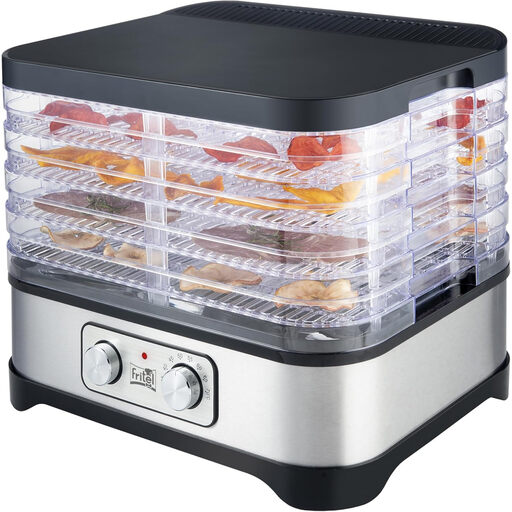
According to the manufacturer, the Princess 112380 is a stackable food dehydrator with six tiers.
According to the manufacturer, the Steba ED 5 has five trays for drying fruit.
According to the manufacturer, the DA 650 is designed for anyone wanting to dry several slices at once.
These products are suited to compact stacking or offer a larger drying area for apple slices. Measure the available space and check the safety information and the suitability of any parts that come into contact with food for the exact model.
 No image available
An option for small batches if you’re looking for a stackable model; measure the space needed for use and storage beforehand.
Five trays, adjustable temperature from 35–70 °C and a stated power rating of 250 W.
Check the CE marking and food-contact information for the parts that touch the apple for this exact model.
 No image available
A stackable model to consider if you want five trays and the option to set the temperature and drying cycle.
The product name specifies five trays, a timer and temperature control.
Check the CE marking and food-contact information for the parts that touch the apple for this exact model.
 No image available
An option for larger batches if you have enough room for a deeper appliance.
According to Rommelsbacher, the model has seven trays and 0,5 m² of drying area; its stated external dimensions are 29 × 43 × 27,5 cm.
Check the CE marking and food-contact information for the parts that touch the apple for this exact model. Also measure the available depth.
Follow your food dehydrator’s manual and check the slices as they dry. Penn State Extension gives 60–66 °C for apples dried in an oven; this isn’t a universal setting or guaranteed drying time for a food dehydrator.
Measure the available width, depth and height, and allow for the ventilation space specified in the manual. Also decide where you can store the appliance after use; the number of trays alone doesn’t tell you how much space it takes up.
It depends on the actual energy consumption and the length of the drying cycle. A stated power rating, such as 350 W, doesn’t measure the energy used per batch; you need the consumption in kWh while the appliance is in use.
Leave sufficiently dried slices to cool and store them in an airtight container in a cool, dry, dark place. The Netherlands Nutrition Centre provides storage advice for dried apples, but a shelf life for packaged products isn’t automatically a guarantee for apples dried at home.
Check the CE marking for the exact model and look for information about parts that come into contact with the apple during drying. The Netherlands Food and Consumer Product Safety Authority describes the CE requirements for electrical products; according to the European Commission, materials that come into contact with food must comply with Regulation (EC) No 1935/2004 and any applicable additional rules. A CE marking alone doesn’t prove that a specific tray is suitable for food contact.