
Cook with a narrow worktop
You want to dry apple slices and, above all, find out whether the appliance will fit in the available space while it’s in use. Compare its external dimensions and the space it needs with your worktop.


First, measure the available width and depth and compare them with the dehydrator’s external dimensions. Then decide how many apple slices you want to dry in each batch. A compact dehydrator may suit regular use on a small worktop, while your existing oven could be an alternative if its manual allows low-temperature use with adequate ventilation to release moisture. For a specific appliance, also check the product documentation for electrical safety and food-contact materials.
You want to dry apple slices and, above all, find out whether the appliance will fit in the available space while it’s in use. Compare its external dimensions and the space it needs with your worktop.
You want to fit more slices in each batch and weigh up the usable drying area against the space the appliance takes up.
You want to know whether you need a separate food dehydrator, or whether your existing oven is suitable for what you have in mind.
Suited to: regularly drying small batches when worktop space is limited.
Bear in mind: a small exterior doesn’t tell you how many slices will fit on the trays.
Suited to: preparing larger batches if you have enough space for the appliance.
Bear in mind: a larger stated drying area doesn’t guarantee a shorter drying time; air needs to circulate around the slices.
Suited to: occasional use if the oven manual allows the required low temperature and ventilation to release moisture.
Bear in mind: the oven will be occupied while the fruit dries. Penn State Extension describes drying apples at 60–66 °C with moisture vented away.
| What to consider | What to look for when buying | Who should prioritise this? |
|---|---|---|
| Will it fit? | Measure the width and depth of the available space and compare them with the external dimensions; follow the model’s placement instructions. | On a narrow worktop, I want to know in advance whether the dehydrator will really fit. Around 36% of consumers give fit the highest priority. |
| Space per batch | Compare the number of trays and their usable dimensions, or the stated drying area; leave space between the slices. | If I want to dry lots of apples at once, the usable space per batch is crucial. Around 29% of consumers prioritise batch size. |
| Drying controls | Check the temperature settings, timer and instructions for use with apples; a set range doesn’t measure the temperature on every tray. | I want to adjust the temperature and time and arrange the slices evenly. Drying controls are the top priority for around 21% of consumers. |
| Separate dehydrator or oven? | Check the oven manual for low temperatures and ventilation to release moisture; if you’re considering a dehydrator, also compare how easy its trays are to clean. | For occasional use, I want to know whether I need another appliance and how much maintenance it involves. Around 14% of consumers prioritise the purchase and upkeep. |
Models vary in both width and depth; a narrow front can still have a relatively deep body.
Compare all the stated external dimensions with the available space and follow the placement instructions in the manual.
Five trays don’t, by themselves, tell you how many apple slices will fit. The pieces need space between them so air can circulate.
Compare the usable dimensions of the trays or the stated drying area, and arrange evenly cut slices without overlapping them.
According to Utah State University Extension and the Netherlands Nutrition Centre, drying and storage depend on how the food is prepared and packaged. A general claim doesn’t guarantee the same result for every batch.
Follow the preparation and storage instructions for the product, and don’t treat a general claim as a guarantee for your apples.
A stated manufacturer’s guarantee period doesn’t automatically limit your right to a product that is fit for purpose. The Dutch government says there is no fixed statutory guarantee period in the Netherlands, and that you should contact the seller if a product is faulty.
Keep your proof of purchase and contact the seller if something goes wrong. A manufacturer’s guarantee is in addition to your statutory rights.
For the DH 2025, the manufacturer lists five trays and external dimensions of 32 × 25.5 × 21.5 cm. These measurements are worth comparing with the space on a narrow worktop.
According to Rommelsbacher, the DA 350 has five height-adjustable trays and a drying area of 0.42 m². Its external dimensions are 31.5 × 33.7 × 25.3 cm.
Steba lists five independently usable trays for the ED 5. Its external dimensions are 28.5 × 33.5 × 26.5 cm (height × width × depth).
According to the product information provided, the Princess 112380 has six stackable trays and external dimensions of 33 × 33 × 20 cm.
WMF describes the KITCHENminis 415250011 Snack to-go as a space-saving model with five levels and a take-away set.
The product options below are stackable food dehydrators for drying fruit, including apple slices. For the specific model, check the product documentation for electrical safety and parts that come into contact with food. The stated settings and trays alone don’t confirm that all applicable requirements have been met.
 No image available
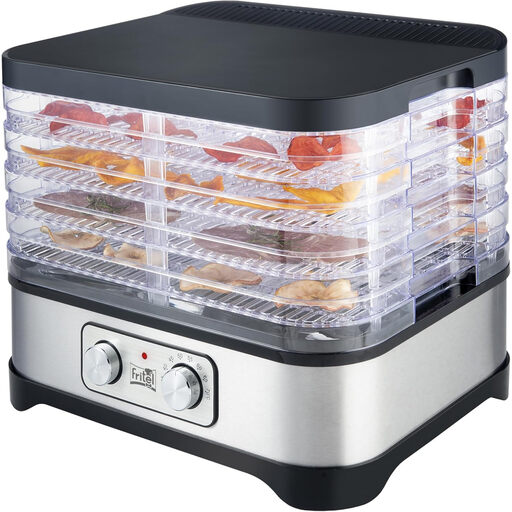
The stackable trays offer different ways to arrange fruit. Compare the available worktop space with the external dimensions before choosing where to put it.
Five trays measuring 24.5 × 31.5 cm; two stacking methods; adjustable range of 35–70 °C; 250 W power. According to Fritel, the external dimensions are 32 × 25.5 × 21.5 cm.
 No image available
The stated number of trays and drying area are useful to consider if you want to prepare larger batches. Also bear in mind how much space the appliance takes up.
Seven trays; stated drying area of 0.5 m²; adjustable temperature range of 35–75 °C; timer up to 99 hours.
Cut the slices to roughly the same thickness and leave space between them. Penn State Extension recommends slices of ⅛ to ½ inch (about 3–13 mm) for apples; thinner slices will become apple crisps sooner. Pretreating them with vitamin C or diluted lemon juice helps limit discolouration.
Dry the slices thoroughly and store them in a well-sealed container in a cool, dry and dark place. The Netherlands Nutrition Centre gives a shelf life of 6–9 months for an opened pack of dried apples; this isn’t a guarantee for every home-dried batch.
You’re entitled to a product that is fit for purpose and can contact the seller if it’s faulty. According to the Dutch government, the Netherlands has no fixed statutory guarantee period; a manufacturer’s or extended guarantee is in addition to your statutory rights.
Electrical appliances must meet the applicable European safety requirements. Ondernemersplein explains the CE marking and EU declaration of conformity. Parts intended to come into contact with food are also covered by Regulation (EC) No 1935/2004 and other applicable materials rules, as explained by the European Commission. These general requirements don’t confirm that a specific appliance on offer complies with them; check the documentation for the exact model.