Who might find a food dehydrator useful for a cookery workshop?

Workshop leader with a tight schedule

If you want to demonstrate the drying process and let participants taste the results at a set time, you can do a test run and, if needed, dry a portion in advance. The Voedingscentrum describes a separate preparation method using an oven or air fryer; Excalibur Dehydrator Recipes has its own dehydrator recipe for apples.

Organiser of a group batch

If several participants are slicing apples at the same time, the key question is how many slices fit side by side on the trays. Utah State University Extension stresses the need for space between the food and the trays to allow air to circulate; Fritel and Princess publish dimensions or the number of layers to help you compare models.

Leader of a small demonstration

If you’re short on worktop space or want to try a small portion first, weigh up the usable tray area against the convenience of using an oven or air fryer you already have. WMF describes the KITCHENminis as a compact model, but check that the trays are large enough for your planned demonstration.

What should you look for when choosing a food dehydrator?

Food dehydrator with multiple trays

Suitable if: you’re preparing slices with a group, want to demonstrate the drying process or can start the batch well before tasting time.

Bear in mind: the drying cycle can take a long time, and multiple trays need worktop and storage space.

Compact food dehydrator

Suitable if: you’re making a small demonstration batch and worktop space is important.

Bear in mind: a smaller design doesn’t mean the batch will dry faster. Check how many slices will actually fit on the trays.

Oven or air fryer you already have

Suitable if: you want to prepare a small portion during the workshop and already have the necessary appliance.

Bear in mind: the Voedingscentrum recipe says to turn the slices partway through cooking, and the oven or air fryer won’t be available for other dishes during that time.

What to consider What should you check? Who is this most important for?
Workshop planning Do a test run using your planned slice thickness and portion size; if needed, set aside a portion that has been dried in advance. If you want participants to taste the results at a set time, it’s important to know whether your chosen method fits the schedule. Around 33% of consumers prioritise session time as their main purchasing concern.
Space per batch Compare the tray dimensions and count how many slices fit side by side; also measure the available worktop space. If several participants are slicing apples at the same time, you’ll want to know whether their slices will fit in one planned cycle. Around 27% of consumers prioritise usable space for the group batch.
Group use and cleaning Read the cleaning instructions for the exact model and agree who will operate the appliance and handle hot parts. When participants are using the appliance, clear controls, a stable position and a manageable cleaning routine are important. Around 20% of consumers prioritise safe group use and cleaning.
Space and necessity Consider how often you run the workshop, what equipment is already available and where a separate dehydrator could go. For a small tasting session, consider whether your existing oven or air fryer will do the job before making room for another appliance. Around 20% of consumers prioritise available space and whether a separate dehydrator is necessary.

Common mistakes when drying apples

  • Expecting fresh slices to be ready during a short session

    An Excalibur Dehydrator Recipes recipe gives a drying time of 7–15 hours at 135 °F for apples in its dehydrator. The Voedingscentrum recipe uses an oven or air fryer instead; the method and timings aren’t directly interchangeable.

    Test your planned slice thickness and batch in advance. Prepare tasting portions ahead of time if the tasting is scheduled for a set time.

    A test run takes extra preparation time and may mean drying a separate portion in advance.

  • Assuming the number of trays equals the number of portions

    The practical batch size depends on the usable tray area and how much room the slices take up without overlapping. Utah State University Extension recommends leaving space between the food and the trays to allow air to circulate.

    Compare the tray dimensions and test with slices of the size you plan to use during the workshop.

    If everything won’t fit in one cycle, you may need to run an extra one.

  • Assuming removable trays are dishwasher-safe

    Tristar states that the parts of the PD-4910 aren’t dishwasher-safe, so cleaning instructions vary by model.

    Check the instructions for the exact appliance before planning your clean-up time.

    If the parts need to be washed by hand, allow time for this.

Brands and models to consider

Fritel

According to Fritel, the DH 2025 has five plastic trays measuring 24,5 × 31,5 cm and two stacking options.

  • Fritel lists an adjustable temperature range of 35 to 70 °C.
  • The manufacturer’s claim about even drying isn’t based on an independent test of a full workshop batch; check whether five trays offer enough space for your portion.

Princess

According to the manufacturer, the Princess 112380 has six transparent layers and analogue controls.

  • Princess lists a thermostat range of 40 to 70 °C and a power rating of 350 W.
  • The number of layers doesn’t tell you how many slices of your chosen size will fit in each cycle; the stated power rating isn’t a measure of energy consumption per drying cycle.

WMF

According to WMF, the KITCHENminis 415250011 Snack to-go is a compact dehydrator with five levels, a timer and accessories for taking snacks on the go.

  • WMF lists a temperature setting range of 30 to 70 °C and a timer from 0 to 24 hours.
  • Check the usable tray area for your group portion; the compact design may limit the size of a large batch.

Tristar

According to Tristar, the PD-4910 has five removable levels and an adjustable temperature range of 35 to 70 °C.

  • Tristar lists a power rating of 220 W.
  • The manufacturer says the parts aren’t dishwasher-safe. Its claim about even drying isn’t based on an independent workshop test.

Food dehydrators with multiple trays at Joybuy

These models are food dehydrators with multiple trays, suited to workshops where you plan a batch in advance or demonstrate the drying process. Focus on comparing the stated tray configuration, controls and timer with your planned portion and session length.

YASHE GGJ-261B food dehydrator with five adjustable trays

YASHE GGJ-261B food dehydrator

The five height-adjustable trays and timer may suit a batch planned in advance; test how many apple slices fit on the trays.

The product listing states: temperature control from 35 to 70 °C, timer up to 72 hours, 240 W and BPA-free.

Joybuy

YASHE GGJ-261A food dehydrator with five adjustable trays

YASHE GGJ-261A food dehydrator

Five adjustable trays offer different drying levels; check the usable space before planning your group portion.

The product listing states: temperature control from 35 to 70 °C, 240 W and BPA-free.

Joybuy
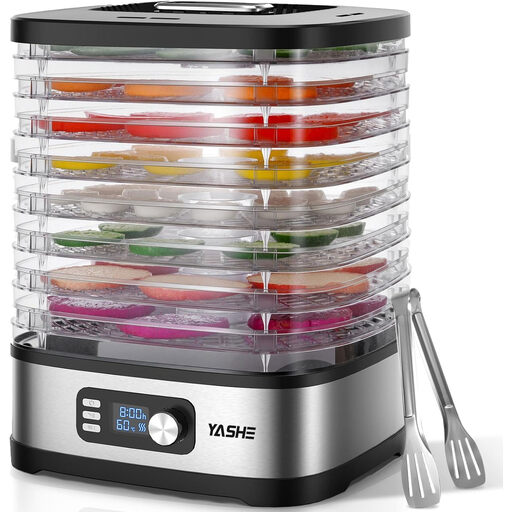
YASHE GGJ-261C food dehydrator with eight trays and accessories

YASHE GGJ-261C food dehydrator

Eight trays may be useful if you want to prepare a larger batch; the number of trays alone doesn’t determine how many slices will fit without overlapping.

The product listing states: timer up to 72 hours, mesh inserts and a fruit leather tray; stainless steel tongs included.

Joybuy

YASHE FD-1019 food dehydrator with five stainless steel trays

YASHE FD-1019 food dehydrator

The five trays may suit a multi-level batch; compare the layout with the number of slices you want to dry at once.

The product listing states: five stainless steel trays, adjustable timer and temperature, 360° airflow and 400 W.

Joybuy
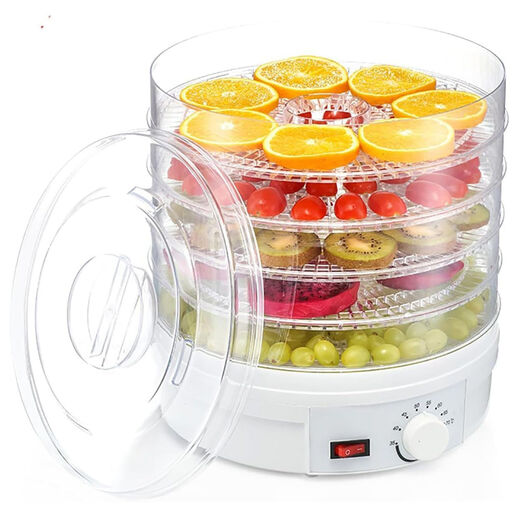
Food dehydrator with five tiers and temperature control from 35 to 70 °C

5-tier food dehydrator

Five tiers provide several levels for a planned drying cycle; check how many apple slices fit on the trays.

The product listing states: temperature control from 35 to 70 °C, 350 W and BPA-free.

Joybuy

Frequently asked questions about drying apple slices

How do you prepare apple slices for a demonstration?

Wash the fruit, cut it into very thin slices and pat them dry. Arrange the slices side by side, then follow the instructions for your chosen dehydrator and do a test run. The cooking times from the Voedingscentrum are for its oven and air fryer recipe and don’t automatically apply to every food dehydrator.

Can you keep homemade apple slices for a long time after the workshop?

Don’t use the storage period for a shop-bought product as a guide for homemade slices. For its own oven or air fryer recipe, the Voedingscentrum recommends keeping them for a few days in an airtight container or bag, or freezing them in portions. For long-term storage of dried fruit, the National Center for Home Food Preservation recommends cooling the fruit, placing it loosely in a sealed jar and conditioning it for 7 to 10 days. Check for condensation during this time and discard any mouldy fruit.

Does a cookery workshop serving food need to be registered with the NVWA?

It depends on how the workshop is organised and what it involves; a workshop isn’t automatically the same as a private cooking session or a food business. The Netherlands Food and Consumer Product Safety Authority (NVWA) requires registration for businesses that supply food directly to consumers. It also outlines the applicable HACCP or hygiene code requirements for professional food preparation. The organiser must assess which rules apply to the activity as it is actually carried out.

What rules apply to materials that come into contact with the apples?

According to the European Commission, food contact materials placed on the EU market must comply with Regulation (EC) No 1935/2004. A claim such as ‘BPA-free’ does not in itself prove that a specific appliance meets all the applicable rules for food contact materials.
