
Vandaag of morgen in huis

Kwaliteit gegarandeerd

Welkomstaanbiedingen ontgrendelen: GRATIS bezorging | Tot 80% korting | Gratis 30 dagen JoyPlus-proefperiode
Download de app
A food chopper can save time when chopping onions, herbs, vegetables, nuts and meat. However, not every appliance is suitable for the same tasks. A small food chopper may be ideal for making a portion of pesto, but fall short when handling a large quantity of vegetables. A multifunctional food chopper may offer more features, but it often takes up more space too.
The main pitfalls usually have less to do with appearance and more to do with the combination of capacity, motor power, blade design and ease of cleaning.
Product descriptions sometimes state the bowl’s total capacity, even though the practical filling capacity is lower. For example, the glass bowl of the Russell Hobbs 24662-56 has a capacity of 1 litre, but the stated filling capacity is 500 ml. Always check the usable capacity, rather than simply choosing the largest figure.
For a one-person household or small portions, a mini food chopper with a capacity of 0.5 to 0.7 litres may be sufficient. A family wanting to prepare several portions of salsa, mince or vegetables will benefit more from a capacity of 1 litre or more.
The wattage indicates the appliance’s power consumption, but it does not determine chopping quality on its own. The number of blades, the shape of the bowl and the way ingredients circulate inside it also play a role. An electric food chopper with 200 watts may be suitable for herbs and soft vegetables, while harder ingredients may require more power or multiple pulse settings.
Also consider the operating time. Some models may only run for short cycles in succession. For example, the Melissa Mini Food Chopper has a stated maximum operating time of 30 seconds per cycle, with a cooling break between cycles.
With many models, only the removable parts are dishwasher-safe. The motor base, plug and cable must not be immersed in water. Also check whether the blades can be removed easily. Blades that are difficult to take out make thorough cleaning less practical.
A food chopper with a glass bowl can be a good choice if you want to limit the absorption of odours and colours. Glass is heavier, however, and can break if dropped or hit hard. Plastic bowls are often lighter, but check whether the material is BPA-free if that is important to you.
Use these guidelines as a practical indication:
Do not fill the bowl above the indicated mark. Too many ingredients can result in uneven chopping and put extra strain on the motor.
Lower power may be sufficient for soft ingredients. If you are looking for a food chopper for meat and vegetables, it is worth checking:
A pulse function gives you greater control over the texture. Short pulses are suitable when you want a coarse chop. Operating the appliance for longer will generally produce a finer texture, but always check the instruction manual.
Stainless steel blades are standard in kitchen food choppers. Look at the number of blade arms and how they are arranged. According to the product information, the Rommelsbacher MZ 800 uses a 9-piece stainless steel blade and offers 22 speed settings. The MZ 500 has a four-blade stainless steel knife and one speed.
An appliance with multiple functions is not automatically suitable for every preparation. A vegetable chopper with cutting attachments works differently from an electric food chopper with rotating blades. For slicing, grating or julienne cutting, a manual or multifunctional vegetable cutter may be more suitable.
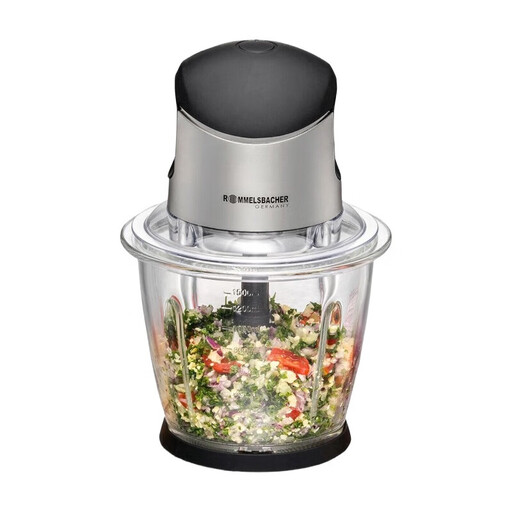
Why it suits this user profile: The 1.5-litre bowl provides plenty of space for everyday preparation, while the appliance has one straightforward speed for easy operation.
The stated bowl capacity is clearly specified, and the metal drive system is designed for ingredients such as onions, herbs, nuts and meat.
500 watts, a 1.5-litre glass bowl and dishwasher-safe removable parts according to the product information.
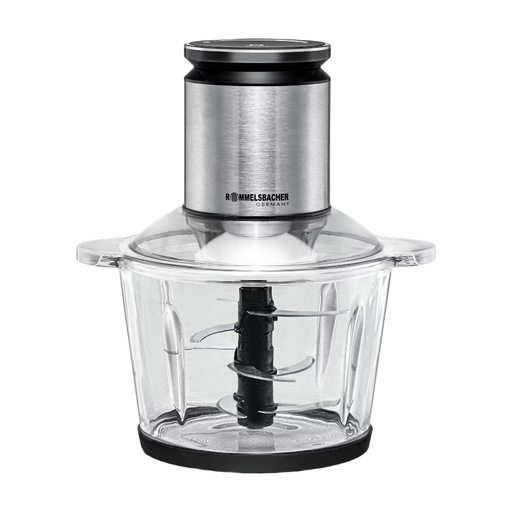
Why it suits this user profile: This model is designed for users who process a wide variety of ingredients and want greater control over the texture.
The product details state both a large 2.7-litre glass bowl and 22 speed settings, so you are not restricted to a single fixed setting.
800 watts, a 9-blade stainless steel knife and parts that can be cleaned in the dishwasher according to the description.

Why it suits this user profile: The three supplied stainless steel bowls are practical when you want to process meat, vegetables and softer preparations separately.
The specifications list three bowls with capacities of 1.8, 2.2 and 2.5 litres, along with a maximum pulse duration of 30 seconds per cycle.
Two speeds, three bowls and a triple-curved stainless steel blade system according to the product description.
Wash ingredients first, cut large pieces into smaller ones and use short pulses. This distributes the load more evenly and gives you greater control over the final result. Always fit the lid correctly before starting, and never touch sharp blades with your bare fingers.
We have put together a complete, up-to-date list of products that fully meet these strict selection criteria and the applicable European safety regulations.
That depends on the model, the blade and the recommended ingredients. Cut hard vegetables such as carrots into smaller pieces first, and do not overfill the bowl. Consult the product manual for ingredients that must not be processed.
Its lifespan depends on usage, maintenance and workload. Use short cycles when recommended, allow the motor to cool down between cycles and clean the removable parts immediately after use. A statutory minimum warranty period of two years applies to many of the models mentioned; check the terms and conditions for each product.
Consumption depends on the power rating and operating time. In theory, a 500-watt appliance uses approximately 0.083 kWh when running for ten minutes. As a food chopper is usually used in short pulses, electricity consumption per preparation is generally limited. Focus on the operating time and the results, rather than the wattage alone.
