
Vandaag of morgen in huis

Kwaliteit gegarandeerd

Welkomstaanbiedingen ontgrendelen: GRATIS bezorging | Tot 80% korting | Gratis 30 dagen JoyPlus-proefperiode
Download de app
A food chopper can take much of the chopping work off your hands. Vegetables, herbs, nuts, meat, dips and sauces can all be prepared more quickly. Yet many consumers end up buying an appliance that is too small, difficult to clean or not suitable enough for their everyday needs.
The most common purchasing mistakes usually concern the specifications rather than the appearance. A high wattage, for example, does not tell you everything about the chopping result. A large bowl is also of little use if the maximum filling quantity is limited. Use these checkpoints to compare a mini food chopper, electric food chopper or manual food chopper more effectively.
A motor power of 400 or 500 watts sounds impressive, but it does not automatically indicate how finely or evenly ingredients will be chopped. The shape of the blade, the number of blades, the shape of the bowl and the operating method also play a part.
So pay attention to the combination of:
According to the product description of the Philips 3000 Series HR1501/00, the blades, cutting angle and airflow are aligned within the stated PowerChop system. This is a claim made by Philips itself and is not a general guarantee for every ingredient or user. Treat wattage as one point of comparison, not the only criterion.
A 1-litre bowl does not mean you can fill it completely. Overfilled bowls can lead to an uneven result and put extra strain on the motor. With a small kitchen chopper, you will often need to process ingredients in several batches.
Therefore, check:
According to the product details, the KitchenAid Mini Chopper has an 830 ml BPA-free bowl. The description advises cutting larger ingredients into pieces of no more than 2.5 cm first. This type of usage information is more practical than simply looking at the bowl volume.
A food chopper only becomes truly convenient when you can clean it after use without too much effort. Check whether the bowl and blades are removable and whether they are dishwasher-safe. With electric models, the motor unit must never be immersed in water.
A manual food chopper has no plug and is quick to store, but it does require more hand movement. An electric food chopper works more quickly with larger quantities, but takes up more space and has a cable or motor unit.
Stainless-steel blades are common in vegetable choppers and kitchen food choppers. Also look at the number of cutting edges and whether the blade is removable. More blades can help distribute ingredients more evenly, but the result also depends on the quantity and chopping technique.
With a manual food chopper, a sturdy pull-cord or lever mechanism is important. Also check that the bowl remains stable during use. A non-slip base helps prevent it from moving.
A model with one push button is easy to use for everyday chopping. Two speeds and a pulse function give you more control: use a short pulse for coarse chopping and run it for longer for a finer texture. Always follow the manufacturer's instructions.
The Philips HR1501/00 lists two speeds and a pulse function. According to the product information, this model has a 1-litre capacity, 450 watts, a non-slip base and dishwasher-safe parts. The stated usage instructions limit continuous operation to a maximum of 30 seconds at a time.
A food chopper with a glass bowl is less prone to discolouration and odour transfer than some plastic bowls. Glass is heavier, however, and can break if dropped heavily. A plastic bowl is generally lighter and easier to handle.
For electric models, look for a safety lock, stable positioning and clear warnings about the blades. Unplug the appliance before removing parts or cleaning it. Do not process ingredients that the manual states are too hot or too hard.
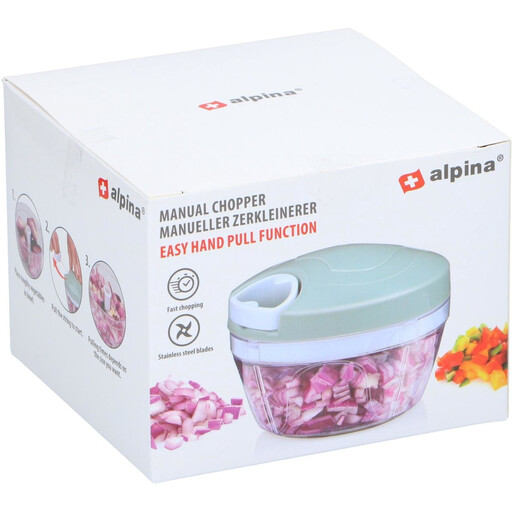
Why it suits this profile: This compact manual food chopper is suitable for small portions of vegetables, herbs and nuts without requiring an electrical connection.
You do not pay for motor power you do not need. Its compact size makes storage easy; it is less suitable for large quantities.
Stainless-steel blade, ergonomic handle, light weight of 210 grams and, according to the product details, dishwasher-safe parts.
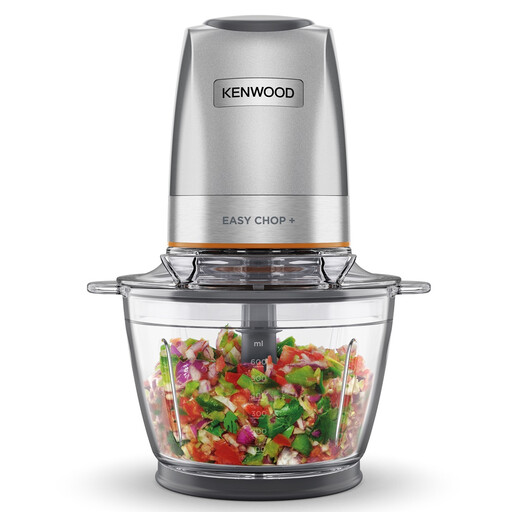
Why it suits this profile: If you value a sturdy bowl and control over preparation, this electric model offers a glass bowl, two speeds and a capacity of 600 ml.
The bowl volume and two speeds are clearly stated. The non-slip ring helps keep the bowl in place while chopping.
600 ml glass bowl, four stainless-steel blades, two speeds and a stated power rating of 500 watts.
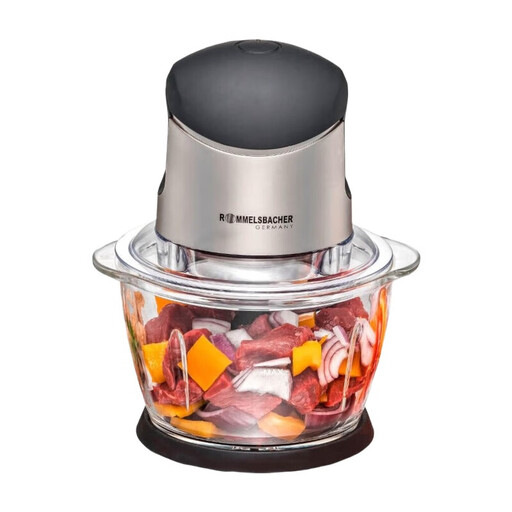
Why it suits this profile: This model is designed for people who regularly process vegetables, herbs, nuts or meat and want to use a larger bowl.
The product specifications state that it has a 1-litre glass bowl, removable blade and safety lock. The usage instructions limit continuous operation to one minute.
400 watts, four stainless-steel blades, 1-litre glass bowl and dishwasher-safe removable parts according to the product description.
A manual food chopper is suitable for small portions and occasional use. You do not need a socket and it makes very little noise. On the other hand, you provide the pulling or pressing action yourself. This can be sufficient for herbs, onions, garlic and small quantities of salad.
An electric food chopper makes more sense if you cook more often or process hard ingredients. Do pay attention to the maximum operating time and allow the motor to cool down when instructed to do so in the manual. If you mainly make sauces, pesto, hummus or dips, you could also consider a compact food processor with a pulse function.
A multifunctional food chopper is useful if you want to carry out several tasks with one appliance, but check that all the stated functions are actually included in the product specifications. A marketing term such as “multifunctional” is no substitute for information about the blades, capacity or accessories.
We have put together a complete, up-to-date list of products that fully meet these strict selection criteria and the applicable European safety regulations.
This varies by model. Check the product description and manual before processing meat, hard nuts or ice. Pay attention to the capacity, blade material and maximum operating time. Cut large pieces into smaller ones beforehand and do not fill the bowl beyond the stated limit.
Its lifespan depends on how it is used, cleaned and stored. A motor can overheat if you run it for longer than permitted. Clean the blades immediately after use, dry the parts thoroughly and store sharp blades out of children's reach. The stated warranty period is not the same as a guaranteed total lifespan.
With a manual food chopper, energy costs are virtually nil. An electric food chopper uses relatively little electricity per short processing cycle, but the exact consumption depends on the power rating and operating time. Above all, consider the power rating together with how often you cook and the quantity you usually prepare.
