
Melody player with limited space
If you want to learn a folk tune, first consider the range of notes you need and how much space the instrument will take up in your spare room.


Want to play melodies in a small spare room? A compact stage keyboard could be a good fit if the melody and your learning materials fall within its range. If you also want to practise piano technique, compare portable 88-key pianos. Check the dimensions, headphone socket and included accessories for the exact version, too. Yamaha lists 61 keys for the CK61 and 88 for the P-145.
If you want to learn a folk tune, first consider the range of notes you need and how much space the instrument will take up in your spare room.
If you want to practise piano technique as well as melodies, compare the key range and touch of piano-focused keyboards.
If you share your home with others, check whether you can practise using headphones with the instrument you choose.
A good fit for: a melody that falls within its range, and a set-up where available space is a consideration.
Keep in mind: a 61-key keyboard is not the same as an 88-key keyboard for piano-focused practice. Yamaha describes the CK61 as having an FSB keyboard.
A good fit for: anyone who wants to practise piano technique and pieces with a wider range, as well as melodies.
Keep in mind: check how much space you have and compare the keyboard type for each model; Roland, Casio and Yamaha use different keyboards.
| What to consider | What should you check? | Who should prioritise this? |
|---|---|---|
| Key range and space | Compare the range of your learning materials with the number of keys, and measure the space available for the instrument and stand. | If I mainly want to learn a folk tune, I want to know whether all the notes fit without the instrument dominating the spare room. Around 33% of consumers give key range and space top priority. |
| Piano touch | Check the keyboard type on the exact model and try out the touch if possible. | If I also want to practise piano technique, I look at the keyboard type, not just the word ‘piano’. Around 25% of consumers prioritise a piano-style touch. |
| Practising with headphones | Check whether the model has a headphone output and whether the connection is compatible with your headphones. | When I practise at home with other people around, I want to check whether a headphone output is available. Around 25% of consumers make quiet practice their top buying priority. |
| Complete practice set-up | Check the contents list for the version you’re considering and see whether you may need to buy pedals, a stand or a power supply separately. | If I want to get started with a practical set-up straight away, I check which accessories actually come with the version I’m buying. Around 17% of consumers prioritise clarity about the accessories they need. |
A shorter keyboard may offer enough range for a particular melody, but that doesn’t make it equivalent to an 88-key keyboard for piano-focused practice.
First check the range of your melody and learning materials, then decide whether you also want to practise piano technique.
A shallow cabinet doesn’t tell you whether the instrument will fit in the room with its stand and enough space to play. Yamaha lists the P-145 as 1.326 mm wide.
Measure the available width and depth, and allow space for the stand, chair and player, too.
What’s included varies by model and version. Casio lists an SP-3 pedal as included with the CDP-S110; Yamaha says the CK61’s power adaptor may or may not be included, depending on the market.
Check the contents list and the compatibility of any pedals and power supplies you need for the version you’re considering.
The CK61 is a 61-key stage keyboard; the P-145 is a portable 88-key piano. Each is suited to different practice goals.
The FP-10 is a portable digital piano for piano-focused practice at home.
The CDP-S110 is a portable 88-key piano for anyone comparing piano-focused practice set-ups.
The ES120 is another portable piano option for comparing keyboards, speakers and connections.
These are 61-key keyboards for practising melodies that fit within that range. For each product, check whether the connections and included accessories suit your practice set-up.
 Image unavailable
Could be a good fit if the melody and learning materials fall within a 61-key range.
The product name lists 300 tones, 300 rhythms, USB-MIDI, speakers and a headphone socket.
 Image unavailable
Could be a good fit if the melody and learning materials fall within a 61-key range.
The product name lists a recording function, speakers, a metronome and a music stand.
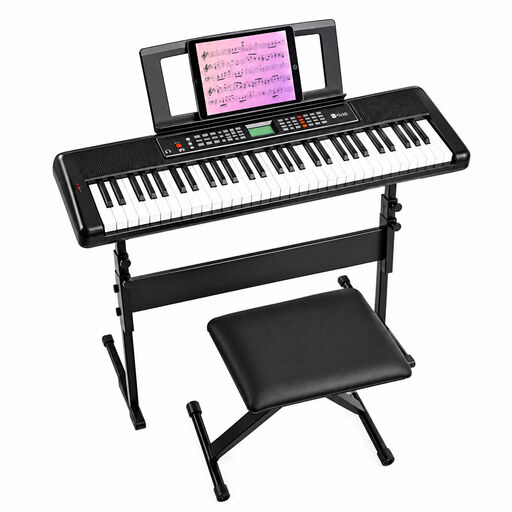 Image unavailable
Could be a good fit if the melody and learning materials fall within a 61-key range.
The product name lists 300 tones, 300 rhythms, an LCD display, USB-MIDI, a music stand and a bench.
No, it depends on the range of the melody and your learning materials. The Yamaha CK61 has 61 keys; if you also want to practise on a full piano keyboard, compare an 88-key model.
Measure the space for the instrument, stand and player. Also check the headphone socket and the contents list for the exact version; Yamaha says the CK61’s power adaptor may be included, depending on the market.
No. According to the Dutch government, there is no fixed statutory guarantee period in the Netherlands: what you can expect from a product depends on factors including the product itself. If something is faulty, the seller must provide a solution.
According to the Dutch government, purchases made at a distance from a business often come with a 14-day cooling-off period. Check the applicable terms and exceptions; an online purchase from a private seller isn’t covered by the same rules.