
Vandaag of morgen in huis

Kwaliteit gegarandeerd

Welkomstaanbiedingen ontgrendelen: GRATIS bezorging | Tot 80% korting | Gratis 30 dagen JoyPlus-proefperiode
Download de app
A folding wagon is handy for carrying camping gear, shopping, garden waste or festival essentials. However, not every folding wagon is suitable for heavy loads or uneven ground. A compact design, for example, may have a low load capacity, while a large model can be difficult to fit in your car boot.
So don’t just look at litres and kilograms. Check the frame, wheels, brakes and folded dimensions too. Below, you’ll find out which features make a real difference in practice and which models suit different situations.
A 200-litre wagon offers plenty of space, but that doesn’t automatically mean it can carry 200 kg. Product information lists capacity and maximum load capacity separately. So a large camping wagon may be spacious but still have a lower weight limit.
Distribute the load evenly and remember to account for the weight of the wagon itself. Heavy items at the bottom help with stability, but a fully loaded wagon can be harder to manoeuvre.
Wide tyres help on grass, sand and mud, but they don’t make a wagon suitable for every slope or loose surface. Check the type and width of the wheels. A folding wagon with pneumatic tyres can provide a comfortable ride, but requires more maintenance. Wide rubber or plastic off-road wheels are often easier to maintain, but can still sink into very soft sand.
Use a trolley on stable ground and avoid steep slopes when carrying a heavy load.
On many models, the brake is designed to keep the wagon stationary, not to slow it down while moving. Check whether the brake is fitted to the wheels, and use it when the wagon is parked. A brake won’t stop a heavily loaded wagon from sliding on a slope if the ground is unstable.
Choose the capacity to suit how you’ll use it:
A stated maximum isn’t a recommendation to use the full capacity as standard. Also check whether the manufacturer warns against use on uneven ground or slopes.
A steel or alloy steel frame provides structural support. Oxford fabric, such as 600D Oxford, is commonly used for the wagon bed. A PU coating may help protect against moisture, according to the product description, but dry the wagon after use before folding it away.
Check the following:
A folding wagon stored away while wet can start to smell unpleasant or develop corrosion on its parts more quickly.
For beaches, grass and unpaved paths, wide all-terrain wheels matter more than a high load capacity alone. An adjustable telescopic handle is practical for users of different heights. Swivel wheels make turning easier on flat ground, while fixed or larger rear wheels can sometimes offer more control with a heavy load.
Always check that the wheels are suitable for your route. A beach wagon or festival wagon will often encounter sand, grass, kerbs and busy paths. Remove sand and mud from the wheels after use.
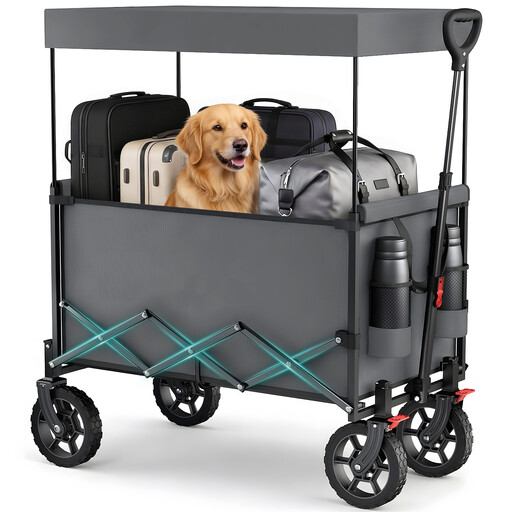
Why it suits this user: This model combines a 150-litre capacity with a stated load capacity of 150 kg. The removable canopy is handy for changeable weather on camping or picnic trips.
The capacity and load limit are listed separately. The wheels and canopy can be removed, making cleaning and storage easier.
150-litre capacity, brakes, adjustable handle and removable parts.
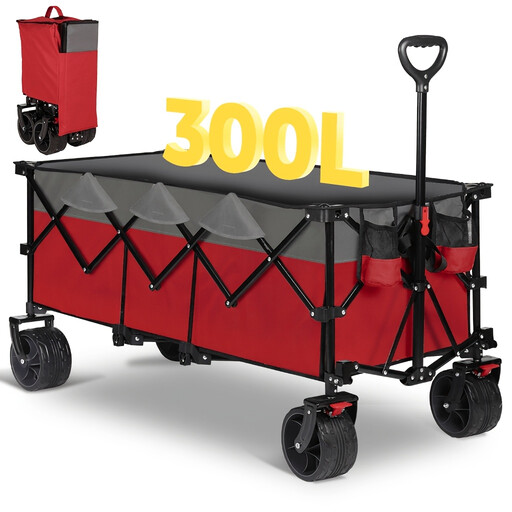
Why it suits this user: The product information lists a 300-litre storage capacity, a load capacity of 200 kg and wide 7-inch tyres. That makes it suitable for bulky camping equipment or heavy gardening tools.
The spacious bed comes with a clearly stated maximum weight. The wagon should still be loaded evenly and isn’t designed to carry people.
300-litre capacity, stated load capacity of 200 kg, 7-inch tyres and brakes.
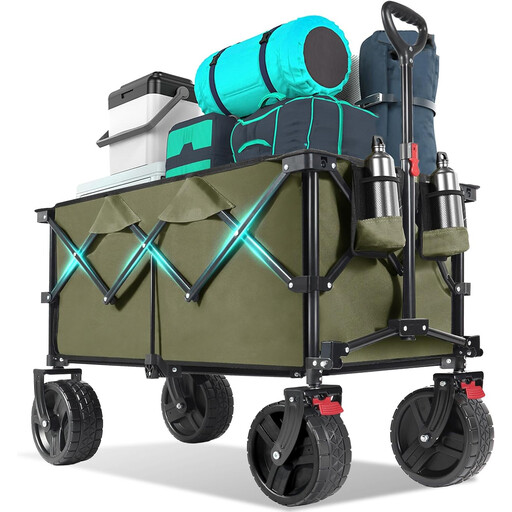
Why it suits this user: The wagon has 200 litres of storage space, wide 7-inch all-terrain tyres, an adjustable handle and a stated load capacity of 150 kg. It’s designed for camping, festivals, gardening and shopping.
The product information states a maximum load of 150 kg, despite the 200-litre capacity. This helps avoid mistaking storage space for load capacity.
Wide 7-inch all-terrain wheels, brake, tie-down straps and compact four-sided folding design.
We’ve put together a complete, up-to-date list of products that meet these strict selection criteria and the current European safety regulations.
Unfold the frame fully and check that the locking mechanism is secure before loading your belongings. Place heavy items low down and distribute the weight across the base. Test the handle and brake before loading the wagon. Keep your fingers clear of the folding mechanism.
Its lifespan depends on the load, the surface it’s used on and how well it’s maintained. Remove sand and mud from the wheels and frame after use. Let the fabric dry completely before storing the wagon. Check the seams, wheel fittings, brakes and hinges regularly. Don’t exceed the stated load capacity.
A folding trolley usually has no motor or battery, so it doesn’t use fuel or electricity. However, the wheels, bearings and folding joints can wear out. If you use it frequently on the beach or in muddy conditions, it’s important to clean and dry it, and check it regularly. A model with removable wheels can make maintenance easier.
