
Vandaag of morgen in huis

Kwaliteit gegarandeerd

Welkomstaanbiedingen ontgrendelen: GRATIS bezorging | Tot 80% korting | Gratis 30 dagen JoyPlus-proefperiode
Download de app
A folding wagon is handy for camping, gardening, festivals, sports days and shopping. Use one to transport crates, garden waste, camping gear or sports equipment without having to carry everything separately. However, a transport trolley that looks sturdy can disappoint in practice. Weak points quickly become apparent, especially on grass, gravel, mud and uneven paths.
So don’t just look at a high load capacity or an attractive price. The construction, wheel size, brakes and stated dimensions all help determine whether a folding wagon is right for you.
A figure such as “150 kg” or “200 kg” doesn’t tell you everything. The maximum load usually applies when the weight is evenly distributed and the wagon is used on a suitable surface. Heavy items at the bottom, loose objects on top and sloping ground can all affect stability.
So check:
A 200-litre folding wagon may be spacious, but that doesn’t automatically mean it can carry 200 kg.
Narrow city wheels can work perfectly well on paving, but they’re less suited to sand, grass or mud. Wide all-terrain wheels are more practical for an outdoor transport trolley. They distribute the weight more effectively and help you get over obstacles such as kerbs or roots.
Check the full wheel specifications: diameter, width, swivel function and material. A folding wagon with large wheels isn’t necessarily suitable for every type of terrain, but according to the product specifications, 7-inch-wide all-terrain tyres provide more clearance between the ground and the frame.
A folding handcart shouldn’t just fold down small; it should also be easy to open, close and store. Check whether assembly is required, how the handle locks and whether there’s any protection around the folding joint.
Keep your fingers clear of the mechanism when folding and unfolding the wagon. You should never fold it while it’s loaded. If you’ll be using it regularly in the car or shed, its folded dimensions and weight are just as important as its maximum capacity.
Choose a load capacity based on the heaviest load you normally carry, not occasional emergencies. For a camping wagon, sleeping bags and tents tend to be bulky. For a gardening wagon, compost, stones and tools can be heavy.
A capacity of 150 to 200 litres gives you plenty of room for several crates or camping bags. Check the internal dimensions too. A deep body isn’t always suitable for long items; an extended tailgate may be more useful in that case.
A frame made from alloy steel or carbon steel is a verifiable construction feature. The fabric determines how the wagon handles moisture, dirt and everyday use. Product information for several models specifies 600D Oxford fabric with a PE coating or water-repellent treatment.
“Waterproof” doesn’t mean you should leave your folding wagon out in the rain for long periods. Clean the fabric with a damp cloth, let it dry and store the wagon in a dry place. This helps limit moisture build-up and dirt around the seams.
A folding wagon with a brake can give you extra control on a short slope, while loading or when the wagon is parked. A brake is no substitute for careful handling: don’t leave the wagon unattended on a steep slope, and distribute the weight evenly.
Also look for swivel front wheels, an adjustable handle and a handle lock. These details affect how much control you have, particularly when manoeuvring between tents, along garden paths or around shopping trolleys.
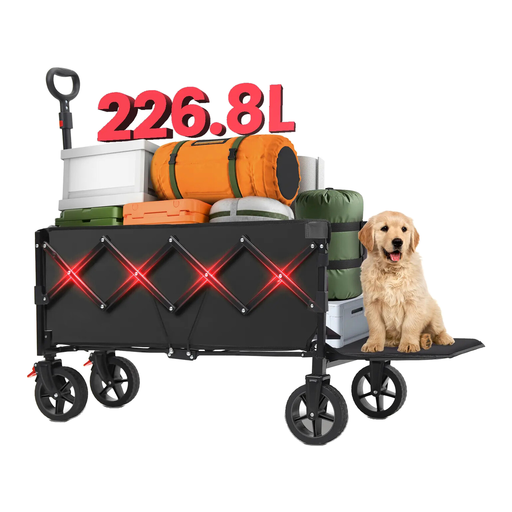
Why it suits this user: This folding transport trolley is designed for everyday use when shopping, gardening, playing sports or camping. The product information gives its folded dimensions as 50,8 × 45 × 19,6 cm.
The product description lists swivel all-terrain wheels, brakes and a handle lock. Before buying, check the capacity carefully: the title and specification table don’t give exactly the same figures in litres and kilograms.
Folding design, brakes, swivel wheels and an extended tailgate, according to the product information.
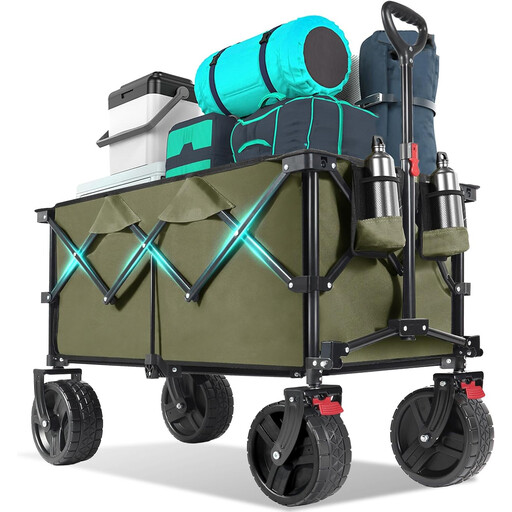
Why it suits this user: Its spacious body and wide 7-inch tyres make this a good fit for campers, festival-goers and families transporting lots of bulky items over grass or mud.
The product details list wide all-terrain tyres, a brake and tie-down straps. The stated maximum load is 150 kg; don’t exceed this limit.
200-litre capacity, water-repellent 600D Oxford fabric, adjustable handle and a tool-free folding mechanism.
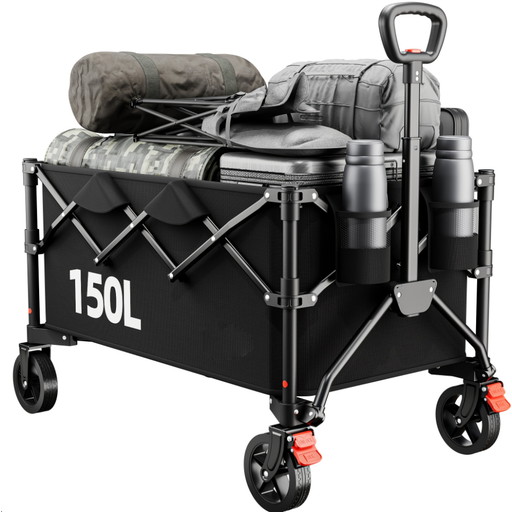
Why it suits this user: This handcart is well suited to gardening, DIY and camping, where you regularly travel over gravel, grass or gentle slopes.
The product specifications list off-road wheels with brakes, a removable bag and wheels, and a load capacity of 120 kg. This makes maintenance and controlled parking easier.
150-litre capacity, one-button handle, folds on all four sides and a bag made from 600D Oxford fabric with a PE coating.
We’ve put together a complete, up-to-date list of products that meet these strict selection criteria and the applicable European safety regulations.
That depends on its folded dimensions and the boot space available. According to the product information, a compact model such as the transport trolley mentioned above measures 50,8 × 45 × 19,6 cm when folded. Always measure the boot opening as well as the space behind the rear seats.
Its lifespan depends on the load, the surface, exposure to moisture and how well it’s maintained. A steel frame and 600D Oxford fabric are verifiable material features, but they don’t guarantee a specific lifespan. Avoid overloading the wagon, clear sand from the wheels and let wet fabric dry before putting it away.
A brake isn’t always necessary on flat, paved paths. But a gardening wagon used on slopes at campsites or festivals can give you extra control when parking and loading. Use the brake to help keep the wagon parked, and hold on to it on a slope whenever needed.
