
Vandaag of morgen in huis

Kwaliteit gegarandeerd

Welkomstaanbiedingen ontgrendelen: GRATIS bezorging | Tot 80% korting | Gratis 30 dagen JoyPlus-proefperiode
Download de app
A folding wagon is useful for camping equipment, shopping, garden waste or sports gear. However, not every wheeled wagon is suitable for the same surfaces or loads. A model that looks compact in the shop may have wheels that are too small, an awkward handle or an unrealistic stated capacity in practice.
As a Joybuy Product Recommendation Officer, I therefore focus on verifiable details such as load capacity, volume, wheel type, brakes, materials and folded dimensions. This makes it easier to see which foldable wagon suits your needs.
A description such as 150 kg wagon or 200 kg wagon sounds clear, but it does not tell you everything. The stated maximum only applies when the wagon is fully opened, locked and loaded evenly. Stability decreases on sand, slopes or uneven paving.
Also pay attention to the difference between:
A large capacity therefore does not automatically mean that you can safely transport 200 kg.
A foldable transport wagon with small, narrow wheels generally rolls well on a flat floor, but may sink into beach sand or wet grass. For a wagon for the beach and camping, wide all-terrain wheels are more practical. Check the diameter and width of the tyres, and see whether the wheels can swivel.
A wagon with a brake is mainly intended to keep the wagon securely in place when parked. Several models explicitly state that the brake is not intended for use while the wagon is moving. Do not leave a heavily loaded wagon on a steep slope, and keep children away from the folding mechanism.
For shopping, a picnic or light camping equipment, an 80 kg model may be sufficient. For tents, chairs, cool boxes and gardening tools, a larger high-capacity wagon is the more logical choice.
The product details in this guide include:
Use these figures as a point of comparison, not as an invitation to load the wagon to its limit. Place heavy items low on the base and check before use that the frame is fully locked.
A steel or aluminium frame offers a different balance of weight and load capacity. Oxford fabric, polyester and PU or PE coatings are commonly used on outdoor wagons. According to the product descriptions, some fabrics may provide better resistance to moisture, but this does not mean you should store a wet wagon folded away straight away.
Clean the fabric with a damp cloth and allow it to dry completely. Remove sand from the wheel housings and regularly check the wheel fixings, seams and pivot points.
Measure your boot, storage area or cupboard before ordering. Do not just consider the folded dimensions, but also look for:
A compact foldable transport wagon that you can lift on your own is more likely to be used regularly than a heavy model that is difficult to get out of storage.
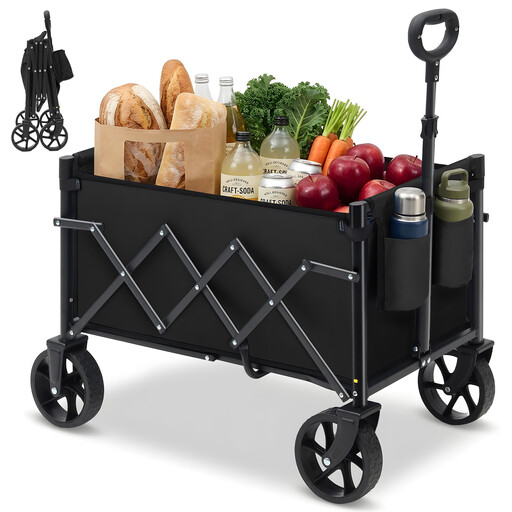
Why it suits this profile: With an empty weight of 4.8 kg, this model is suitable for shopping, picnics and everyday use. The wagon folds down compactly and the wheels are removable.
The product listing states 80 kg as the maximum and 4.8 kg as the empty weight. This makes the difference between load capacity and empty weight clear.
Reinforced steel frame, adjustable handle with three positions, free-standing design and a two-year warranty according to the product information.
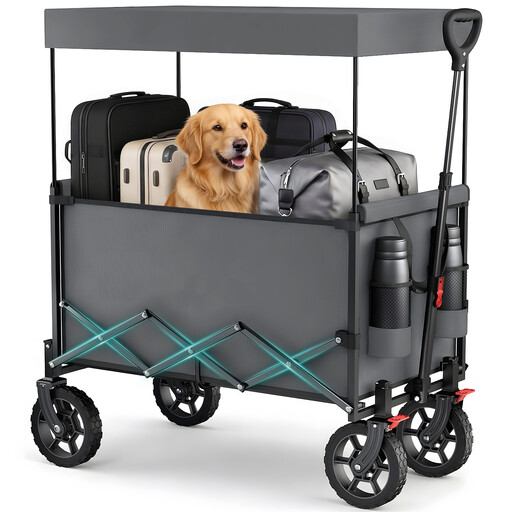
Why it suits this profile: This camping wagon combines a 150-litre capacity with a stated load capacity of 150 kg, a telescopic handle and off-road tyres.
The product information lists removable wheels and a brake for keeping the wagon stationary. This makes cleaning and parking more straightforward, but do not use the brake while moving.
Removable canopy, off-road tyres, adjustable handle and a two-year warranty according to the product listing.
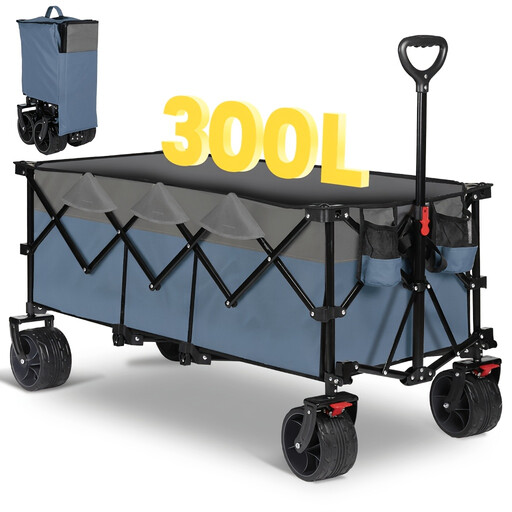
Why it suits this profile: The combination of a 300-litre capacity, a stated load capacity of 200 kg and wide 7-inch tyres is designed for large quantities of camping equipment, gardening tools or supplies.
The product description specifies that the load should be distributed evenly, the wagon should be used on flat terrain and the brake should only be used when parked. These are important conditions when carrying heavy loads.
Folds in four directions, wide tyres, quiet bearings, brakes and two cup holders according to the product details.
We have put together a complete, up-to-date list of products that fully meet these strict selection criteria and the applicable European safety regulations.
Follow the manufacturer’s instructions for every folding wagon. In particular, check:
When using the wagon on the beach, remove sand from the bearings and wheel openings as soon as possible. For garden or festival use, it is best to let mud dry first and then brush it off. With intensive use, regularly check for loose bolts, tears in the fabric and worn tyres.
Fully open the wagon on a level surface and check that all the locks are secure. Only then load your belongings. Keep your fingers away from hinges and folding points.
That depends on the wheels. Wide all-terrain tyres are less likely to sink than narrow wheels, but even they can be difficult to pull through very soft sand. Distribute the load evenly and avoid steep sections.
Its lifespan depends on the load, surface, moisture and maintenance. A wagon that is frequently used at close to its maximum load capacity will wear out faster. Dry the fabric, clean the wheels and store the frame somewhere dry to limit unnecessary wear.
