
Vandaag of morgen in huis

Kwaliteit gegarandeerd

Welkomstaanbiedingen ontgrendelen: GRATIS bezorging | Tot 80% korting | Gratis 30 dagen JoyPlus-proefperiode
Download de app
A folding wagon is handy for camping, gardening, shopping, festivals and days at the beach. But a utility wagon can disappoint in practice. For example, a high load capacity doesn’t automatically mean it will roll smoothly over grass, gravel or sand. Some models can also be harder to fit in your car when folded than the product photo suggests.
Before you buy, watch out for these three common pitfalls:
For light shopping or a picnic, a folding utility wagon with an 80 kg capacity may be enough. For garden waste, camping gear or market purchases, a higher capacity gives you more flexibility. Don’t just look for search terms such as 150 kg folding wagon or 200 kg folding wagon; also check:
A model with a capacity of 200 litres isn’t automatically suitable for carrying 200 kg. Always follow the product specifications and don’t exceed the stated limit. Place heavy items low down and as centrally as possible in the wagon.
A folding wagon with pneumatic tyres may seem suitable for sand or uneven paths, but pneumatic tyres need their pressure checked and can get punctures. Many models in this selection use PVC or rubber all-terrain tyres. Wide tyres can distribute pressure over soft ground, while swivel wheels make it easier to manoeuvre on a square or campsite.
A folding wagon with a brake is particularly useful when parking on a gentle slope or when you want to keep the wagon stationary for a moment. Check whether the brake works on one or more wheels. Some models explicitly state that the brake is for parking only. So don’t use a loaded wagon as if it had a handbrake or bicycle brake.
A steel or alloy steel frame provides a sturdy base, but also adds to the wagon’s own weight. Product descriptions state that 600D Oxford fabric with a coating is hard-wearing and more resistant to moisture; this doesn’t mean that every model is fully waterproof. Let the fabric dry after a wet trip before folding the wagon.
Also check:
A folding wagon with an adjustable push handle can be more comfortable for people of different heights. For a camping wagon or a garden wagon, removable wheels and a detachable bag are also handy for cleaning.
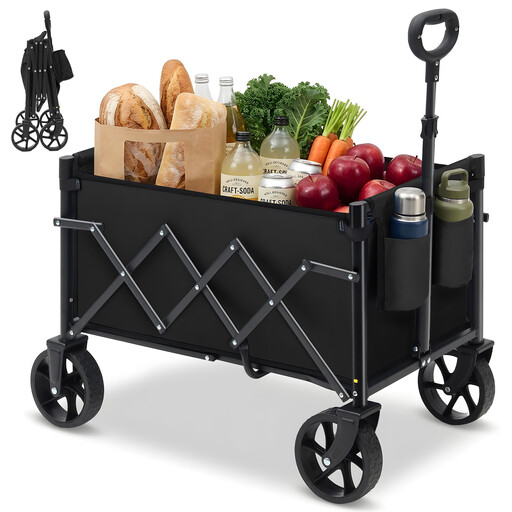
Why it suits this type of user: This lightweight folding handcart is designed for shopping, picnics and everyday use where a compact size matters.
Its stated load capacity of 80 kg is paired with an own weight of 4.8 kg. This makes it clearer what the wagon is and isn’t designed for.
Folds with one hand, stands upright for storage, has quick-release wheels and a handle with three positions.
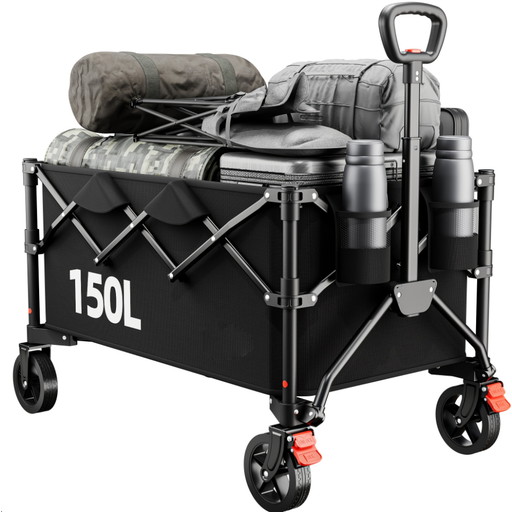
Why it suits this type of user: A practical choice for gardeners, campers and anyone who needs a spacious wagon with all-terrain wheels.
The product information lists both a 120 kg load capacity and a 150-litre capacity. The wheels have brakes for parking and can be removed for maintenance.
600D Oxford fabric with a PE coating, PVC all-terrain wheels, a quick-release handle and a four-sided folding design.
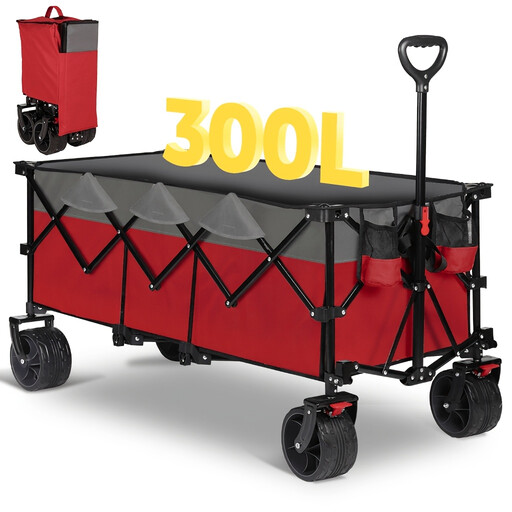
Why it suits this type of user: This heavy-duty utility wagon is designed for large loads of camping gear, garden tools and other heavy items.
The stated specifications list a storage capacity of 300 litres and a load capacity of 200 kg. The safety information advises distributing the load evenly and using the wagon on stable ground.
Wide 7-inch tyres, quiet bearings, brakes, a four-sided folding design and two cup holders.
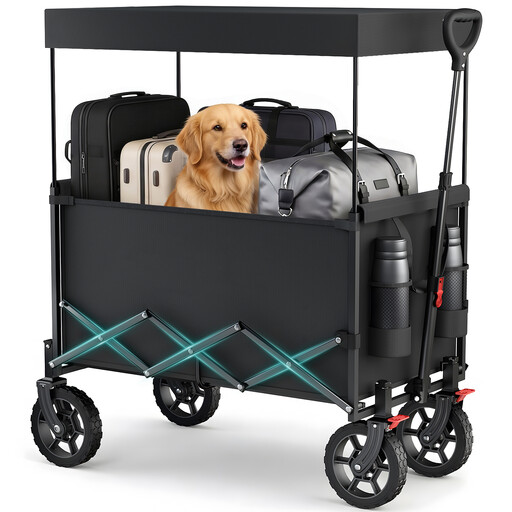
Why it suits this type of user: The removable canopy makes this camping wagon a good option for outings when you want to shield your belongings from the sun or light rain for a while.
The product description lists a load capacity of 150 kg and a capacity of 150 litres separately. The brakes are designed to keep the wagon stationary; the manufacturer’s information advises against exceeding the maximum limit.
Adjustable telescopic handle, all-terrain tyres with brakes, removable wheels and a detachable canopy.
We’ve put together a complete, up-to-date list of products that meet these strict selection criteria and the applicable European safety regulations.
Unfold the frame fully and check that the locking mechanism is secure before adding your belongings. Place heavy items at the bottom, distribute the weight across the base and secure any loose loads. Test the handle and check that the wheels turn freely. Use the parking brake when the wagon is stationary.
Its lifespan depends on the load, surfaces, moisture and maintenance. Clean sand and mud off the wheels after use, let a wet fabric compartment dry and store the wagon somewhere dry. Check the seams, frame joints, brakes and wheel fixings regularly. A stated warranty period, such as two years on some models, isn’t the same as a guaranteed lifespan.
That depends on the wheels and the load. Wide all-terrain tyres are generally more practical on grass, gravel and firm sandy paths than narrow wheels. Even a model with wide tyres can be hard to pull over soft beach sand. Check the load capacity beforehand, keep the load light on soft ground and don’t use the wagon as a seat or to carry people.
