
Vandaag of morgen in huis

Kwaliteit gegarandeerd

Welkomstaanbiedingen ontgrendelen: GRATIS bezorging | Tot 80% korting | Gratis 30 dagen JoyPlus-proefperiode
Download de app
A folding wagon is handy for camping, the beach, the garden or a festival. You can use it to carry cool boxes, tent poles, shopping and gardening tools without making several trips. However, models vary considerably in load capacity, wheel type and stability.
Marketing terms such as “extra-large”, “heavy-duty” and “all-terrain” don’t tell you much on their own. Always check the actual product specifications. A spacious load area may look appealing, for example, but if the wheels are small, pulling it over grass or sand can still be difficult.
A 200-litre wagon may offer more space than a 150-litre model, but that doesn’t automatically mean it can carry more weight. Check each of the following separately:
A wagon with a 150 kg capacity may be sufficient for camping gear, while a model with a 200 kg or 300 kg load capacity may be better suited to paving slabs, wood, heavy crates or gardening tools. Don’t exceed the stated capacity.
A wagon with large wheels is generally easier to pull over grass and unpaved paths than a compact model with narrow wheels. Even so, not every utility wagon is suitable for loose sand or slopes. Check the wheel width and material, and whether it has swivel wheels.
On the beach, wide wheels are less likely to sink into the sand. Swivel wheels are more practical on paved surfaces and at festivals, where easy manoeuvring matters. A wagon with brakes gives you more control when you park it temporarily, but don’t rely on the brakes instead of placing it on stable, level ground.
A folding utility wagon should not only fold down, but also be easy to lift and store. So check:
A large, spacious wagon can carry a lot, but it also takes up more room in your car, shed or storage area when unfolded.
For shopping or a picnic, 80 to 150 litres may be enough. Families, market traders and campers often need 200 litres or more. As well as checking the total volume, look at the internal dimensions. A long tent bag or folding chair may not fit in a load area that’s deep but short.
Many models use a steel or aluminium frame with 600D Oxford fabric. This fabric is tightly woven and often treated with a water-repellent coating. That doesn’t mean the wagon is completely waterproof. After using it in the rain or at the beach, make sure the fabric, seams and frame are dry before putting it away.
For a camping wagon that sees heavy use, a sturdy frame, reinforced joints and a reliable locking mechanism matter more than a high litre capacity alone.
An adjustable telescopic handle makes pulling more comfortable for people of different heights. Wide rubber or plastic off-road tyres are practical on grass, mud and paths. Swivel wheels can improve manoeuvrability on paving and tarmac.
Also check whether the product description clearly explains when the brakes are engaged and whether the wagon stays stable when parked. If it’s carrying a heavy load, place it on level ground wherever possible.
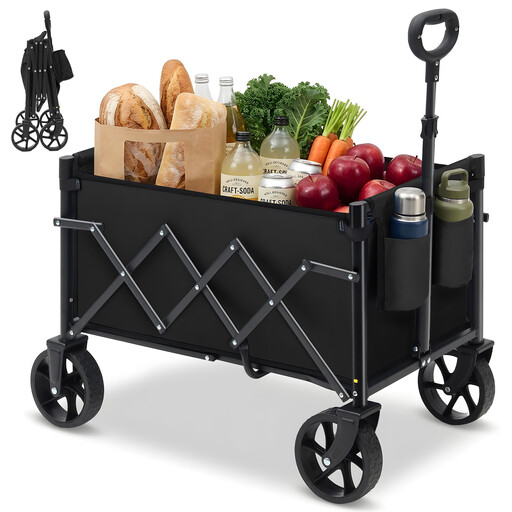
Why it suits this type of buyer: This compact folding handcart is designed for shopping, picnics and everyday use. At around 4.8 kg, it’s relatively easy to take with you.
The maximum load of 80 kg is clearly stated, making it easier to avoid overloading the wagon.
Freestanding design, folds with one hand, and comes with an adjustable handle and removable wheels.
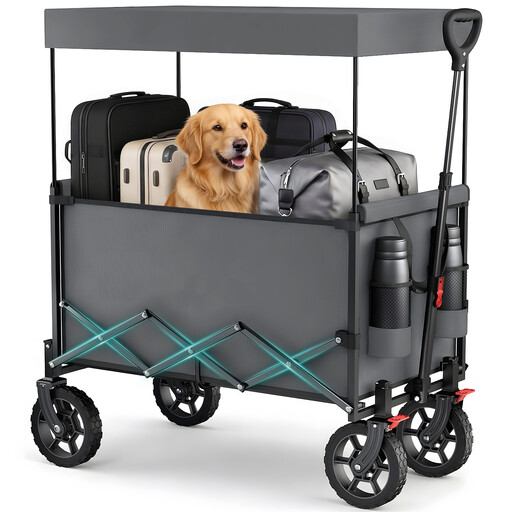
Why it suits this type of buyer: A practical choice for camping, the beach and the garden when you want protection from the sun or light rain. The removable canopy gives you extra flexibility on days out.
The specifications list a 150-litre capacity and a maximum load of 150 kg separately. The wheels and canopy can be removed for cleaning.
600D Oxford fabric with a PU coating, off-road tyres, brakes and an adjustable telescopic handle.
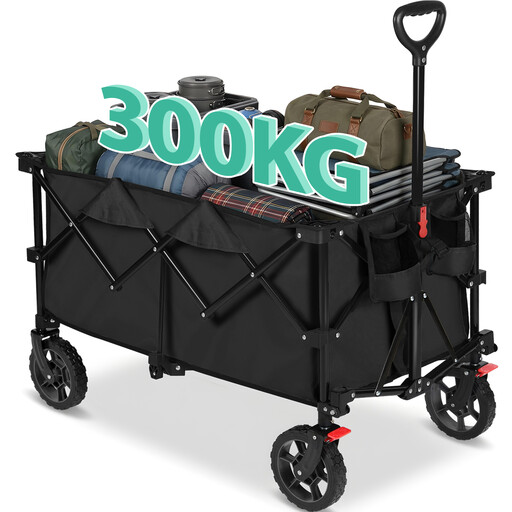
Why it suits this type of buyer: This model is designed for heavy, bulky loads in the garden, at the campsite or beach, or for moving things around the home. The load area has a stated capacity of 200 litres.
The product information states both the capacity and the specified load limit. Before use, check that the ground and weight distribution are suitable for the load.
Painted steel frame, adjustable handle and a folding mechanism that, according to the description, can be used without assembly.
We’ve put together a complete, up-to-date list of products that meet these strict selection criteria and current European safety regulations.
Unfold the frame fully and check that the locking mechanism is secure. Then fit the wheels and handle according to the product instructions. Test the wagon while empty first and make sure the wheels turn freely. If your model has brakes, engage them when the wagon is stationary.
Its lifespan depends on the load, the ground it’s used on and how well it’s maintained. Clean sand and mud off the wheels after use, let wet fabric dry first, and store the wagon in a dry place. Regularly check the seams, wheel fixings, frame joints and folding mechanism. Stop using the wagon if any parts are bent or damaged.
The direct running costs are usually low. However, wider wheels, brake components or a more complex folding mechanism may need extra maintenance. So don’t just consider the purchase price: check the availability of spare parts, how easy it is to clean, and the warranty terms too.
