
Vandaag of morgen in huis

Kwaliteit gegarandeerd

Welkomstaanbiedingen ontgrendelen: GRATIS bezorging | Tot 80% korting | Gratis 30 dagen JoyPlus-proefperiode
Download de app
A day at the beach, a weekend camping trip, or a visit to a festival: it quickly becomes a chore hauling coolers, chairs, bags, and toys. A folding wagon seems like the perfect solution. But the market is flooded with models that look good at first glance but cause frustration in practice.
Before you make a purchase, it's wise to know the common pitfalls. Many wagons have weaknesses that only become apparent after a few uses. These are the three most common problems:
folding utility cart.To avoid a bad purchase, it's essential to look beyond the marketing buzzwords. Pay attention to the following objective specifications to find a model that suits your needs.
The maximum load capacity (indicated in kg or lbs) is a key indicator of sturdiness. Be aware: manufacturers often list the static load capacity (the weight the wagon can hold when stationary). The dynamic load capacity (the weight it can handle while moving over uneven terrain) is often lower. A good rule of thumb is to choose a model with a load capacity well above the weight you plan to carry. A frame made of carbon steel or alloy steel is typically more robust than standard steel or aluminium.
The wheels determine where you can use the wagon. For a day at the beach, a wagon with wide wheels is essential. Pay attention to the following features:
beach cart.A collapsible wagon must be practical. Check the folded dimensions (L x W x H) in the specifications and measure to see if it will fit in your car or storage space. Some models collapse in the middle like an accordion, which often yields the most compact result. A festival cart or camping wagon should be quick and easy to set up without needing any tools.
Based on these criteria, we have selected several models that suit different user profiles.

Why This Fits Their Persona: This wagon is built for heavy-duty work. With a 300-litre capacity and a 132 kg load capacity, you can transport a complete set of camping gear or festival supplies in one go. The dual brakes provide extra control on slopes.
The wide (10 cm) PU wheels with bearings are designed for rough terrain and won't get bogged down in mud or grass, unlike cheaper plastic wheels.
Large 300-litre capacity, dual brakes for safety, and quick-release wheels for easy cleaning.
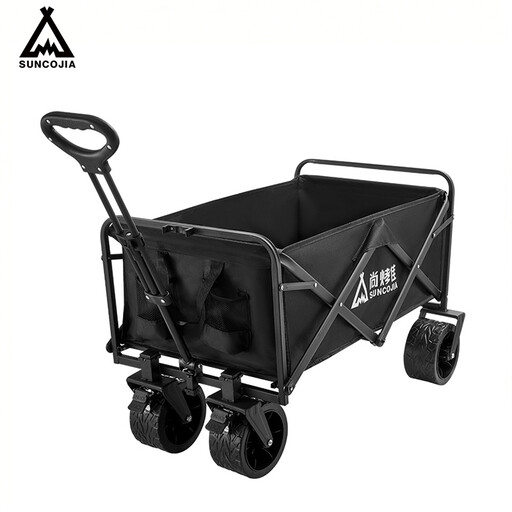
Why This Fits Their Persona: With a massive 350-litre cargo bed, there's room for everything: from the cooler and beach chairs to sand toys. The wide wheels are specifically designed for rougher terrain, making it ideal for the beach.
The thickened steel frame and high static load capacity (200 kg according to the manufacturer) prevent bending, a common problem with cheaper models under heavy load.
Very large 350-litre capacity, a robust carbon steel frame, and wide shock-absorbing wheels.

Why This Fits Their Persona: For those looking for a handy assistant for weekly groceries, taking out garden waste, or moving items. This wagon offers a good balance between a usable capacity (127L) and a compact size.
The folding mechanism is simple, and the folded package is genuinely compact. This prevents the frustration of a "folding" wagon that is still awkward to store.
High load capacity (200 kg according to the manufacturer) in a compact design, with 360° swivel wheels for optimal manoeuvrability.
We have compiled a complete, up-to-date list of products that meet these selection criteria and practical usability.
The specified load capacity is often the static load (when the wagon is stationary). Keep in mind that the stress on the wagon is higher when moving, especially on uneven terrain. To be safe, choose a model with a capacity at least 20-30% higher than what you expect to carry. For example, a wagon with a 100 kg load capacity is suitable for a load of about 70-80 kg.
Not necessarily. The width of the wheels is crucial, but so is the material. Wide, soft wheels made of PU or rubber perform significantly better on loose sand than wide, hard plastic wheels. The latter can still sink. For optimal beach use, you should look for a combination of wide and soft wheels.
Most wagons have a fabric liner made of Oxford polyester. It's best to clean this with a damp cloth and mild soapy water. On many models, the liner is removable, which makes cleaning easier. Rinse the wheels and frame with water to remove sand, salt, and mud, and let everything dry thoroughly before storing the wagon. This prevents rust on the frame and mould in the fabric.
