
Vandaag of morgen in huis

Kwaliteit gegarandeerd

Welkomstaanbiedingen ontgrendelen: GRATIS bezorging | Tot 80% korting | Gratis 30 dagen JoyPlus-proefperiode
Download de app
A folding trolley is handy for gardening, camping, festivals, shopping and sports days. However, a model that looks spacious and sturdy on paper can disappoint in practice. A frame that’s too lightweight, small wheels or an unclear weight limit can quickly lead to frustration.
So the key question isn’t just how many litres the trolley holds. You should also check its actual load capacity, the surfaces you’ll be using it on and its dimensions when folded.
A large bag doesn’t automatically mean you can carry a lot of weight. For example, a 200-litre trolley may have a maximum load of 150 kg, while a more compact folding hand trolley can support 80 kg. Always check both figures:
Distribute the weight evenly. A heavy load on one side can reduce stability, especially on grass, gravel or a slope.
Wide tyres help on grass, sand and mud, but they don’t automatically make a trolley suitable for steep slopes or very uneven ground. Check the wheels’ diameter, width and manoeuvrability. A trolley with all-terrain wheels will generally travel more easily over soft ground than a model with small, narrow wheels.
A trolley with a brake is especially useful for keeping it in place when parked. On many models, the brakes are designed to hold the trolley still rather than slow down a heavy load while it’s moving. Apply the brake when you stop, and don’t use the trolley on a steep slope with a heavy load.
As well as the folded dimensions, check the trolley’s weight. A heavy-duty transport trolley may be sturdy, but less practical if you regularly need to lift it into a car or storage space. Ideally, look for a design with:
A steel or alloy steel frame provides a sturdy base for gardening and outdoor activities. The models in this selection include 600D Oxford fabric. This is a tightly woven synthetic material often used for transport bags and outdoor products. A coating can help protect against moisture, but it doesn’t mean the trolley is completely waterproof.
Let a wet bag dry thoroughly before folding the trolley away. This helps reduce the risk of odours, mould and premature wear.
For light everyday use, a load capacity of 80 to 100 kg may be sufficient. If you’ll be carrying compost, tools, camping gear or festival luggage, consider a high-capacity trolley rated for 120 to 200 kg. Bear in mind that the stated maximum isn’t necessarily the recommended load for every surface.
A heavy-duty transport trolley is easier to control when heavy items are placed low down and in the centre. Use tie-down straps or internal compartments if the contents could shift while you’re on the move.
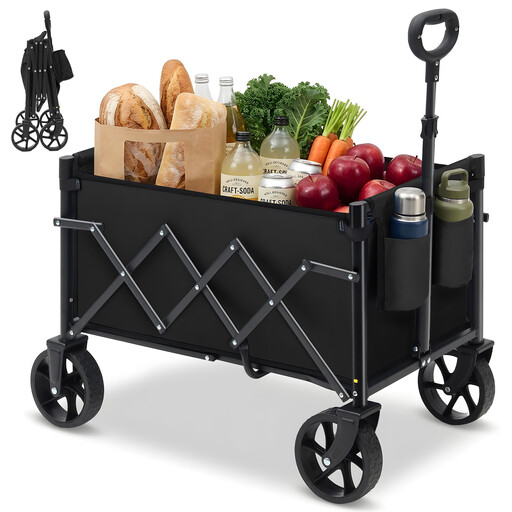
Why it suits this profile: Weighing 4.8 kg, this lightweight wagon is designed for shopping, picnics and everyday use. Its one-handed folding mechanism and adjustable handle make it easier to store and move around.
Its 80 kg load capacity is clearly stated, so you won’t judge the trolley on capacity alone. The wheels can be removed for storage.
Weighs 4.8 kg; maximum load of 80 kg; freestanding design; two-year warranty according to the product information.
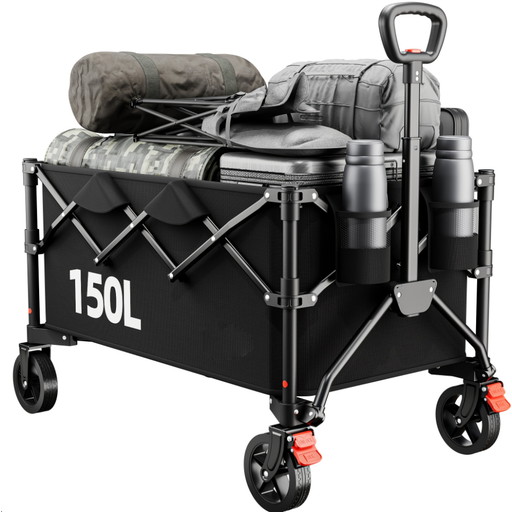
Why it suits this profile: This folding transport trolley combines a 150-litre capacity with an alloy steel frame. Its four-sided folding design, detachable wheels and brakes make it a good fit for regular gardening or camping.
The specifications state both the 120 kg load capacity and the 150-litre volume. This lets you assess weight and capacity separately.
120 kg load capacity; 150-litre volume; off-road wheels with brakes; detachable wheels and fabric bag.
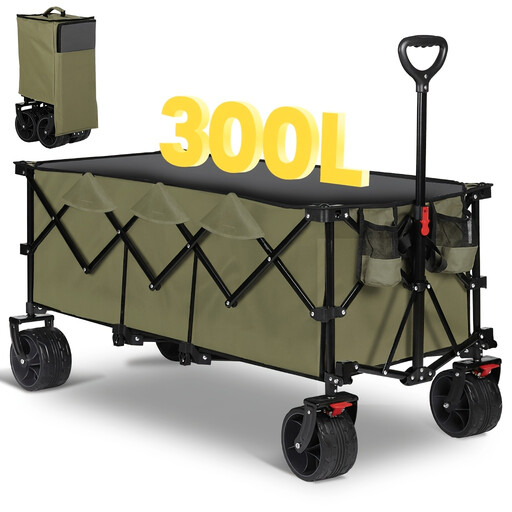
Why it suits this profile: With a stated 300-litre capacity and 200 kg load limit, this trolley is designed for bulky loads such as gardening tools, camping equipment or sports gear.
The wide 7-inch tyres, folding lock and brakes are listed separately. Use the brakes as a parking brake and distribute heavy loads evenly.
Stated load capacity of 200 kg; 300-litre storage capacity; wide tyres; two cup holders; two-year warranty according to the product information.
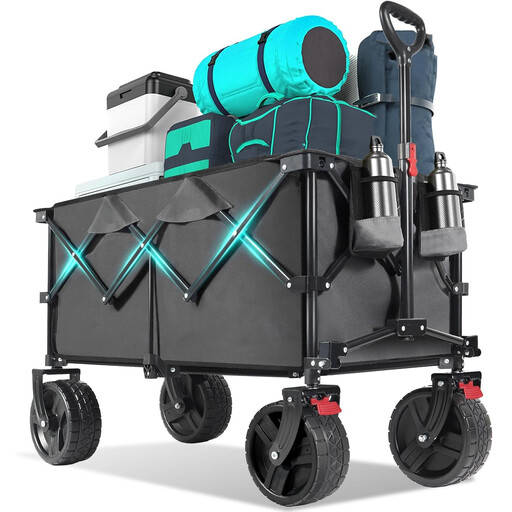
Why it suits this profile: This festival trolley has a 200-litre capacity, 7-inch-wide all-terrain tyres, an adjustable handle and a stated load capacity of 150 kg. It’s well suited to bulky luggage on grass or unpaved paths.
The product information lists both the capacity and maximum load. Tie-down straps help secure your load, but the weight should still be distributed evenly.
200-litre capacity; maximum load of 150 kg; wide all-terrain tyres; adjustable handle; tie-down straps to secure luggage.
We’ve put together a complete, up-to-date list of products that meet these strict selection criteria and the applicable European safety regulations.
Empty the load compartment and place the trolley on a flat surface. First, check how to release the frame and keep your fingers away from the hinges. Don’t fold the trolley completely until the handle, wheels and any brakes are free from tension. Always follow the instructions for your specific model.
Its lifespan depends on the load, the surface it’s used on, moisture and maintenance. Don’t exceed the stated load capacity, clear sand and mud from the wheels, and let the fabric bag dry before putting the trolley away. Regularly check the seams, wheel attachments, brakes and frame joints.
Not necessarily, but a larger model is often heavier to transport. Unlike an electric transport vehicle, there are no fuel or charging costs; the main running costs are usually maintenance or replacing wheels and parts. So there’s no need to choose a 300-litre wagon if you’ll only be carrying shopping or light luggage in practice.
