
Vandaag of morgen in huis

Kwaliteit gegarandeerd

Welkomstaanbiedingen ontgrendelen: GRATIS bezorging | Tot 80% korting | Gratis 30 dagen JoyPlus-proefperiode
Download de app
A folding trolley can make it much easier to move shopping, camping gear, garden waste or moving boxes. But the range can be less straightforward than it first appears. A trolley with a high load capacity is not necessarily suitable for a small car, and large wheels are no help if the base or frame is not sturdy enough.
So don’t focus only on the price or an eye-catching product photo. The following points will help you avoid a costly mistake.
A stated capacity of, say, 150 kg tells you how much weight the manufacturer specifies under certain conditions. It doesn’t mean the trolley will be equally stable on every surface. An uneven load, a slope or soft ground can make it harder to pull.
So check:
For a hand trolley with a large load capacity, the volume in litres is just as important as the number of kilos. A compact sack truck, for example, is suitable for boxes, but not for loose blankets, beach gear or garden waste.
Some models only fold the loading area, while the wheels or handles still stick out. So measure the folded width and height before buying a folding transport trolley for a shed, cupboard or boot.
Pay attention to the folding mechanism, too. A quick-fold mechanism is handy, but the hinges must lock securely during use. Keep your fingers away from moving parts and check that the frame is fully unfolded before you set off.
Small, hard wheels roll smoothly on a flat shop floor, but are less comfortable on cobbles, grass or gravel. Wide tyres or off-road wheels are usually more practical for a folding trolley for camping and the garden.
A transport trolley with a brake can be useful when you need to park it temporarily on a gentle slope. A brake won’t stop a heavily loaded trolley from tipping over. Always park it securely and follow the manufacturer’s safety instructions.
Start by thinking about what you’ll be carrying:
A stated load capacity isn’t an invitation to load the trolley to its limit. Heavy items should sit low and in the centre. Also check whether the stated weight applies to hand trolley mode or platform mode.
A lightweight transport trolley is easier to take with you, but a very light model often has a smaller loading plate or lower load capacity. An aluminium sack truck weighing 3.5 kg, for example, is handy for parcels and crates, while a large camping trolley weighs more because of its frame, wheels and fabric loading area.
Measure the space where you plan to store the trolley. A stated folded width of 5,7 cm means something very different for a sack truck than the folded dimensions of a wide beach trolley.
Many folding wagons have a metal frame and 600D Oxford fabric. This fabric is suitable for everyday outdoor use, but “water-repellent” doesn’t automatically mean waterproof. Let the loading area dry before putting it away if it gets wet.
Removable wheels or a detachable bag make cleaning easier. If you use the trolley on sand, mud or gravel, this is no small detail: dirt can build up around the axles, hinges and brakes.
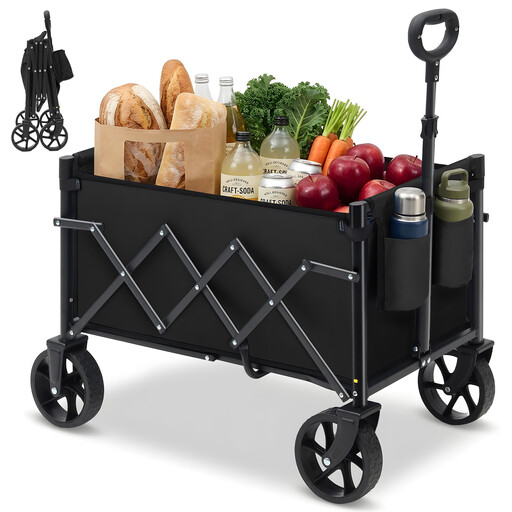
Why it suits this type of user: This model is designed for shopping, picnics and everyday transport. With a stated weight of 4,8 kg and a load capacity of 80 kg, it’s a practical camping trolley for anyone looking for a straightforward model.
The specifications state both the trolley’s own weight and its maximum load capacity. It folds down compactly, and the wheels can be removed for storage.
4,8 kg own weight; stated load capacity of 80 kg; stands upright on its own and folds with one simple action.
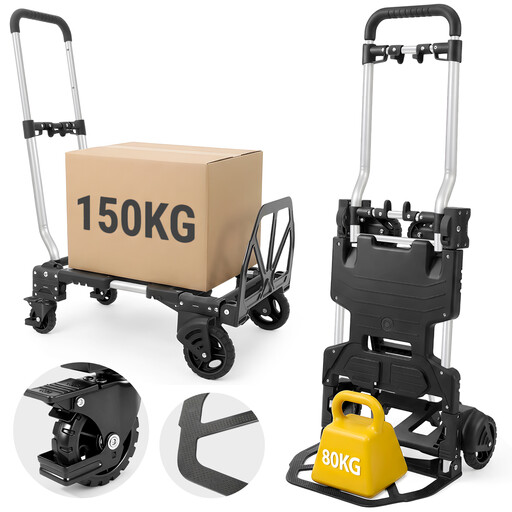
Why it suits this type of user: Switching between sack truck and platform trolley mode makes this model suitable for both boxes and wider loads. It’s a good choice for households that want one folding transport trolley for several different tasks.
The load capacities are specified for each mode: 80 kg as a hand trolley and 150 kg as a platform trolley. The parking brake and adjustable handle are listed separately.
2-in-1 design; 7 kg own weight; parking brake; handle with multiple height settings.
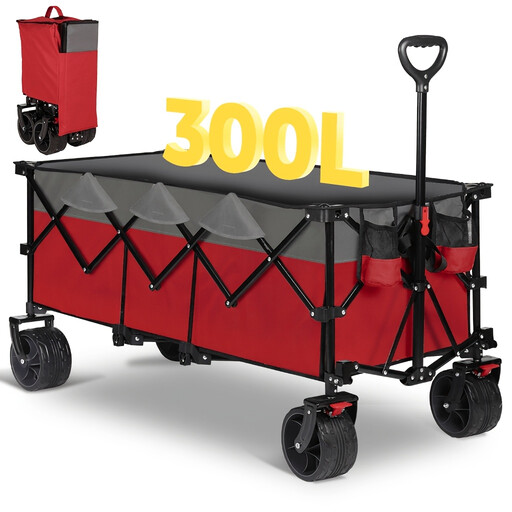
Why it suits this type of user: With a stated capacity of 300 litres and a load capacity of 200 kg, this wide wagon is designed for bulky camping equipment, garden tools and larger loads.
The product information lists the capacity, maximum weight and wheel size separately. It also states that this trolley is not intended for carrying people or children.
300 litres capacity; stated load capacity of 200 kg; wide 7-inch tyres; folding frame.
We’ve put together a complete, up-to-date list of products that meet these strict selection criteria and the applicable European safety regulations.
Fully unfold the frame, fit any wheels according to the instructions and check all the locks. Test the handle and brake before loading the trolley. Distribute the load across the base and stay within the stated maximum weight.
Its lifespan depends on the weight it carries, the surface it’s used on and how well it’s maintained. Regularly clear sand and mud from the wheels and hinges. Let fabric parts dry before folding the trolley, and store it somewhere dry. Check the frame, seams, axles and brakes before each use.
Maintenance is usually limited to cleaning, drying and a visual check. Models with removable wheels or a detachable bag are easier to clean. Don’t use the trolley above its stated load capacity: overloading can put unnecessary strain on the frame, wheels and folding mechanism.
