
Vandaag of morgen in huis

Kwaliteit gegarandeerd

Welkomstaanbiedingen ontgrendelen: GRATIS bezorging | Tot 80% korting | Gratis 30 dagen JoyPlus-proefperiode
Download de app
A folding trolley with wheels is handy for shopping, parcels, camping gear and household items. However, not every transport trolley is equally practical. For example, a high maximum load capacity means little if the wheels get stuck on a kerb, while a compact trolley can be awkward if its load space is too small.
When comparing models, look out for these three common pitfalls:
Don’t just look at the highest figure in the product title. A folding sack truck carries loads differently from a folding pull-along wagon with a deep load compartment. So check:
For example, a compact hand truck weighing 3.5 kg with a stated capacity of 80 kg is mainly designed for boxes, crates and parcels. A larger camping wagon offers more space, but its size also means it needs more room for storage and transport.
For everyday use in the Netherlands, wheels with a decent diameter, a stable axle and a comfortable handle are important. TPR wheels with bearings may roll smoothly according to the product specifications, but the results also depend on the surface and the load.
A trolley with a brake is handy when you’re working on a slope, in a garage or beside a market stall. Check the difference between:
For a shopping trolley, quiet wheels and a lightweight design are often more important than a very high load capacity. Stability matters more for a transport trolley used for crates or boxes.
An aluminium trolley is generally lightweight compared with a steel frame. That makes it easier to take in the car or store in a shed. Check the hinges, wheel attachments and loading plate too, as these parts come under a lot of strain during use.
An adjustable telescopic handle lets you change the height. Check how many height settings are available, rather than relying on the term “ergonomic”. Also check the folded dimensions. A model that folds down to just a few centimetres wide is easier to fit behind a cupboard or in a narrow hallway.
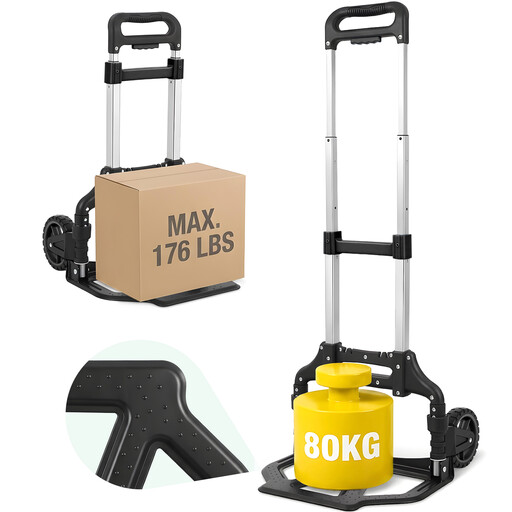
Why it suits this type of user: This model is ideal if you want to move boxes, crates or parcels without bringing a heavy trolley into your home. According to the product specifications, it weighs 3.5 kg and the handle can be set to 63, 90 or 100 cm.
The product specifications state a load capacity of 80 kg, an automatic wheel-folding feature and a folded width of 5.7 cm. Always check the maximum load and locking mechanism before use.
Lightweight aluminium frame, three height settings and TPR wheels with precision ball bearings, according to the product specifications.
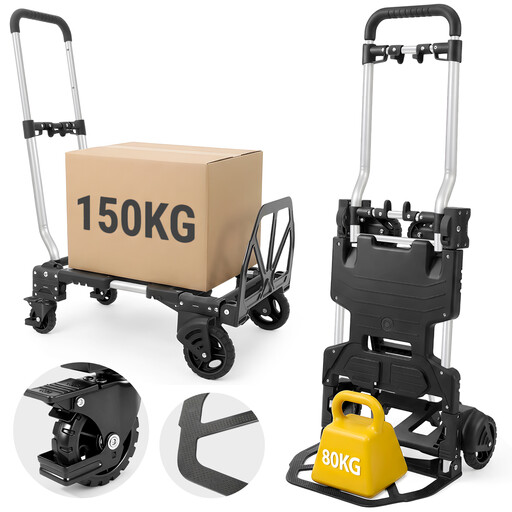
Why it suits this type of user: This model is a good fit for households, small business owners and movers who want to use one trolley in two different modes. According to the product specifications, it carries 80 kg as a sack truck and 150 kg as a platform trolley.
The two load capacities are listed separately. The integrated parking brake makes it easier to keep the trolley still, but don’t rely on the brake instead of a stable surface.
2-in-1 design, adjustable handle, 360° swivel wheels and one-step folding, according to the product information.

Why it suits this type of user: This camping wagon is designed for campers, garden enthusiasts and shoppers who mainly need extra space. The product specifications list an internal capacity of 127 litres and a maximum load of 200 kg.
The load space and maximum load are listed separately. Unfold the wagon fully and check that it is locked before loading it. Use it on a stable surface.
Folding design, spacious load compartment and dual brake, according to the product information. Suitable for camping, the garden, the beach and shopping.
We’ve put together a complete, up-to-date list of products that meet these strict selection criteria and the applicable European safety regulations.
Unfold the frame fully and check that all the hinges and locks are secure. If your model has detachable wheels, fit them first according to the instructions. Place heavy items as low as possible and distribute the weight across the loading surface. Test the trolley with a light load first, especially if you’ll be using it on a pavement, slope or uneven surface.
Its lifespan depends on the weight it carries, the surface it’s used on and how well it’s maintained. Remove sand and dirt from the wheels and folding joints. Dry a camping wagon after using it outdoors, and store an aluminium trolley or shopping trolley in a dry place. Regularly check that the wheel fittings, handles and hinges are secure. Never exceed the stated load capacity.
The direct running costs are usually limited to maintenance and replacing wheels or fittings when needed. A trolley with a higher load capacity may be heavier, while a lightweight shopping trolley is easier to carry. So choose one to suit your usual load, storage space and the surfaces you’ll use it on. The right trolley helps you avoid paying for capacity you rarely need.
