
Vandaag of morgen in huis

Kwaliteit gegarandeerd

Welkomstaanbiedingen ontgrendelen: GRATIS bezorging | Tot 80% korting | Gratis 30 dagen JoyPlus-proefperiode
Download de app
A folding trolley is handy for camping, gardening, festivals, shopping and days at the beach. But a transport trolley can sometimes disappoint in practice. A large capacity, for example, doesn’t automatically mean you can safely carry heavy items. And wide wheels aren’t always easy to steer along a narrow garden path.
So pay attention to the construction and specifications, not just words such as “extra strong” or “off-road”. Below, you’ll find out which features matter and which models suit different uses.
A 150-litre trolley offers plenty of space, but that doesn’t mean you can load it with 150 kg. Litres indicate volume; kilograms indicate the maximum load capacity. Heavy bags of compost, stones or tools therefore call for a model with a suitable load capacity and a sturdy frame.
Also check for conflicting information in the product title and specifications. For some models, a figure in the title differs from the load capacity in the technical description. Use the most specific product specification to guide your purchase, and leave a safety margin. Never exceed the stated limit.
A trolley with all-terrain wheels and wide PVC or plastic wheels may roll over grass, gravel and campsite paths better than a small shopping trolley. But even a wide set of wheels will meet resistance on soft sand. So check:
Wide wheels are useful on a beach trolley, but a compact folding hand trolley with small wheels is mainly suited to paved paths and short distances.
An folding transport trolley must be fully opened and locked into place before you load it. Check that the frame is securely fixed and stable when unfolded, and that the handle can be adjusted to a comfortable height. A trolley that folds away compactly but is difficult to clean can quickly become impractical for use at the beach or in the garden.
A removable bag or wheels make maintenance easier. Always let a wet fabric basket dry before storing the trolley. This helps prevent damp and unpleasant smells.
Start by choosing a trolley to suit the loads you typically carry. For shopping, a picnic or light camping gear, 56 to 80 litres may be enough. For gardening tools, tents and cool boxes, 113 to 150 litres may be more suitable. A large transport trolley with a capacity of around 200 litres is especially useful if you want to carry lots of bulky items at once.
Also compare the external dimensions. A trolley around 90 cm long won’t fit in every car boot when folded. So check the folded dimensions listed on the product page.
A frame made of alloy steel or steel tubing provides a sturdy base. The fabric determines how easy the trolley is to clean. Product information often lists 600D Oxford fabric with a PE or PU coating for its combination of durability and some water resistance. That doesn’t mean the trolley is waterproof: don’t leave it out in the rain for long, and store it somewhere dry.
An adjustable or telescopic handle makes pulling more comfortable for people of different heights. A trolley with a brake can help keep it still when parked. Always use the brake as instructed in the manual, and don’t rely on it as the only safeguard on a steep slope.
360° swivel wheels improve manoeuvrability on flat surfaces. On gravel, grass or a sloping path, stability matters more than simply having a tight turning circle. Distribute the load evenly and place heavy items as low as possible.
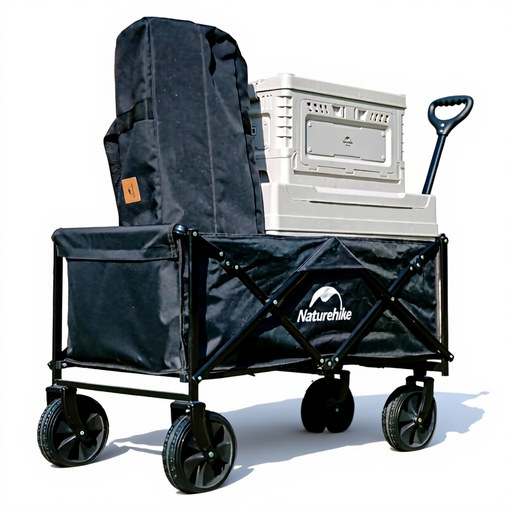
Why it suits this profile: According to the product specifications, this garden trolley has a capacity of 113 litres, an adjustable handle and a stated maximum load capacity of 100 kg. It’s a good choice for garden supplies, plants and camping gear without stepping up to a very large trolley.
The capacity and stated load limit are listed separately. Always check the current product page before use, as the product title and description may give different load limits.
113-litre capacity, folding frame, adjustable handle and a weight of 7.5 kg according to the product specifications.
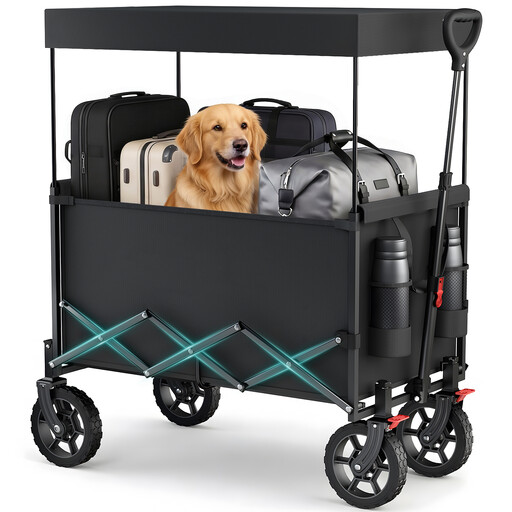
Why it suits this profile: For campers and families carrying lots of gear, this camping trolley offers a 150-litre capacity, off-road wheels, an adjustable telescopic handle and a removable canopy.
The wheels and canopy are removable, making cleaning and storage easier to manage. The stated brakes are designed to keep the trolley still; load it evenly and don’t use it to transport people.
150-litre capacity, stated load limit of 150 kg, removable canopy and a two-year warranty according to the product information.
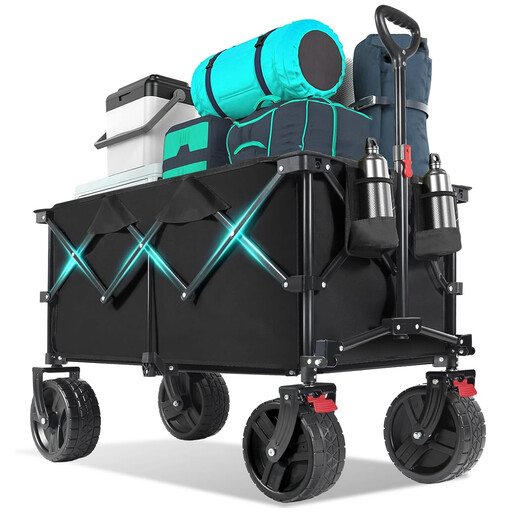
Why it suits this profile: This festival trolley is designed for bulky loads such as tents, crates and outdoor gear. The product information lists a 200-litre capacity, extra-wide all-terrain wheels, 360° wheels and a brake.
The wheel specifications are clearly stated. However, note the difference between the product title and the technical details: the product specification gives a load limit of 150 kg. Use that figure as your guide.
200 litres of storage space, wide all-terrain wheels, adjustable handle and a folding frame that requires no assembly, according to the product information.
We’ve put together a full, up-to-date list of products that meet these strict selection criteria and the applicable European safety regulations.
Fully unfold the frame, check all the locks and attach the handle according to the instructions. Then check that the wheels turn freely and distribute the load evenly. If your model has a brake, test it before loading the trolley heavily.
Its lifespan depends on the weight of the load, the surface and how well you maintain it. Remove sand and mud after use, dry the frame and fabric basket, and regularly check the wheel fixings and hinges. Store the trolley folded and somewhere dry. Don’t use it if the frame, fabric or any wheel is damaged.
Maintenance usually involves cleaning and drying the trolley, and checking its moving parts. Removable wheels and a detachable bag make this easier. A folding trolley with wheels doesn’t use fuel or electricity, so the main running costs are usually replacement parts such as wheels or fixings.
