
Vandaag of morgen in huis

Kwaliteit gegarandeerd

Welkomstaanbiedingen ontgrendelen: GRATIS bezorging | Tot 80% korting | Gratis 30 dagen JoyPlus-proefperiode
Download de app
A folding trolley is handy for camping, the garden, the market, sports clubs or a day at the beach. You can use it to transport tents, shopping, garden waste or festival essentials, then store it in the shed or car boot. But a high load capacity doesn’t tell you everything. A trolley might look spacious, but prove difficult to steer, become unstable on grass or take up too much storage space.
So don’t focus only on the price or claims such as “extra strong”. Check the specific features and any restrictions on how the trolley can be used.
A claim such as folding trolley with a 200 kg capacity sounds appealing. However, it doesn’t mean you can safely move 200 kg over every type of surface. The maximum load capacity applies only when the trolley is fully opened, loaded evenly and used on a suitable surface.
Heavy items placed at the top can raise the centre of gravity. This can cause the trolley to tip on a slope or uneven ground, even when the total weight is below the limit.
A large-capacity trolley might offer, for example, 200 or 300 litres of space. But a large loading area doesn’t necessarily mean a high load capacity. Check both figures separately:
A folding wagon with a high capacity in litres is best for bulky, relatively light items. For paving slabs, wood or heavy sacks, the permitted load is more important.
A trolley with all-terrain wheels may roll better over grass, gravel or sand than a model with small, narrow wheels. However, there can be a big difference between wide tyres, swivel wheels and fixed wheels. Check the wheel size and whether they swivel, as well as the surfaces the manufacturer says the product is suitable for.
A trolley with a brake is particularly useful when you’re parking. On some models, the brakes aren’t designed to slow down a moving trolley with a heavy load. So don’t use the brake instead of pulling the trolley under control, and take care on slopes.
A steel or alloy steel frame provides a sturdy base. The fabric then determines how well the basket stands up to moisture, abrasion and dirt. 600D Oxford fabric with a PE coating is used on several models. This is a verifiable material specification, but it doesn’t guarantee that the trolley is fully waterproof.
After using the trolley in the rain or on wet grass, it’s a good idea to let the fabric and frame dry before folding it away. This helps reduce moisture and dirt around the folding points.
A good folding hand trolley should not only open quickly but also lock securely. Before loading it, check that the frame is fully opened and locked in place. Also consider:
For a flat, a lightweight model weighing around 5 kg is practical. For intensive gardening, a heavier frame with larger wheels may make more sense.
Four swivel wheels turn easily on a flat surface, but can be less predictable on gravel or grass. Wide all-terrain wheels often provide better contact with those surfaces. Also consider the position of the front wheels and the turning circle: a long trolley with a large basket needs more room to turn.
If you’re looking for a garden transport trolley, it’s worth considering mud, branches and uneven paths. For camping or festivals, wide wheels, an adjustable handle and a removable fabric basket are often useful features.
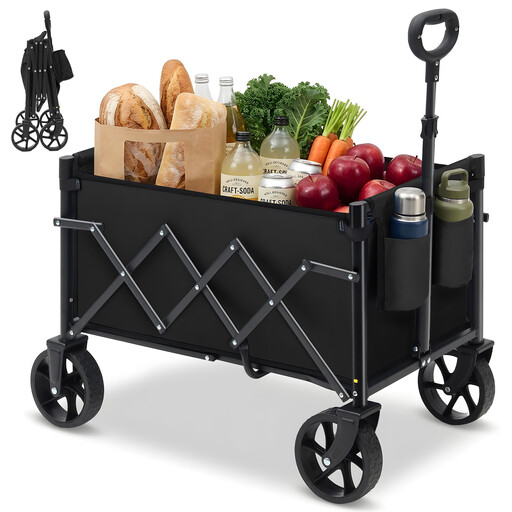
Why it suits this profile: Weighing just 4.8 kg and featuring a one-handed folding mechanism, this folding hand trolley is ideal for shopping, picnics and light camping gear.
Its stated load capacity of 80 kg is clearly separate from its low weight. This makes the trolley suitable for everyday, lighter loads rather than excessively heavy ones.
Weighs 4.8 kg, folds compactly, has removable wheels and an adjustable handle with three positions.
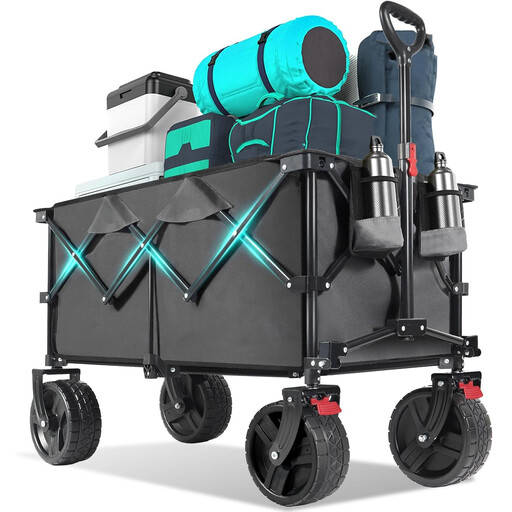
Why it suits this profile: With a capacity of 200 litres, wide all-terrain tyres and a brake, this trolley is a good fit for campers and festival-goers who regularly transport larger loads.
The product details state both the 200-litre capacity and the 150 kg load capacity. This makes it easier to compare with models that highlight only their large volume.
600D Oxford fabric, alloy steel frame, four-sided folding design, wide all-terrain wheels and an adjustable handle.
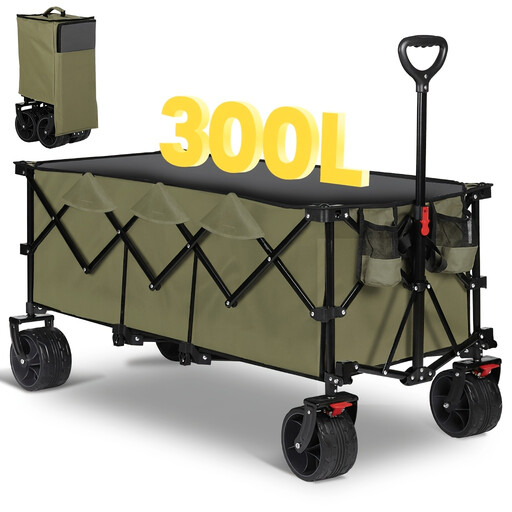
Why it suits this profile: This model is designed for heavy and bulky loads, such as camping gear, garden tools or equipment for frequent outdoor use.
The stated load capacity of 200 kg and capacity of 300 litres are listed separately. Load the trolley evenly and always follow the safety instructions.
300-litre capacity, 7-inch-wide tyres, brakes, four-sided folding mechanism and two cup holders.
We’ve put together a complete, up-to-date list of products that meet these strict selection criteria and the applicable European safety regulations.
Your folding trolley will last longer if you:
Also check that the trolley will fit in your storage space, car or lift. Even when folded, a model with a long loading area can still take up quite a lot of room.
Fully open the frame according to the product instructions and check that all the locks are secure. Then put the fabric basket and handle in the correct position. Test the trolley while empty first, then load it evenly.
That depends on the load, surface, care and storage. Regular use on gravel or mud puts more strain on the wheels than smooth paving. Cleaning it when dry, avoiding overloading and storing it in a dry place all help to reduce wear.
Usually not. A damp cloth, removing dirt from the wheels and periodically checking the hinges, tyres and brakes are generally enough. Always follow the care instructions for your specific model.
