
Vandaag of morgen in huis

Kwaliteit gegarandeerd

Welkomstaanbiedingen ontgrendelen: GRATIS bezorging | Tot 80% korting | Gratis 30 dagen JoyPlus-proefperiode
Download de app
A folding transport trolley can be useful for shopping, gardening, camping, festivals or a day at the beach. Yet many people buy a trolley that disappoints in practice. The capacity turns out to be smaller than expected, the wheels get stuck on uneven ground or the folding mechanism still takes up a lot of space.
With these points to consider, you can compare a folding beach trolley, collapsible trolley with wheels or folding hand trolley based on verifiable features rather than eye-catching marketing claims.
A 200-litre trolley may be spacious, but that does not automatically mean you can transport 200 kg in it. Capacity is expressed in litres, while the maximum load capacity is stated in kilograms. A large camping trolley with a soft fabric compartment may offer plenty of volume but still have a lower weight limit.
Therefore, always check both values. Also check whether the load capacity applies to an evenly distributed load. Heavy items placed in one spot can affect stability.
Small, narrow wheels are often suitable for flat floors, but less practical on grass, sand, gravel or cobbles. For a beach trolley, garden trolley or camping trolley, wider wheels and sturdy wheel mounts are usually more relevant than simply counting the wheels.
A swivelling front wheel makes manoeuvring easier, but check whether the construction can also be locked. With a heavy load, too much play can make pulling uncomfortable.
Check the dimensions when folded. Some models only fold the fabric compartment, while the frame, handle or wheels still take up a relatively large amount of space. For storage in a Dutch shed, boot or utility cupboard, the folded thickness, length and weight are important details.
Also check whether the trolley can be locked securely when fully folded. A loose folding mechanism could collapse unexpectedly while loading or moving the trolley.
Choose the load capacity based on how you intend to use the trolley:
A specification such as 200 kg transport trolley is not an invitation to load the trolley to its maximum every time. Take thresholds, slopes and uneven weight distribution into account. Never use a trolley to transport people or children unless the manufacturer explicitly provides for this safely.
A steel or aluminium frame offers a different balance of weight and strength from a lightweight plastic frame. With fabric compartments, you will often see 600D Oxford fabric, a relatively durable polyester weave. This alone does not mean that the compartment is waterproof. A coated product may offer better protection against splashes, but allow a folding transport trolley to dry after use before storing it.
A removable fabric compartment is practical when transporting sand, mud or garden waste. Check whether the base is supported; without sufficient base support, a heavy load may sag.
Look out for:
According to the product descriptions of some models, they are suitable for a range of terrains. Treat this as information from the seller and adapt usage to the load, slope and ground conditions. Check the wheels, connections and locking mechanism before every trip.
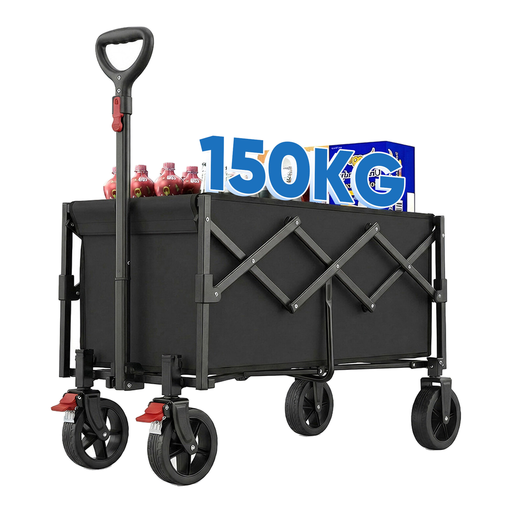
Why it suits this profile: This compact folding hand trolley is a straightforward choice for shopping, small gardening trips and transporting items in the car. The stated capacity is 80 litres, while the maximum load capacity in the product information is 150 kg.
The product details state both the volume and the load capacity. The removable wheels and fabric compartment make cleaning easier.
600D Oxford fabric, 80-litre capacity and a stated net weight of 5.8 kg.
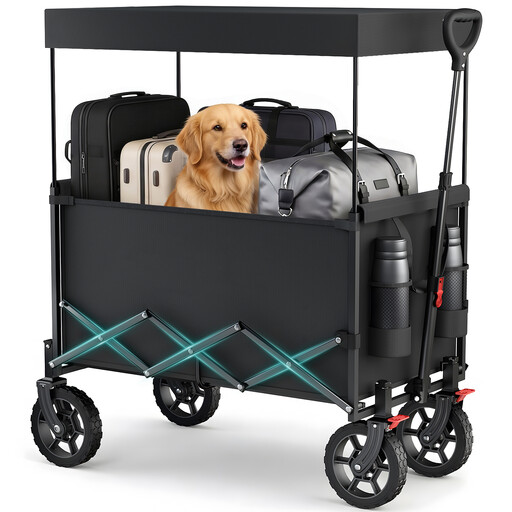
Why it suits this profile: The combination of 150 litres, a telescopic handle, brakes and a removable canopy is well suited to campers and families looking for extra protection from the sun or rain.
The specifications state the 150 kg load capacity rather than only describing a spacious compartment. The brakes help keep the trolley in place when stationary.
Dimensions of 97 × 51 × 95.5 cm, off-road tyres and a two-year warranty according to the product description.
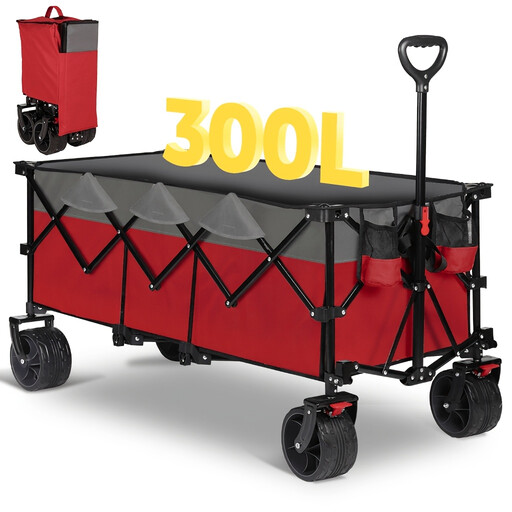
Why it suits this profile: This model is designed for heavy, bulky loads such as gardening tools, camping equipment and festival gear. The product listing states a capacity of 300 litres and a load capacity of 200 kg.
The stated capacity and weight limit are listed separately. Wide 7-inch tyres, brakes and a metal frame are verifiable features for heavy-duty use.
300 litres of storage space, a stated load capacity of 200 kg, wide tyres and a four-way folding mechanism.
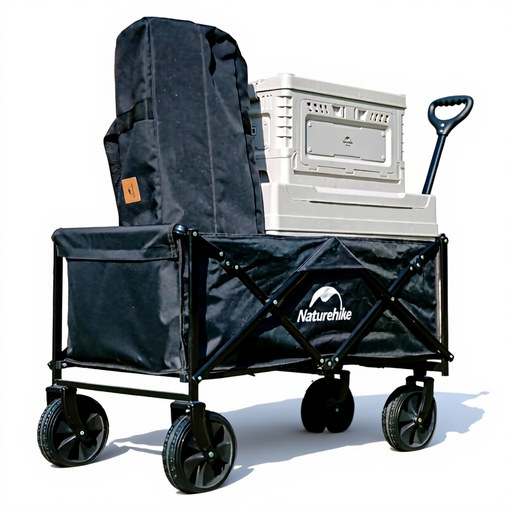
Why it suits this profile: The combination of 113 litres, an adjustable handle and a stated load capacity of 100 kg is practical for plants, compost, tools and camping equipment.
The product information gives specific dimensions of 85 × 47.5 × 101 cm and recommends checking the wheels and connections before use.
Folding design, steel frame, adjustable handle and 113-litre capacity according to the product listing.
We have put together a complete, up-to-date list of products that fully meet these strict selection criteria and the applicable European safety regulations.
Unfold the frame fully and check that all locks are securely fastened. If necessary, fit the wheels according to the instructions. Then check the handle, wheel mounts and any brakes. Place heavy items low down and distribute the weight across the base.
Its lifespan depends on the load weight, ground conditions, moisture and maintenance. Wipe the frame and wheels clean, allow a fabric compartment to dry completely and store the trolley somewhere dry. Regularly check the seams, tyres, axles and hinge points. Do not exceed the stated load capacity.
Most models do not need fuel or electricity. Ongoing maintenance mainly involves cleaning, drying and checking the wheel and frame connections. With intensive use, you may need to clean the wheel axles or lightly lubricate them according to the product instructions.
