
Vandaag of morgen in huis

Kwaliteit gegarandeerd

Welkomstaanbiedingen ontgrendelen: GRATIS bezorging | Tot 80% korting | Gratis 30 dagen JoyPlus-proefperiode
Download de app
Lifting a full shopping bag, moving a crate of drinks along the street or bringing a parcel home: a folding shopping trolley can make these tasks far more manageable. However, many models look very similar. A low price says little about stability, while a large load capacity does not automatically mean that the trolley is pleasant to use.
Pay particular attention to the construction, the wheels and how the bag is protected. Below, you can read about the pitfalls that are often overlooked, which specifications make a practical difference and which type of wheeled shopping trolley suits your situation.
A manufacturer may state a high load capacity, but practicality also depends on the base, wheel axle and weight distribution. A narrow base with a heavy bag can tip over more easily. Check whether the load capacity is clearly stated and whether it applies to the bag, the frame or the hand truck function.
For everyday shopping, a bag of 25 to 38 litres is often sufficient. If you also transport boxes, crates or bottles of water, it may be better to choose a model with a separate hand truck function.
A shopping trolley with stair-climbing wheels can help with kerbs and steps, but you still need to tilt the trolley correctly and control the weight. Check whether the wheels are suitable for your type of stairs and the surface. A shopping trolley with stair-climbing wheels is not the same as a device that takes heavy loads upstairs without any effort.
For flat shopping streets, supermarket aisles and cycle paths, standard EVA or plastic wheels are often more practical and lighter.
An Oxford fabric bag with a water-repellent coating can protect against dirt and light rain. This does not mean that its contents will remain dry for a long time in heavy rain or if the bag is submerged. Look for a protective flap, zipped compartments and how the bag is attached to the frame.
A shopping trolley with a cool bag or insulated compartment is useful for chilled products, but check that the compartment is genuinely insulated and how much space it takes up.
The right choice depends on your route:
Also pay attention to the wheel axle, attachment points and the width of the base. A sturdy axle and a low centre of gravity contribute to a more stable shopping trolley for older people, students and commuters.
An aluminium frame is usually lighter than steel. Steel, on the other hand, can offer greater structural rigidity, depending on the tube diameter, joints and base construction. Therefore, always compare:
A lightweight 1.15 kg shopping trolley is easy to put in a car or storage space, but according to the product information it has a hand truck capacity of 20 kg. A heavier model may carry more, but is less convenient if you need to climb stairs every day.
For compact storage, the folded size is not the only relevant factor. Also measure the space behind a door, in a utility cupboard, under a bed or in the boot. A model that folds flat generally takes up less space than a trolley that only folds lengthways.
A 2-in-1 shopping trolley can offer added value: use it as a shopping trolley with the bag attached and as a hand truck without it. Check whether the bag can be removed easily and whether the bare loading platform is large enough for boxes or crates.
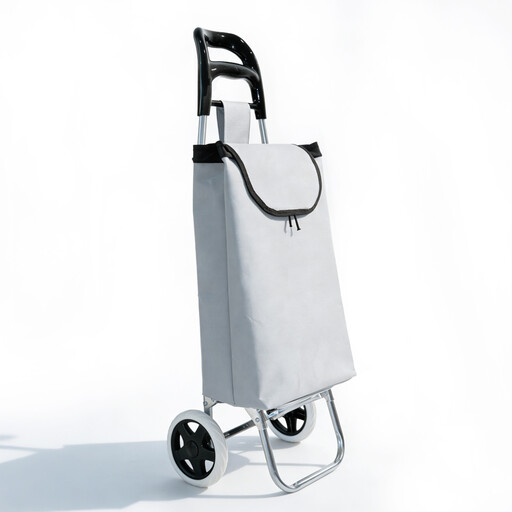
Why it suits this profile: According to the product information, the frame weighs 1.15 kg and the bag has a capacity of 25 litres. This makes the model suitable for light everyday shopping and easy to carry with you.
The hand truck function’s load capacity is stated as 20 kg. The bag has a protective flap and water-repellent Oxford fabric, avoiding confusion about the coating’s purpose.
1.15 kg frame; 25L bag; 2-in-1 use; EVA wheels according to the product information.
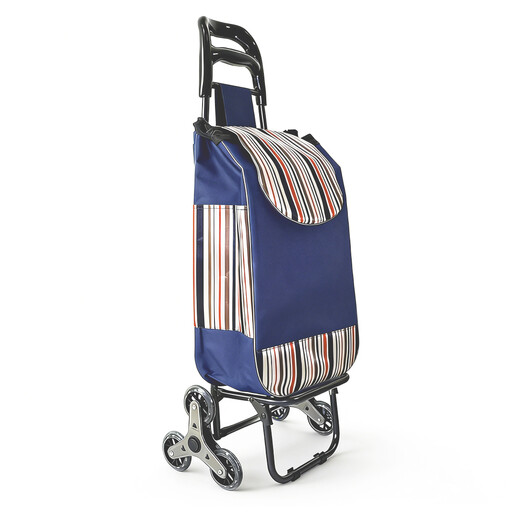
Why it suits this profile: For households with larger shops or routes involving thresholds, kerbs and stairs, this model offers a spacious bag and a six-wheel stair-climbing system.
The product information states both a bag capacity of 38 litres and a hand truck capacity of 30 kg. This clearly distinguishes between bag use and the transport function.
38L Oxford bag; six PU wheels; protective flap; folding frame.
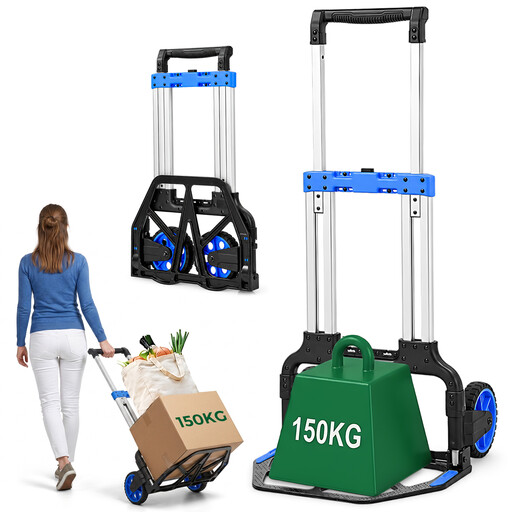
Why it suits this profile: If you mainly transport boxes, crates, garden equipment or removal boxes, a folding transport trolley may be more useful than a wheeled shopping bag.
The product information states a maximum load of 150 kg, an anti-slip loading platform and instructions for even weight distribution. Do not exceed the stated limit.
Stated load capacity of 150 kg; aluminium frame; adjustable handle at 77 or 107 cm; TPR wheels.
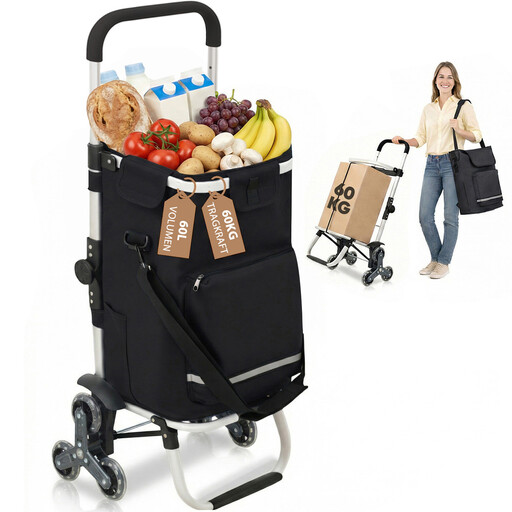
Why it suits this profile: The combination of a 60-litre capacity, a cool section and three functions is ideal for larger shops, picnics and other trips where extra space is useful.
The product information separately lists the bag, hand truck function and removable shoulder bag. The maximum load is stated as 60 kg; always secure the load properly.
60L capacity; aluminium frame; PU stair-climbing wheels; insulated cool compartment; adjustable handle.
We have put together a complete, up-to-date list of products that fully meet these strict selection criteria and the applicable European safety regulations.
Not necessarily. Stair-climbing wheels are mainly designed for controlled manoeuvring over steps, thresholds and kerbs. The width of the staircase, the weight of the load and the surface determine how practical the system is. Use the trolley carefully, hold the handle firmly and do not exceed the stated load capacity.
Its lifespan depends on the frame, wheel axle, fabric and how it is used. Remove sand and hair from the wheels, check the fixings regularly and store the trolley in a dry place. Wash a removable bag according to the care instructions supplied; water-repellent fabric does not necessarily belong in the washing machine.
There are generally no fixed running costs. Possible expenses include replacement wheels, a damaged bag or wear to the folding mechanism. A model with standard components or clear maintenance advice may therefore be more practical in the long term. As well as the purchase price, compare the capacity, empty weight and expected frequency of use.
