
Vandaag of morgen in huis

Kwaliteit gegarandeerd

Welkomstaanbiedingen ontgrendelen: GRATIS bezorging | Tot 80% korting | Gratis 30 dagen JoyPlus-proefperiode
Download de app
A folding shopping trolley is handy for shopping, parcels and days out. But some models can disappoint in practice. A bag that’s smaller than expected, wheels that catch on pavements or a frame that’s awkward to fold are common reasons why a purchase doesn’t suit everyday use.
So don’t just look at the bag’s capacity or an attractive offer. Check the load capacity, wheel type and folded dimensions in particular. Below, you’ll find what to look out for and which models suit different needs.
A stated load capacity isn’t an invitation to always load the trolley to its limit. The weight should be distributed evenly, and the surface you’re using it on matters too. A shopping trolley with wheels designed for smooth shop floors isn’t automatically suitable for stairs, loose stones or sloping pavements.
Also check whether the stated weight applies to the bag, the frame or the trolley as a whole. For example, a 2-in-1 shopping trolley may have a different limit when you remove the bag and use the frame as a hand truck.
Some models only fold the bag, while the frame still takes up a lot of space. So measure the trolley when it’s folded. A flat-folding model may fit under a bed or in a cupboard; a folding camping trolley with a large frame needs more storage space.
Pay attention to the folding mechanism, too. Hinges should be easy to reach and shouldn’t jam because of sand, dust or a heavy load. Keep your fingers clear of moving parts when folding the trolley.
Two larger wheels are often enough for a short trip to the supermarket. If your route includes stairs, kerbs or cobbled streets, look for a stair-climbing shopping trolley with six wheels or a tri-wheel system. This design can make it easier to roll over obstacles, but it’s no substitute for taking care on a steep staircase.
For sand, grass or a campsite, wider off-road wheels are often a better choice. Also check whether the trolley has a brake for when it’s stationary on a slope or beside a market stall.
A small 20 to 25-litre shopping trolley is suitable for everyday shopping. A 60-litre model offers more room for a larger shop and can also be used as a transport trolley. If you’re carrying camping gear, gardening tools or several crates, you may need a large hand truck.
A 60 kg load capacity sounds generous, but the volume and stability determine how much of that capacity is practical to use. Heavy items should go at the bottom, as close to the wheel axle as possible. Always check the maximum load in the product information and don’t exceed it.
An aluminium frame is usually lightweight, making it a good choice if you need to lift the trolley regularly. Steel can feel heavier, but is also used in models with a sturdier frame. Check the joints, the base and how the bag attaches to the frame.
According to the product description, an Oxford bag with a water-repellent coating can protect against light rain and splashes. That doesn’t mean the bag is waterproof. An integrated cool compartment can be useful for chilled shopping, drinks or a picnic, but check whether it’s insulated rather than actively cooled.
An adjustable handle makes it easy to set the height to suit different users. A bag with a wide opening is easier to load than a narrow, deep one. For older people and those with limited mobility, low overall weight, a firm grip and easy folding are often more important than extra capacity.
If you also want to carry boxes or crates, consider a 2-in-1 shopping trolley or a folding transport trolley. These models have a removable shopping bag, leaving you with a hand truck or platform.
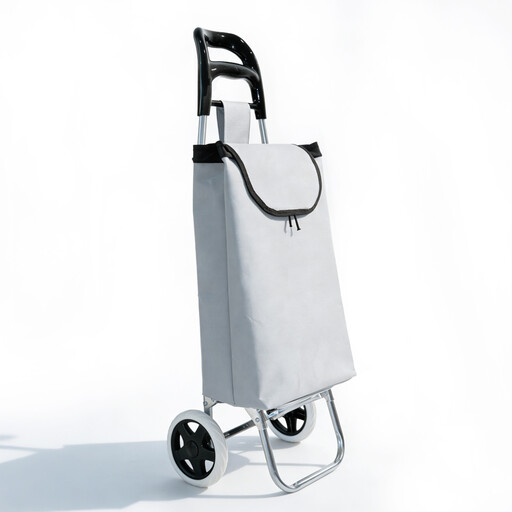
Why it suits this type of user: With a stated weight of 1.15 kg, this model is designed for anyone looking for a lightweight shopping trolley for the supermarket, market or public transport.
The product description specifies a 25L bag and a separate hand truck function with a 20 kg limit. This makes the capacity and usage limit clearer.
1.15 kg overall weight, 25L water-repellent Oxford bag and EVA wheels, according to the product information.
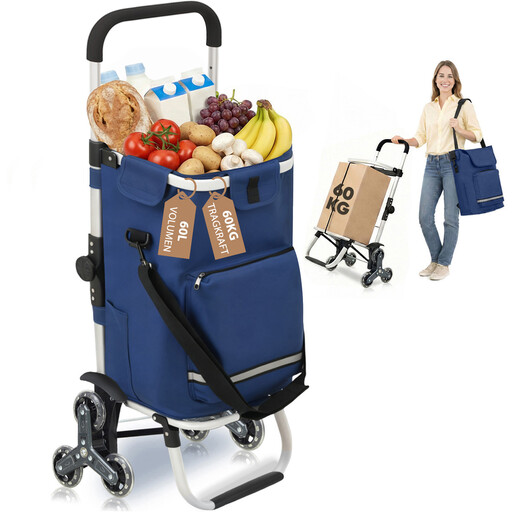
Why it suits this type of user: This 3-in-1 trolley is designed for anyone who wants to combine shopping, transporting goods and outdoor activities in one product.
The product specifications list a bag, a hand truck function and a shoulder bag separately. The maximum load of 60 kg is also stated, making it easier to compare.
60L capacity, six PU stair-climbing wheels, an adjustable handle and an insulated cool compartment, according to the product description.
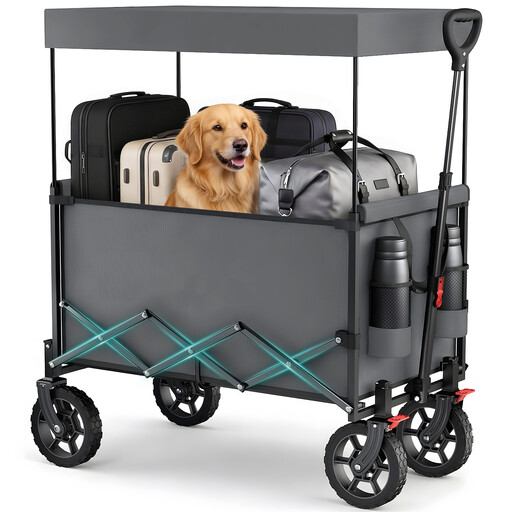
Why it suits this type of user: Its large capacity and stated load limit make it suitable for camping, picnics, gardening or carrying several items at once.
The product information states a 150L capacity and a maximum load of 150 kg, as well as the dimensions, brakes and removable wheels. Make sure this large trolley will fit in your storage space and suit your route.
150L capacity, stated load limit of 150 kg, off-road wheels with brakes and a removable canopy, according to the product description.
We’ve put together a complete, up-to-date list of products that meet these strict selection criteria and the applicable European safety regulations.
No. According to the product description, a six-wheel system can help with kerbs and steps, but you still need to guide the trolley. Check the width of your staircase, keep the load stable and don’t use a model beyond its stated load capacity.
Its lifespan depends on the load, the surface, moisture and maintenance. Wipe sand and dirt off the wheels, dry the bag before storing the trolley and check the hinges and attachment points regularly. A trolley that’s often pulled over cobbled streets is put under more strain than one used only in shops.
An insulated cool compartment usually doesn’t use electricity, but it only keeps items cool for a limited time. You may need cool packs for longer journeys. Check the compartment’s capacity, clean up any spills straight away and check whether the bag is water-repellent or fully waterproof according to the product information.
