
Vandaag of morgen in huis

Kwaliteit gegarandeerd

Welkomstaanbiedingen ontgrendelen: GRATIS bezorging | Tot 80% korting | Gratis 30 dagen JoyPlus-proefperiode
Download de app
A folding shopping trolley is handy for groceries, luggage and heavy items. However, models vary greatly in load capacity, wheel type and ease of use. A trolley that looks spacious in the shop can be difficult to manoeuvre at home or turn out to be too big for the cupboard.
Older people, city dwellers and those without a car in particular benefit from making the right choice. A folding shopping cart or transport trolley can also be practical for camping, gardening or a house move. When choosing, don't just focus on an appealing product title – pay attention to verifiable specifications instead.
A claim such as 60 kg load capacity doesn't mean you should always load the trolley with 60 kg. The surface, weight distribution and construction all affect how stable the cart remains. Heavy bottles at the bottom and lighter items on top generally create a lower centre of gravity.
Also check whether the load capacity refers to the bag, the frame or the whole trolley. For a shopping trolley for older people, a manageable load is often more important than the highest stated maximum.
A shopping trolley with stair wheels can help with kerbs and steps, but that doesn't mean every staircase can be tackled effortlessly or without risk. PU wheels with multiple contact points are designed for a different movement pattern than two standard wheels.
So look at the number of wheels, the material and the manufacturer's instructions. Hold the trolley securely on stairs and avoid overloading it.
With a shopping trolley that includes a cool bag, it's important to know how large the insulated compartment actually is. A cool bag doesn't automatically mean products will stay at a certain temperature for a long time. According to the product description, some models feature aluminium insulation; that's a material specification, not a guarantee of a specific cooling duration.
Also check the folded dimensions. A trolley may have a generous capacity but still take up too much space in a narrow hallway, cupboard or boot.
For a shopping trolley with 60 litre capacity, the difference between volume and load weight is important. Litres tell you how much space the bag offers; kilograms tell you how much weight can be carried according to the product specification.
Distribute the load evenly and don't exceed the stated maximum.
A trolley with wheels performs differently on paving slabs and tarmac compared to cobbles, sand or steps. PVC or PU wheels are suitable for many everyday surfaces, while wider tyres can offer more stability on larger transport wagons.
Bear in mind:
A wheel type doesn't automatically make a trolley suitable for every surface. Always check the user manual and stability.
An aluminium frame can combine a relatively low weight with a sturdy base. Oxford fabric is used for the bag on several models. Check whether the bag is described as water-repellent and which parts are removable.
An adjustable ergonomic handle is practical when several people use the cart. For older people, the height adjustment can help to set the pulling height correctly. Also pay attention to the folding mechanism: a compact folding shopping cart is only useful if you can fold it up easily without too much effort and lock it securely.
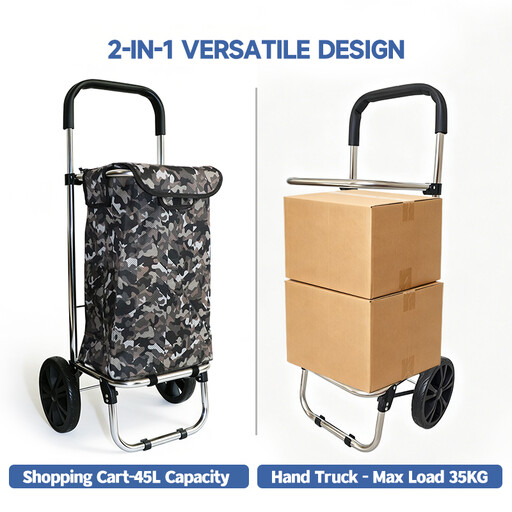
Why this fits the profile: This model is aimed at everyday shopping and mentions a large size, an ergonomic handle and a foldable design. Check the exact capacity and load limit on the product page before purchasing.
The product information refers to practical features rather than just a capacity slogan. Compare the dimensions and wheel configuration with your regular route.
Foldable design and ergonomic handle for regular shopping use.
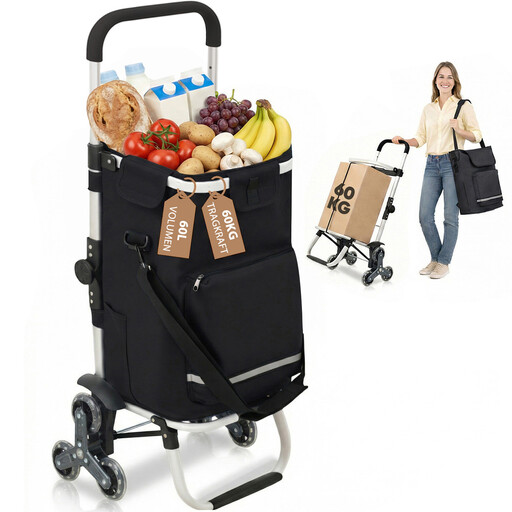
Why this fits the profile: The specifications mention an aluminium frame, Oxford fabric, PU stair wheels, a 60-litre capacity and a maximum load weight of 60 kg.
The product page lists material, dimensions and maximum load separately. This makes comparing easier than relying on "large capacity" alone.
3-in-1 use as a trolley, sack truck and shoulder bag; adjustable handle and stair wheels.
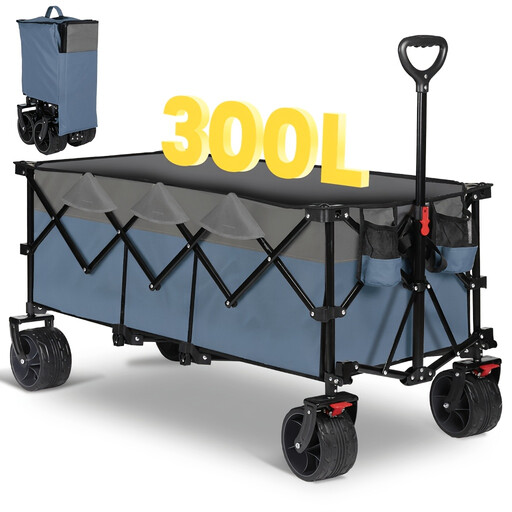
Why this fits the profile: According to the product data, this folding transport cart is designed for a maximum of 200 kg and has a capacity of 300 litres. That suits camping gear, garden tools and larger luggage.
The specifications give both capacity and load limit, and warn about even weight distribution. Do not use the wagon as a seat or on steep slopes.
300 litres of storage space, 200 kg stated load capacity and wide 7-inch tyres.

Why this fits the profile: According to the product information, this 3-in-1 model has a 60-litre capacity, an adjustable handle, a cool compartment and a tie-down strap for securing the load.
The tie-down strap helps keep loose shopping in place. The aluminium insulation should be seen as a construction feature, not a stated cooling duration.
3-in-1 design, insulated cool compartment, adjustable handle and 60 kg stated maximum weight.
We've put together a full, up-to-date list of products that fully meet these strict selection criteria and comply with current European safety regulations.
Wipe down the frame, wheels and bag with a slightly damp cloth. Allow all parts to dry completely before folding the trolley. This prevents moisture from lingering in the fabric or seams. For a cool compartment, follow the care instructions on the product page.
The lifespan depends on the load, surface, folding frequency and storage. Don't exceed the maximum load weight, check the connections regularly and store the trolley in a dry place. Wheels and folding points take more strain on cobbles, steps and with heavy loads than on flat shop floors.
It can be, especially if you regularly encounter kerbs or steps. For purely flat routes, two or four standard wheels can be simpler and lighter to manoeuvre. Choose based on your route, not just the term "stair wheels".
