
Vandaag of morgen in huis

Kwaliteit gegarandeerd

Welkomstaanbiedingen ontgrendelen: GRATIS bezorging | Tot 80% korting | Gratis 30 dagen JoyPlus-proefperiode
Download de app
A folding shopping trolley is useful for shopping, parcels and days out. However, not all models are equally well suited to everyday use in the Netherlands. A full bag may need to travel over pavements, kerbs, cobbles and sometimes stairs. You’ll also want to store the trolley compactly when it’s not in use.
The main differences aren’t just about price. Pay particular attention to the type of wheels, carrying capacity, frame and how the bag folds away.
A trolley with a large capacity may look appealing, but a high litre figure doesn’t automatically mean the frame or wheels are suitable for heavy shopping. Always check these two separate specifications:
A large bag can also be harder to pull if the load is unevenly distributed. For a few everyday essentials, a compact shopping trolley may be more practical than a high-capacity model.
A shopping trolley with stair-climbing wheels usually has three wheels on each side. They rotate around a central point as you go over a kerb or up steps. This is different from a standard shopping trolley with two larger wheels.
Stair-climbing wheels can be useful for flats, stations and uneven pavements. However, they won’t automatically make a loaded trolley effortless or safe to use on every staircase. Keep a firm hold of the trolley, avoid overloading it and follow the manufacturer’s safety information.
Many bags are made from 600D Oxford fabric with a water-repellent coating. According to the product description, this is designed to protect the contents from dust and light rain. It doesn’t guarantee that the bag will stay completely dry in prolonged or heavy rain.
A protective flap, zipped pocket or insulated compartment can be useful, but also check that the base is sturdy enough and whether the bag can be removed for cleaning.
For smooth shop floors and pavements, a model with two EVA, PVC or rubber-like wheels is often sufficient. EVA wheels are often described in product information as quiet and hard-wearing. Pay particular attention to the diameter, axle fittings and frame stability.
For cobbles, kerbs and steps, consider a folding sack truck with six PU wheels. These models have a three-wheel system on each side. Use the trolley carefully and keep the load as low as possible.
A lightweight shopping trolley is easier to lift into a car or carry up stairs. A 1.15 kg frame is practical for light shopping, but the corresponding model has a maximum sack truck capacity of 20 kg. An aluminium 3-in-1 model weighing around 3.8 to 4 kilograms often offers more capacity and features, but is heavier to lift.
So don’t automatically choose the lightest model. First consider how much you usually carry and how often you’ll need to lift the trolley.
Look out for these features:
A shopping trolley with an insulated compartment is especially useful if you’re carrying shopping, drinks or picnic supplies. According to the product description, an insulated compartment helps maintain the temperature, but it doesn’t replace active cooling.
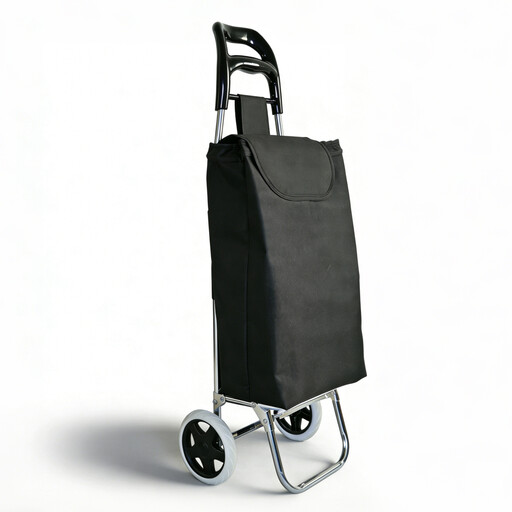
Why it suits this shopper: Its lightweight frame is practical for students, city dwellers and anyone who needs to lift their trolley regularly. The 25-litre bag can be removed to use the frame as a sack truck.
The product information gives both the frame weight of 1.15 kg and the maximum sack truck load of 20 kg. This makes the limits clearer than on models that only emphasise a large bag.
1.15 kg frame, 25-litre Oxford bag, 20 kg sack truck capacity and EVA wheels.
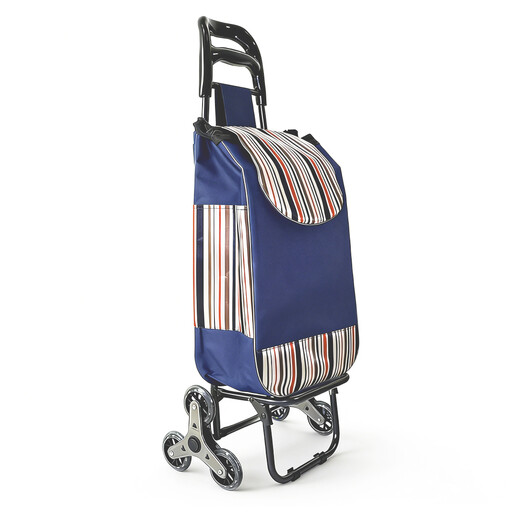
Why it suits this shopper: This model combines a spacious shopping bag with six PU wheels and a sack truck function. It’s designed for weekly shops and routes with kerbs, thresholds or steps.
The stated figures are listed separately: 38 litres for the bag and 30 kg for the sack truck function. This avoids confusing bag capacity with the permitted load.
38-litre capacity, six PU wheels, steel frame, protective flap and a flat-folding design.

Why it suits this shopper: With a 60-litre capacity, sack truck function, detachable shoulder bag and insulated compartment, this model is well suited to big shops, camping and picnics.
The product details specify a maximum load of 60 kg and recommend securing the load. This makes clear that a large capacity doesn’t mean you should load it to the maximum without checking.
60-litre capacity, 3-in-1 design, six PU stair-climbing wheels, adjustable handle and insulated compartment.

Why it suits this shopper: The 2-in-1 design gives you a shopping bag and sack truck in one. The six PU wheels are designed for routes with uneven surfaces, while the frame folds flat for storage.
The specifications state a bag capacity of 25 litres and a sack truck capacity of 25 kg. This helps you plan your shopping around the stated limits, rather than focusing only on the number of wheels.
25-litre Oxford bag, 25 kg sack truck capacity, six PU wheels and foldable storage.
We’ve put together a complete, up-to-date list of products that meet these strict selection criteria and the applicable European safety regulations.
First, remove the bag if possible. Wipe the frame, wheels and bag with a slightly damp cloth. Allow all the parts to dry completely before folding the trolley away. This helps limit moisture and dirt around the hinges.
Its lifespan depends on the load, surfaces, storage and maintenance. Regular overloading, hard kerbs and damp storage put extra strain on the wheels and joints. Check the wheel axle, folding mechanism and bag attachment before each use.
According to the product description, an insulated compartment can help maintain the temperature for a limited time. How well it works depends on the outside temperature, journey time and whether you use ice packs. For longer journeys, a separate cooling solution is a good idea.
