
Vandaag of morgen in huis

Kwaliteit gegarandeerd

Welkomstaanbiedingen ontgrendelen: GRATIS bezorging | Tot 80% korting | Gratis 30 dagen JoyPlus-proefperiode
Download de app
A folding shopping trolley is handy for trips to the supermarket, markets, carrying parcels and days out. However, models can vary considerably in load capacity, wheel type and ease of use. For example, a compact trolley that rolls well on smooth shop floors may not be suitable for pavements with high kerbs or for taking up stairs.
So don’t focus only on a large capacity or a low price. These three pitfalls are common:
Check two separate figures: the capacity in litres and the maximum load in kilograms. A 25-litre bag is suitable for everyday shopping, while a large-capacity trolley with 60 litres offers more room for families or a bigger shop.
For heavy items such as bottles, pet supplies or moving boxes, a wheeled transport trolley with a sturdy frame is more practical. Never exceed the stated maximum. For example, the 1.15 kg model has a 25-litre bag, and its frame can carry up to 20 kg when used as a sack truck. That’s a different use case from a large camping trolley with a stated capacity of 127 litres and a 200 kg load capacity.
Pay attention to how the load is distributed, too. Put heavy items at the bottom and make sure the bag or luggage is securely closed. A high centre of gravity increases the risk of tipping, especially on uneven paving.
Two large wheels are often enough for smooth shop aisles and pavements. On cobbles, over thresholds and on stairs, a different system may be more practical:
Also check whether the wheels are puncture-proof, fixed in place or removable. This affects both maintenance and ease of storage.
An aluminium frame can combine low weight with a stable construction. Steel is usually worth considering if you’ll mainly be carrying boxes or heavier loads. The bag itself deserves attention, too. Oxford fabric is used in several models and may be water-repellent, according to the product description. This helps protect against light rain, but doesn’t automatically make the trolley waterproof.
A shopping trolley with a cool bag compartment is handy for chilled shopping, picnics or days out. Check whether the compartment is integrated, how large it is and whether there’s a drinks holder. With a 2-in-1 shopping trolley, you can sometimes remove the bag and use the frame as a sack truck. A 3-in-1 transport trolley may also include a shoulder bag, for example.
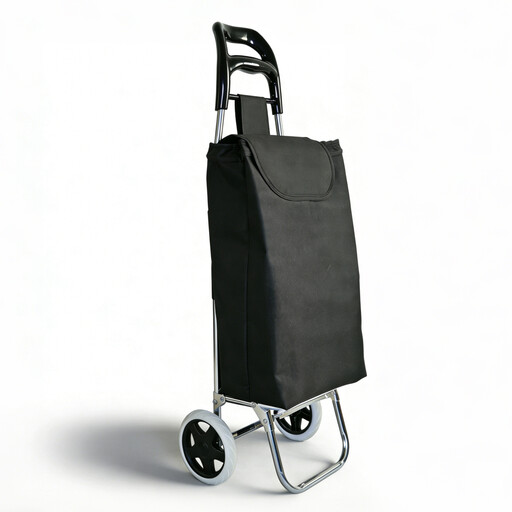
Why it suits this need: Weighing just 1.15 kg, this model is practical for students, city dwellers and anyone who wants to store their trolley in the car or under a bed.
The product information lists the 25-litre capacity and the 20 kg load capacity as a sack truck separately. This makes it clear that capacity and load limit are different things.
25-litre Oxford bag, folding frame and EVA wheels. The bag can be removed so you can use the frame as a sack truck.
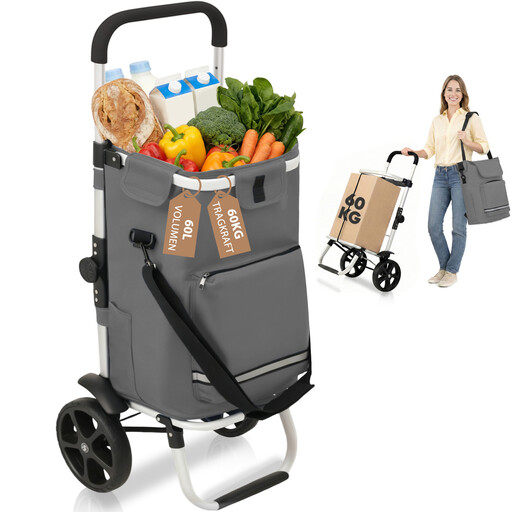
Why it suits this need: This model combines shopping with transporting items and outdoor use. Its capacity makes it suitable for larger shops and days out.
The specifications state both a 60-litre capacity and a maximum load of 60 kg. Use the cooling compartment as an extra feature, not as a substitute for an actively cooled cool box.
Aluminium frame, integrated insulated compartment, drinks holder and removable shoulder bag.

Why it suits this need: For campers, families and anyone carrying bulky items, this wide trolley offers more loading space than a traditional shopping trolley.
The stated 127-litre capacity and maximum load of 200 kg are listed separately. Use the trolley on a stable surface and lock it in place after unfolding.
Folding design, 127 litres of internal space and 360° swivel wheels with a dual brake, according to the product information.
We’ve put together a complete, up-to-date list of products that meet these strict selection criteria and the applicable European safety regulations.
Wipe the frame, wheels and outside with a slightly damp cloth. Let the bag and frame dry completely before folding the trolley. Only wash a fabric bag if the product information says it’s safe to do so. Some models explicitly state that washing is not permitted.
Its lifespan depends on the load, the surface and how it’s stored. Regularly rolling over rough cobbles puts more strain on the wheels and joints than using it in a supermarket. Check the wheel attachments, folding mechanism and bag seams from time to time. Store the trolley in a sheltered place once it’s dry, and don’t exceed the maximum load.
An insulated cooling compartment usually doesn’t use electricity if it’s a passive insulated space. In that case, it will only keep its contents cool for a limited time, depending on the surroundings, what’s inside and whether you use ice packs. Check the product description before assuming that the compartment actively cools.
