
Vandaag of morgen in huis

Kwaliteit gegarandeerd

Welkomstaanbiedingen ontgrendelen: GRATIS bezorging | Tot 80% korting | Gratis 30 dagen JoyPlus-proefperiode
Download de app
A folding garden trolley is useful for camping, days at the beach, festivals, gardening and shopping. However, an inexpensive transport trolley can sometimes look sturdier online than it is in practice. For example, a large load capacity does not automatically mean that the trolley will remain stable with a heavy load. All-terrain wheels can also appear suitable for sand or grass on paper, while performing less well in reality.
So don’t just look at the price and photos. Check the load capacity, dimensions, wheel construction, brake function and folded size. This will help you avoid buying a hand trolley that becomes difficult to pull, starts to sag or barely fits in your car after just a few trips.
A garden trolley with a capacity of 200 or 300 litres can hold a lot of belongings, but that does not mean you can fill the entire volume with heavy materials. The maximum load is determined by the frame, base, wheels and connecting points.
Also watch out for conflicting information. Some models, for example, mention 200 kg in the product title while the specifications state 150 kg. In that situation, use the lowest clearly stated capacity until the seller confirms the correct figure.
Wide wheels help on grass, gravel and firm sand, but they do not automatically make a fully loaded trolley suitable for every type of terrain. On loose beach sand, a slope or uneven ground, a heavy transport trolley can tip over. A swivelling front wheel improves manoeuvrability, but under a heavy load it may also require more stability while pulling.
On many folding garden trolleys, the brakes are designed to keep the trolley in place when parked. They are not necessarily suitable for slowing down a fully loaded trolley while it is moving. Place the trolley on as level a surface as possible and apply the brake as soon as you stop.
Don’t automatically choose the highest figure. Think about what you will actually be transporting:
Distribute the weight evenly across the base. A concentrated load, such as tiles or a heavy toolbox, puts different stresses on the frame and wheels than bulky but lightweight items. Never exceed the stated capacity, and do not use a garden trolley as a seat or step.
A frame made from steel or alloy steel provides a sturdy foundation. 600D Oxford fabric with a PE or PU coating is often described in product information as hard-wearing and water-repellent. This does not mean that every trolley is completely waterproof. Allow a wet fabric bag to dry thoroughly before folding the trolley to help prevent odours and material damage.
Removable wheels and a detachable bag are practical after a day at the beach. Sand and mud can get into bearings and pivot points. Wipe down the frame, check the wheel attachments and store the folded trolley somewhere dry.
Measure not only your car’s boot space, but also the place where you plan to store the trolley at home. A model with a 300-litre capacity may have a long side measuring more than 1.2 metres. A more compact folding hand trolley with a capacity of 80 to 150 litres is often more convenient for a flat or a smaller boot.
Also check:
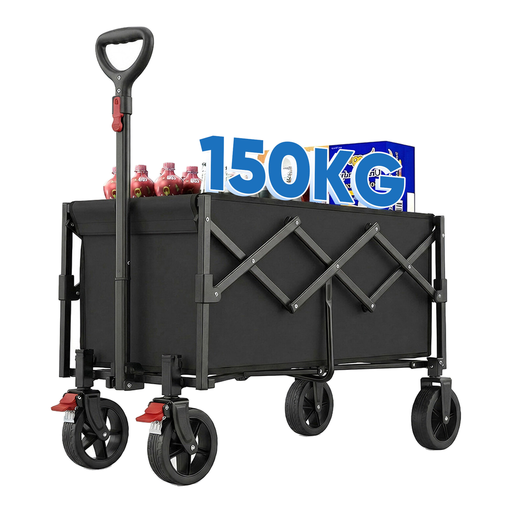
Why it suits this profile: A lightweight 5.8 kg hand trolley for shopping, picnics and smaller gardening jobs. The product information states a capacity of 80 litres and a maximum load of up to 150 kg; check which figure applies in the current specifications before buying.
The stated capacity and net weight are clearly listed. According to the product description, the wheels and fabric bag can be removed for cleaning.
600D Oxford fabric with PE coating, a compact folding design and brakes, according to the product information.
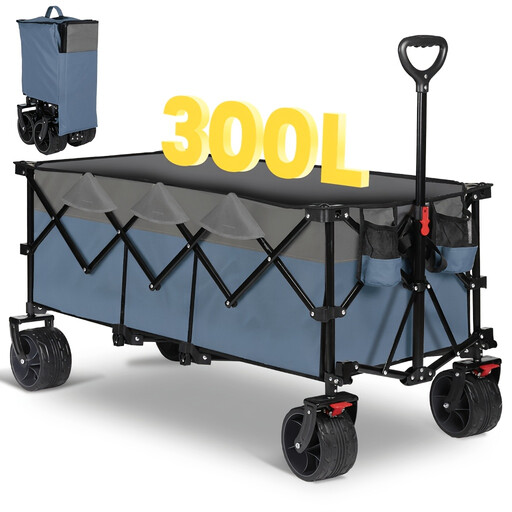
Why it suits this profile: Designed for large camping equipment, gardening tools or several heavy bags. The stated capacity is 300 litres and the maximum load is 200 kg.
The specifications list both load volume and load capacity separately. The safety information warns against uneven loading and use on slopes.
300 litres of load space, wide 7-inch tyres, brakes and a folding mechanism that can be operated with one hand, according to the product information.
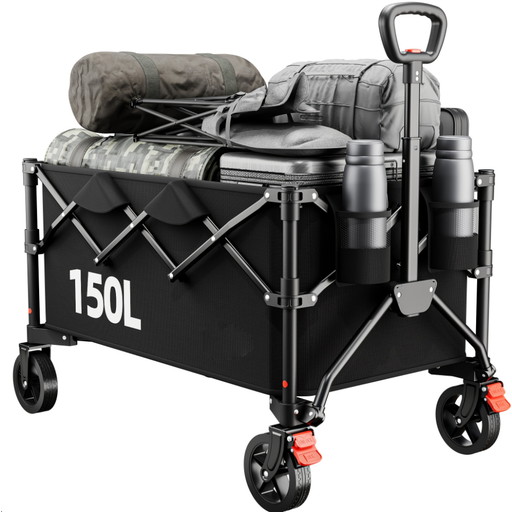
Why it suits this profile: Suitable for gardening, camping and transporting items over gravel, grass or other varied surfaces. This model has an alloy steel frame, off-road wheels and a handle with one-click operation.
According to the product description, the wheels and bag can be removed. This makes cleaning after mud or sand easier than with a fully enclosed design.
150-litre capacity, stated load capacity of 120 kg, PE-coated 600D Oxford fabric and all-terrain wheels with brakes.
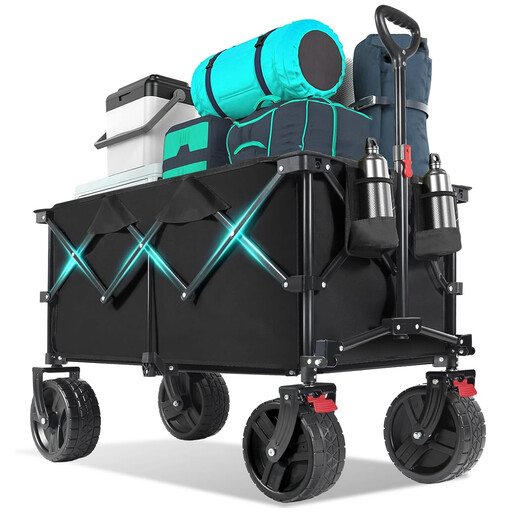
Why it suits this profile: A spacious folding transport trolley for festival essentials, beach items and camping equipment. The product information states a capacity of 200 litres and wide all-terrain wheels.
The product details state a load capacity of 150 kg, despite the reference to 200 kg in the title. Therefore, use 150 kg as the baseline and check the current listing.
Water-repellent 600D Oxford fabric, adjustable handle, 7-inch-wide wheels and a stated two-year warranty.
We’ve put together a complete, up-to-date list of products that fully meet these strict selection criteria and the applicable European safety regulations.
For shopping and a picnic, 80 to 150 litres is often sufficient. For camping, gardening or a festival, 200 litres may be more practical. In addition to capacity, look at the internal dimensions: a long bag or cool box will not always fit in a trolley that is wide but low.
A brake is generally intended for parking, not for slowing down while the trolley is moving. A fully loaded trolley can become difficult to control on a slope. Therefore, use the trolley on stable ground, keep the load low and distribute the weight evenly.
Remove sand, mud and leaves after use. Wipe the fabric bag and frame clean with a damp cloth, then allow all parts to dry completely. Regularly check the wheel axles, hinges, locking mechanism and any straps. This will help keep a folding garden cart or camping trolley usable for longer.
