
Vandaag of morgen in huis

Kwaliteit gegarandeerd

Welkomstaanbiedingen ontgrendelen: GRATIS bezorging | Tot 80% korting | Gratis 30 dagen JoyPlus-proefperiode
Download de app
A foldable transport trolley can be useful for shopping, gardening supplies, luggage, moving boxes or camping equipment. However, many models appear more suitable at first glance than they are in practice. A low price says little about stability, while a high load capacity does not automatically mean that the trolley is easy to manoeuvre.
The following points deserve extra attention before you place your order.
A 150 kg hand trolley or a foldable trolley with a large capacity may sound appealing. However, always check what the maximum load actually refers to. For some models, it means an evenly distributed load on a flat surface. Heavy objects placed on one side can cause the trolley to tip over, even if the total weight remains below the limit.
Treat the stated load capacity as an upper limit, not as your everyday target weight. Distribute the load evenly and secure loose items with a tension strap or fastening strap.
A foldable shopping trolley should not only be compact when stored. Pay attention to its dimensions when in use, too. Will it fit through the lift, the storage-room door or the supermarket aisle? With a camping trolley fitted with wide tyres, the width is also important when transporting it in the car.
Also check that the folding mechanism locks securely. A trolley that has not been fully unfolded and locked in place can become unstable while being loaded.
Terms such as “suitable for all terrains” are not always clearly defined. A transport trolley with wheels designed for asphalt may work well on paving slabs, but be less comfortable to pull through sand, mud or loose gravel. Look at the wheel type, diameter, width and the surfaces the product description says it is designed for.
For an elderly shopper’s trolley, an adjustable handle, low weight and predictable steering are often more important than a large number of extra features.
For light shopping, 60 to 80 kg is often sufficient, depending on how you intend to use the trolley. For bags of compost, crates or tools, a heavy-duty transport trolley with a capacity of 90, 150 or 200 kg may be more suitable. Note the difference between a platform trolley, sack truck and wagon trolley:
A higher load capacity is often combined with a heavier frame and larger wheels. This can improve stability, but makes the trolley more difficult to lift.
Aluminium is lightweight and practical for a foldable shopping trolley or folding sack truck. Steel can carry more weight, but usually increases the trolley’s own weight. For fabric trolleys, 600D Oxford fabric is, according to the product description, a commonly used material for the load compartment. Check whether the base is supported and whether the fabric is easy to clean.
A loading surface with an anti-slip coating is useful for boxes and bags. A fastening strap prevents the load from shifting while the trolley is moving. In everyday use, these details are often more important than an extra cup holder.
Large, wide tyres generally roll more easily over uneven surfaces than small, hard wheels. PU or TPR wheels may be suitable for pavements and floors, but check the product specifications rather than relying solely on the advertising copy.
An adjustable handle helps users of different heights. With a folding sack truck, the height of the telescopic bar is also relevant. Brakes are primarily intended to keep the trolley stationary when parked. Do not use them as a substitute for taking care when travelling down a slope.

Why it suits this profile: Weighing 3.8 kg, this lightweight shopping trolley is designed for shopping, short trips and everyday use. According to the product description, it has a capacity of 60 kg.
The stated dimensions, unladen weight and maximum load are clearly listed. This allows you to assess in advance whether the model suits your shopping routine.
3-in-1 design with shopping trolley, sack truck function and detachable shoulder bag; integrated insulated compartment and adjustable handle.
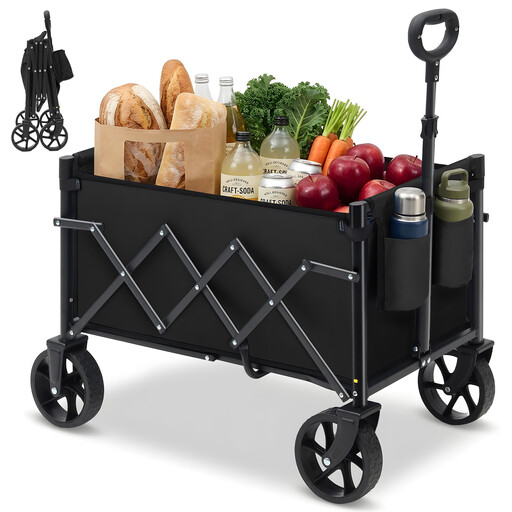
Why it suits this profile: This wagon trolley is designed for shopping, picnics and everyday transport when you need more space than a traditional shopping trolley provides.
The model has a stated load capacity of 80 kg, a self-standing design and detachable wheels. This makes storage and pre-use checks more straightforward.
Reinforced steel structure, weight of 4.8 kg, compact folded size and a handle adjustable to three positions.
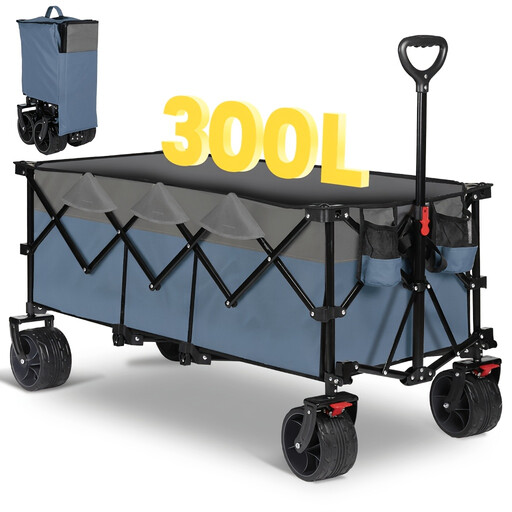
Why it suits this profile: According to the product specifications, this spacious camping trolley is designed for heavy camping equipment, gardening tools and other bulky loads.
The product information states both a capacity of 300 litres and a maximum load of 200 kg. The load must be distributed evenly and the trolley must be fully locked in place.
Large 7-inch tyres, four-way folding mechanism, 300-litre storage volume and a stated load capacity of 200 kg.
We have put together a complete, up-to-date list of products that fully meet these strict selection criteria and the applicable European safety regulations.
Check the following before ordering:
Do not use a foldable transport trolley as a seat or step. On models with brakes, these are intended for parking according to the product information, not for controlling your speed while moving.
This varies from model to model. The range includes examples with capacities of 60, 80, 90, 150 and 200 kg. Actual suitability also depends on the surface, how the weight is distributed and the type of load. Do not exceed the stated limit.
For boxes, crates and moving boxes, usually yes, because the load rests against a support plate. A shopping trolley is more practical for loose shopping and may include extra features such as a bag or cooling compartment. Choose based on the shape of your load, not just the load capacity.
Remove dirt after use with a soft, damp cloth. Allow a fabric trolley to dry completely before folding it. Regularly check the wheels, hinges, fastening points and any straps. Store the trolley in a dry place and always follow the safety instructions in the product description.
