
Vandaag of morgen in huis

Kwaliteit gegarandeerd

Welkomstaanbiedingen ontgrendelen: GRATIS bezorging | Tot 80% korting | Gratis 30 dagen JoyPlus-proefperiode
Download de app
A foldable wagon is useful for camping, gardening, shopping, beach days and festivals. However, not every cart is suited to the same terrain or load. A large utility wagon may appear to carry many kilograms on paper, yet be awkward to store in a small shed. Likewise, a compact folding handcart may not offer enough capacity for camping equipment or garden tools.
So do not focus solely on the price or terms such as “off-road” and “heavy duty”. Look at verifiable specifications: load capacity, volume, wheel type, brakes, dimensions and how the cart folds.
A listing such as 150 kg wagon or 200 kg wagon only indicates the stated maximum weight. It does not mean you can comfortably pull the cart with that load across sand, grass or a slope. The surface, weight distribution and construction also affect how the cart performs.
Place heavy items low and distribute them as evenly as possible. Also check that the load capacity in the product description matches the title. With some models, the title and specification table may list different values.
Wide tyres help on grass, gravel and firm sand, but they do not make a fully loaded cart effortless to pull across soft beach sand. Pay attention to wheel width, diameter and bearing type. A 7-inch-wide wheel may roll more steadily than a narrow wheel, but it may also require more storage space.
A utility wagon with wheels and a brake is particularly practical when you need to park it regularly. However, check what the brake is designed for. Several models specify that their brakes are intended to keep the cart stationary, not to slow down a moving wagon.
A folding wagon can be stored compactly, but its unfolded dimensions determine whether it will fit through a door, in the boot of your car or between garden furniture. Also check the cart’s weight. A 10- to 11-kg model with a capacity of 200 or 300 litres is more difficult to lift than a lightweight portable utility cart.
For a day at the beach or a festival, a camping wagon of around 80 to 150 litres may be sufficient. For tent poles, a cool box, chairs and several bags, a large wagon with a capacity of 200 to 300 litres is more practical.
Pay attention to the difference between total volume and internal dimensions. A stated capacity of 228 litres does not automatically mean that a rectangular box of those dimensions will fit. Check the internal length, width and height when transporting bulky items.
Many folding trolley models use a metal or alloy-steel frame with 600D Oxford fabric. A PE or PU coating may help protect against splashes, but it does not automatically make the bag suitable for prolonged exposure to rain. Allow wet fabric to dry fully before folding the cart.
Removable wheels and a detachable bag make cleaning easier, particularly after using the cart as a beach wagon. Sand and mud can get into the wheels and bearings. Wipe the frame and fabric with a damp cloth and store the cart in a dry place.
A wagon with a brake is useful in a car park, at a campsite or on a gentle slope. Always engage the brake before loading or unloading the cart. Do not exceed the stated maximum, and check that the frame is fully unfolded and locked into place.
Do not use a utility wagon as a seat or step. Keep your fingers away from the folding mechanism, and do not use a heavily loaded cart on a steep slope. The product information takes precedence; check it before purchasing and using the cart.
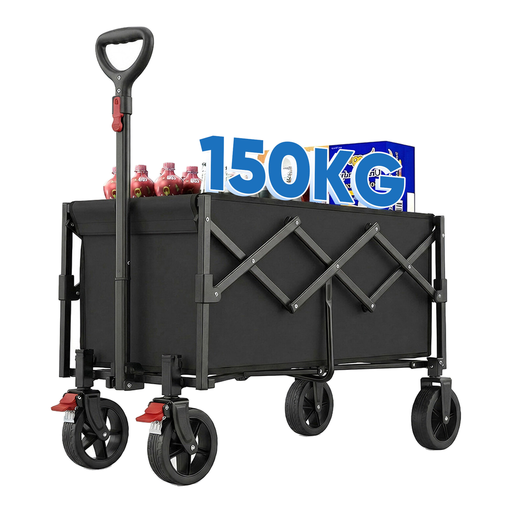
Why it’s a good fit: A compact option for shopping, light gardening tasks and use in the car.
The 80-litre capacity and 5.8 kg weight give a clearer picture of its size than a general claim of compactness. The product specification states a maximum load capacity of 150 kg; verify this at checkout.
Removable wheels and bag; folds down for storage at home or in the car boot.
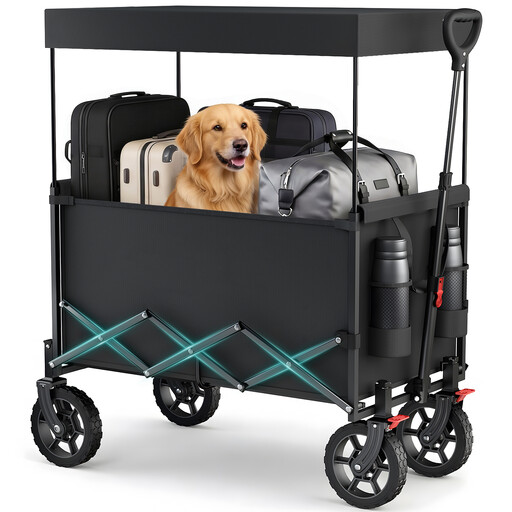
Why it’s a good fit: Suitable for campers and families who want to protect their belongings from the sun or light rain during outings.
The removable cover and brakes are described clearly. The brakes are intended to keep the cart stationary; do not use them as a running brake.
150-litre capacity, an adjustable telescopic handle and all-terrain tyres; stated load capacity is 150 kg.
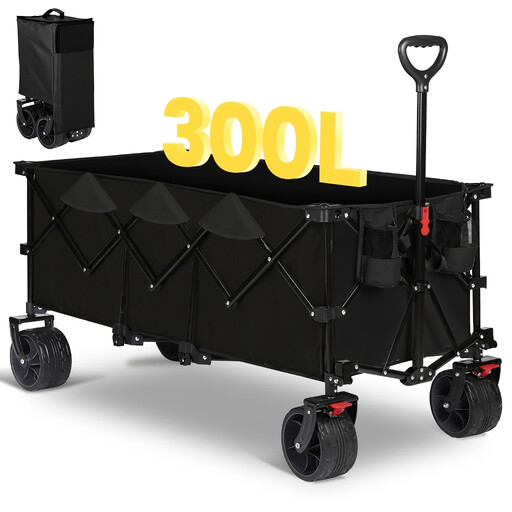
Why it’s a good fit: For gardening enthusiasts, campers and professionals who need to move large or heavy items at the same time.
The product description specifies 300 litres, 200 kg and 7-inch-wide wheels. Distribute the load evenly and stay below the stated maximum, especially on uneven terrain.
Folds in four directions, requires no assembly, and features wide wheels and brakes according to the product information.
Browse a current selection of utility wagons and compare capacity, load capacity, wheels and storage convenience.
That depends on the surface and wheel type. Wide all-terrain wheels generally perform better on grass, gravel and firm sand than narrow wheels. On soft, deep sand, even a camping wagon with wide tyres can be difficult to pull. Distribute the load evenly and avoid overloading the cart.
Its lifespan depends on the load, terrain, moisture and maintenance. Allow a wet bag to dry, remove sand from the wheels and regularly inspect the frame, locking mechanism and seams. Use the cart within the stated specifications. A model with a two-year warranty provides a clear point of contact for the applicable terms, but always check the specific warranty and return information on the product page.
Not for everyday light use. For shopping, a picnic or a few garden tools, 80 to 150 kg may be sufficient. A heavy-duty utility wagon with a 200 kg load capacity and 300-litre volume is mainly worthwhile if you regularly transport bulky or heavy items. In addition to the maximum weight, consider your own lifting capacity, available storage space and the surfaces on which you intend to use the cart.
