
Vandaag of morgen in huis

Kwaliteit gegarandeerd

Welkomstaanbiedingen ontgrendelen: GRATIS bezorging | Tot 80% korting | Gratis 30 dagen JoyPlus-proefperiode
Download de app
A day at the beach, a weekend camping trip, or a visit to a festival: it quickly turns into a chore of lugging coolers, chairs, bags, and toys. A foldable wagon seems like the perfect solution. Just unfold it, load it up, and start rolling. Yet, the purchase often ends in disappointment. A wagon that rusts after one season, wheels that get stuck in the sand, or a frame that bends under the weight of a few grocery bags.
As a Joybuy Product Recommendation Officer, I see a lot of products come and go. I'm here to help you see through the marketing jargon and choose a model that actually delivers on its promises. Before you make a choice, it's wise to be aware of a few common pitfalls.
wagon for the beach.To avoid a bad purchase, it's smart to check a few specifications. These determine whether a collapsible wagon becomes a helpful tool or a cumbersome obstacle.
These two are often confused.
A wagon with a large bin (high capacity) but a low load capacity is not suitable for heavy loads. Always look at both specifications and match them to what you plan to transport.
The wheels make or break the user experience, especially for a wagon for camping or the beach.
wagon with a brake is not an unnecessary luxury. It prevents the wagon from rolling away on a slope, significantly increasing safety.The frame is the skeleton of the wagon. A sturdy frame ensures a long lifespan. Powder-coated or painted steel offers good protection against rust and is often very strong. Carbon steel is another robust option. The fabric of the bin, usually Oxford polyester, should be durable and easy to clean.
Based on these objective criteria, we have selected a number of models that suit different user profiles.
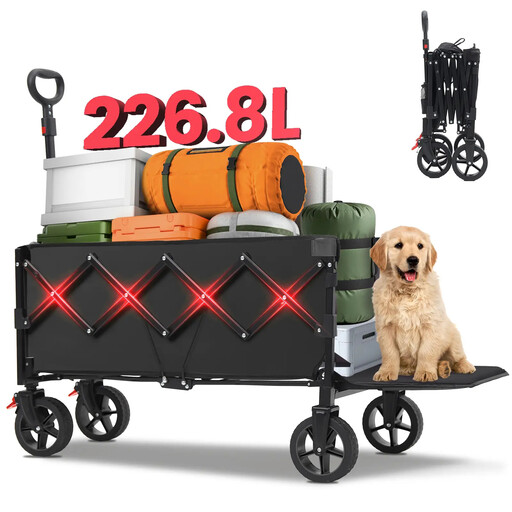
Why This Fits Their Persona: Ideal for family outings to the park or beach. The spacious 160-litre bin offers plenty of room for towels, a cooler, and toys, while the 100 kg load capacity is sufficient for most situations. The fold-out tailgate is a handy extra for transporting longer items like a parasol.
The frame is made of carbon steel, which is more robust and resistant to rust than standard steel. The wheels are designed for mixed-terrain use, not just for smooth surfaces.
Capacity: Large 160-litre volume.
Extra Feature: Fold-out tailgate for additional loading space.

Why This Fits Their Persona: For those who need to transport heavy camping gear over unpaved terrain. The very high load capacity of 200 kg is ideal for tents, cooking equipment, and other heavy gear. The compact folding design saves precious space in the car.
This model tackles the 'inflated load capacity' pitfall with a specified heavy-duty capacity of 200 kg. This indicates a reinforced frame and axles built for heavy loads, not just volume.
Load Capacity: Very high at 200 kg.
Safety: Equipped with a dual brake and 360° swivel wheels for control.
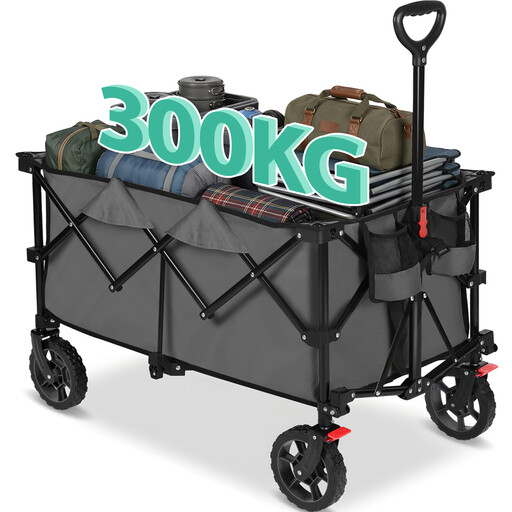
Why This Fits Their Persona: For those who need maximum load capacity. Think gardening with heavy bags of soil, doing large grocery runs, or setting up for a small event. The combination of a 200-litre capacity and 300 kg load rating makes this a true `transport cart`.
The painted steel frame with secure welds is specifically designed for a maximum load capacity of 300 kg. This model is built for strength and durability, completely bypassing the pitfall of a weak frame.
Extreme Load Capacity: Can carry up to 300 kg.
Large Volume: A spacious 200-litre bin.
We have compiled a complete, up-to-date list of products that fully meet these strict selection criteria and safety standards.
It's wise to remove sand and salt as quickly as possible to extend the life of the wheels and bearings. Rinse the wheels thoroughly with clean water. Use a soft brush to remove stubborn sand from the treads and rotating parts. Let the wagon dry completely before folding and storing it.
A foldable wagon has a fabric bin and is designed for carrying various, often loose items. This makes it ideal for recreational use. A transport cart, often called a utility cart or hand truck, usually has a flat loading surface and is intended for moving stacked items like boxes, crates, or furniture.
No, unless the manufacturer explicitly states so and the product is certified for it. Most foldable wagons are designed for transporting goods, not people. They have not been tested for the specific safety requirements for child transport, making it unsafe to use them for this purpose. Always check the manufacturer's manual and safety warnings.
