
Vandaag of morgen in huis

Kwaliteit gegarandeerd

Welkomstaanbiedingen ontgrendelen: GRATIS bezorging | Tot 80% korting | Gratis 30 dagen JoyPlus-proefperiode
Download de app
A foldable utility wagon can save you a lot of heavy lifting. Think camping equipment, shopping, garden waste or beach essentials. However, not every model is suitable for every surface or load. For example, a spacious load compartment says little about stability when the wagon is fully loaded.
So look beyond the number of litres and an impressive weight claim. Below, you’ll find the key buying criteria, common pitfalls and a selection of products for different uses.
A manufacturer may state a load capacity of 200 or 300 kg, but that does not automatically mean the wagon will remain stable on every surface. The centre of gravity, wheelbase and weight distribution all play an important role.
So check:
Some models may include different weight claims in the description. Before buying, use the specific technical table and, if in doubt, allow for a safe margin.
Wide wheels help on grass, gravel and sand, but they do not automatically make a full wagon easy to steer. Small, hard wheels can get stuck on a beach path, while large swivel wheels provide less control on a slope.
An all-terrain utility wagon is particularly useful if you regularly move between paving, grass and unmade paths. For occasional use in the supermarket or garage, more compact wheels are often sufficient.
Pay attention to the dimensions when folded, not just the size during use. A wagon measuring around 90 cm in length will not fit in every boot or storage space. Also check whether:
A collapsible utility wagon with a four-way folding system can be convenient for smaller homes, flats and cars with limited boot space.
For a family or camping equipment, 120 to 150 litres is often practical. A high-capacity utility wagon of 200 to 300 litres provides room for larger items, but it also becomes heavy and less manoeuvrable more quickly.
As well as the load volume, look at the internal dimensions. A long tent, cool box or garden tools may not fit well in a load compartment that is deep but narrow. Place heavy objects at the bottom and lighter items on top.
A frame made from alloy steel or painted steel provides, according to the product specifications, a sturdy foundation. Oxford fabric, such as 600D Oxford fabric, is used on several models. A coating of PE, PU or a similar material can make the fabric more resistant to splashing water.
Water-repellent does not mean completely waterproof. So allow a wet camping trolley to dry thoroughly before folding it away. This helps limit odours, stains and material deterioration.
Wide PVC or rubber tyres are practical on uneven terrain. A 360° swivel wheel at the front makes turning easier, particularly at a festival or campsite. A transport wagon with a brake is useful when you need to park the wagon temporarily.
Only use the brake as described in the product instructions. On some models, the brake is designed to keep the wagon stationary, not to slow down a moving, heavily loaded wagon. Do not place the wagon on a steep slope, even if it has a brake.
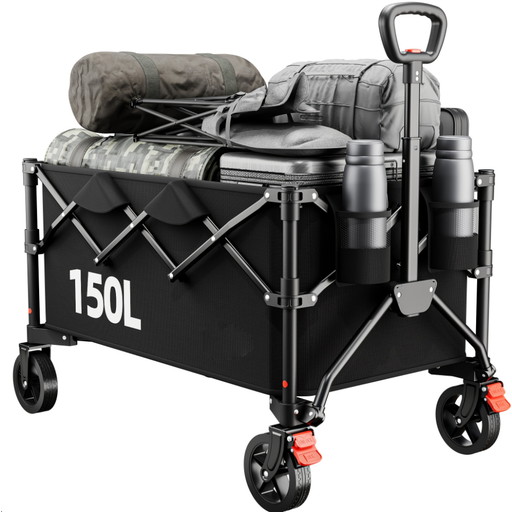
Why it suits this profile: This compact foldable transport wagon combines a 150-litre capacity with a stated load capacity of 120 kg. That makes it practical for camping, gardening and shopping.
The product specifications state both the volume and the load capacity. The off-road wheels with brakes and one-click handle are clearly described.
120 kg load capacity, 150-litre load space, four-way folding, and removable wheels and bag.
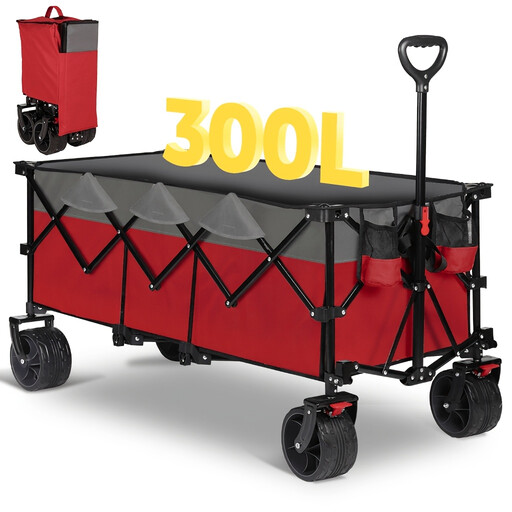
Why it suits this profile: The 300-litre extended load compartment is designed for users who need to transport lots of camping equipment, gardening tools or bulky festival items at once.
The product specifications separately state the 300-litre load space, 200 kg load capacity and 7-inch tyre size. However, check beforehand that its length of over 1.2 metres will fit in your storage space.
300-litre capacity, stated load capacity of 200 kg, wide 7-inch tyres, brakes and two cup holders.
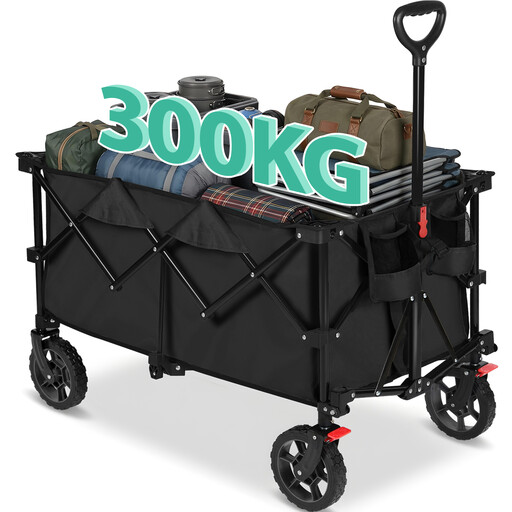
Why it suits this profile: According to the product information, this model is designed for heavy-duty transport on paving, grass, the beach and sand. It suits keen gardeners, organisers and campers with lots of equipment.
The description mentions a steel frame, a four-way folding system and an adjustable handle. Distribute the load evenly and always follow the stated maximum load.
200-litre load volume, stated load capacity of 300 kg, painted steel frame and universal wheels.
We’ve put together a complete, up-to-date list of products that fully meet these strict selection criteria and the applicable European safety regulations.
A handcart with wheels will remain useful for longer when you load it appropriately and check it after every use outdoors.
Do not use a utility wagon as a seat or step, unless the manufacturer expressly permits this. Most models are designed for goods, not people or children.
First remove any loose items and place the wagon on a level surface. Unlock or pull the folding mechanism according to the instructions. Then fold in the handle and, if applicable, the side panels. Keep your fingers away from the hinges and check that the wagon is securely held in its folded position.
Its lifespan depends on the load, surface, moisture and maintenance. Regular use on sand or gravel puts more strain on the wheels than use on paving. So check the frame joints, tyres, brakes and fabric regularly. Do not exceed the stated load capacity.
A braking system adds components that need to be checked, but day-to-day maintenance is generally limited to cleaning and checking for dirt. Make sure the brake engages correctly when the wagon is stationary. If the brake is worn or not working properly, using the wagon on a slope is not advisable.
