
Vandaag of morgen in huis

Kwaliteit gegarandeerd

Welkomstaanbiedingen ontgrendelen: GRATIS bezorging | Tot 80% korting | Gratis 30 dagen JoyPlus-proefperiode
Download de app
A foldable trolley can make it considerably easier to move shopping, garden waste, camping equipment or festival essentials. However, a large load capacity is not automatically enough. A trolley rated for 200 kg on paper can still be difficult to steer on grass, sand or a slope. Even a compact model may offer too little space in practice.
Pay particular attention to the construction, wheels and the way the weight is distributed. Below, you’ll find the key points to consider, along with some popular choices for different situations.
A load capacity of 120, 200 or even 300 kg sounds appealing, but this does not mean you should always load the trolley to its maximum. Stability also depends on the ground, wheelbase, height of the load and weight distribution.
Heavy items should go at the bottom and as close to the centre as possible. Also check whether the manufacturer distinguishes between load capacity, load volume and the weight that can be pulled over a particular surface.
A high-capacity trolley is useful for bulky items, but an open compartment without dividers or securing points can become untidy while you’re on the move. Loose shopping can shift around and gardening tools can fall out of the trolley.
A tie-down strap, side pocket or enclosed design helps keep the load in place. With a foldable wagon, it is also important that the base remains flat and sturdy once unfolded.
Small swivel castors are suitable for kitchens, bathrooms or warehouses. For grass, gravel, beaches or uneven paving slabs, wider tyres and a larger wheel diameter are usually more practical. Also check whether brakes are fitted and what they are designed for.
A brake is generally intended to keep the trolley stationary when parked, not to slow down a heavy load while you’re moving. Careful manoeuvring is still essential on a slope.
For shopping or a picnic, a model with a capacity of around 60 kg is often sufficient. For gardening, camping or moving boxes, a heavy-duty trolley with a higher stated load capacity may be more suitable. In addition to weight, check the capacity in litres:
A high load capacity does not automatically make a trolley suitable for heavy loads on a slope. Always follow the instructions and never exceed the stated maximum.
An aluminium frame is relatively lightweight and suits a shopping trolley or hand trolley for regular everyday use. Steel can support more weight, but often makes the trolley heavier. For a fabric wagon, 600D Oxford fabric, a protective coating and a sturdy base are useful specifications to look for.
Check whether the fabric compartment can be removed. This makes cleaning easier after use in the garden, on the beach or during a camping trip. An adjustable push or pull handle is useful when several people will be using the trolley.
For a foldable trolley with wheels, the following points are important:

Why it suits this profile: This compact 3-in-1 trolley is designed for shopping, day trips and light outdoor activities. Combining a shopping trolley, sack truck and shoulder bag, it offers several ways to use it.
The stated 60 kg capacity, tie-down strap and adjustable handle make the usage limits clearer than those of a simple open compartment. Use the strap to secure the contents.
Aluminium frame, insulated cool compartment, drinks holder and PVC wheels. Dimensions: 36 x 42 x 98 cm.
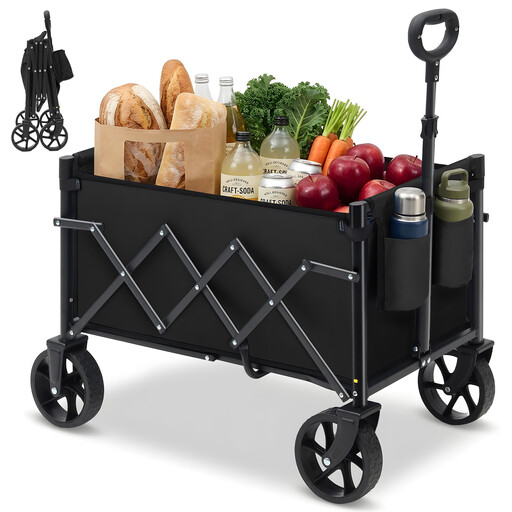
Why it suits this profile: This model is ideal for anyone looking for a lightweight, self-standing trolley for shopping, picnics and everyday use.
The description mentions click-release wheels and a folded size comparable to a travel bag. This makes it easier to store in a cupboard, shed or car.
Steel frame, stated load capacity of 80 kg, weight of 4.8 kg and a handle adjustable to three positions.
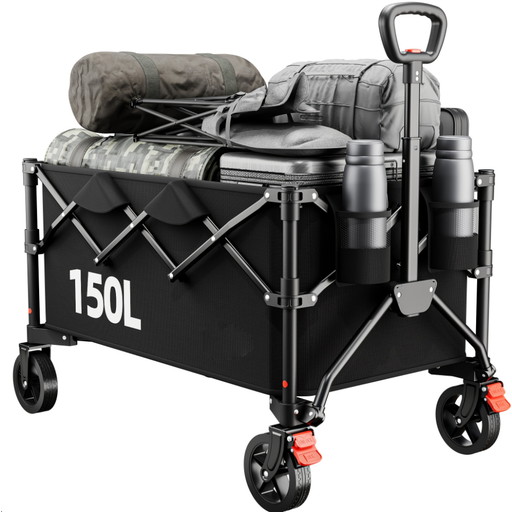
Why it suits this profile: Its 150-litre capacity, off-road wheels and brakes make it suitable for gardening, camping and transporting items over grass, gravel or other uneven surfaces.
The specifications list wide off-road wheels with brakes and a removable bag. This supports control and maintenance, but heavy loads must still be distributed evenly.
Stated load capacity of 120 kg, load volume of 150 litres, foldable frame and a one-click handle.
We’ve put together a complete, up-to-date list of products that fully meet these strict selection criteria and the applicable European safety regulations.
Fully unfold the frame and check that all the locks are securely fastened. Then position the handle as required. For a trolley with a fabric compartment, check that the base is lying completely flat. Only load the trolley once the frame is fully open.
Its lifespan depends on the weight, surface and maintenance. Wipe the frame and wheels clean after use, allow a wet fabric compartment to dry completely and store the trolley in a dry place. Regularly check the wheel fittings, brakes, seams and folding mechanism.
That depends on how you plan to use it. A sack truck is generally suitable for compact, tall loads such as boxes. A camping trolley or garden wagon offers more loading space and is more practical for loose or bulky items. For shopping, a lightweight trolley with a cool compartment may be more convenient than either option. So first consider the shape and type of load, not just the price.
