
Vandaag of morgen in huis

Kwaliteit gegarandeerd

Welkomstaanbiedingen ontgrendelen: GRATIS bezorging | Tot 80% korting | Gratis 30 dagen JoyPlus-proefperiode
Download de app
A foldable transport wagon can save you a great deal of lifting during a camping weekend, garden project, day at the beach or house move. However, models often look stronger and more spacious online than they are in practice. A high capacity, for example, does not automatically mean that the wagon remains stable when fully loaded and pulled across grass or sand.
As a Joybuy Product Recommendation Officer, I therefore focus primarily on verifiable specifications: load capacity, volume, wheel type, brakes, dimensions and foldability. This makes it easier to identify which model suits your needs and helps you avoid an unsuitable purchase.
A 200- or 300-litre wagon may look spacious, but that does not mean you can safely transport hundreds of kilograms in it. Always check both values:
Pay attention to weight distribution as well. Keeping heavy items low down and as centrally positioned as possible helps reduce the risk of tipping. Never exceed the specified load capacity.
Wide off-road tyres can be more practical on grass, sand or an unpaved campsite path than small swivel wheels. Even so, the surface remains an important factor. A fully loaded camping utility wagon can become difficult to control on a slope or loose ground, even when fitted with large tyres.
Pay attention to:
On some models, the brakes are intended only to keep the wagon stationary. They are not designed to slow down a moving wagon.
A foldable trolley may be easy to collapse, but check its folded dimensions if you intend to store it in a car, storage room or apartment. A long wagon with a frame measuring more than one metre can still be difficult to store despite its folding mechanism.
Removable wheels and a detachable fabric compartment are particularly practical for cleaning and storage. Allow a damp cover or muddy compartment to dry completely before putting the wagon away.
For groceries, picnics or lightweight items, an 80-litre hand cart with wheels may be sufficient. For garden waste, potting soil or camping equipment, a capacity of 100 to 200 litres is generally more suitable. If you want to transport several large bags or pieces of equipment in one trip, consider a high-capacity trolley ranging from 228 to 350 litres.
A higher stated load capacity is useful only when the frame, base and wheels are designed to support it. Also check whether the product description refers to a static load or a practical transport load. When in doubt, allow for a sensible safety margin.
Many foldable wagons combine a steel or alloy-steel frame with 600D Oxford fabric, polyester or PVC-coated fabric. A coating can help protect against splashes, but it does not automatically make a wagon fully waterproof. According to the product descriptions of some models, cleaning with a damp cloth is recommended; machine washing is not always permitted.
For intensive use in the garden or at the campsite, a sturdy frame, securely fastened joints and a removable loading compartment are more valuable than a broad marketing label such as “heavy duty”.
A swivelling front axle or dual swivel wheels makes manoeuvring easier, particularly along narrow paths. For a heavy-duty transport wagon, wide wheels and an adjustable handle are often more important than an additional cup holder.
Check the following before use:
Do not use a transport wagon as a seat, step or people carrier unless the manufacturer explicitly and verifiably states that it is suitable for this purpose.
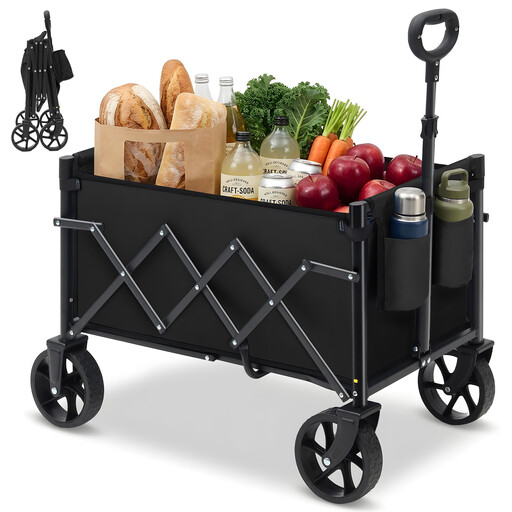
Why it’s a good match: A lightweight option for groceries, picnics and everyday use when storage space is limited.
The stated maximum load is 80 kg and the wagon itself weighs 4.8 kg. This clearly indicates that the model is intended for lighter loads.
According to the product description, the wagon folds in one movement and the wheels can be removed.
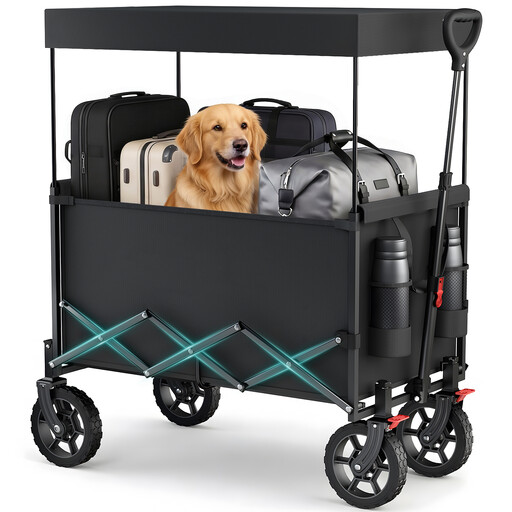
Why it’s a good match: Suitable for families and campers who want to transport luggage, beach essentials or camping equipment across a range of surfaces.
The product description lists off-road wheels, brakes and an adjustable telescopic handle. The canopy is removable, making storage and cleaning easier.
The stated capacity is 150 litres and the maximum load is 150 kg. According to the specifications, the model weighs 9.8 kg.
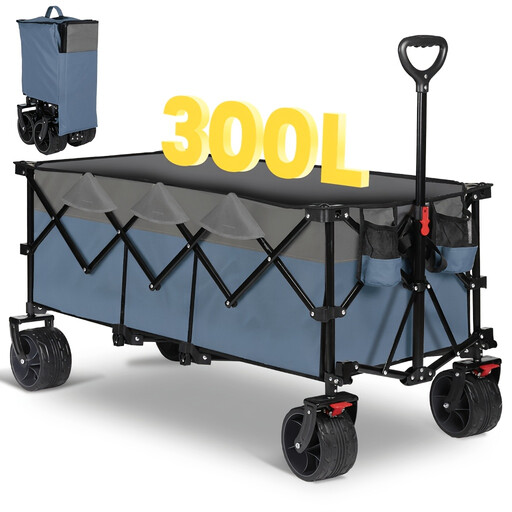
Why it’s a good match: Designed for heavy garden materials, large quantities of camping equipment or moving supplies when making several trips would be inconvenient.
The product information states a maximum load of 200 kg, while also recommending even loading and use on relatively level ground.
The stated capacity is 300 litres. The wagon has 7-inch-wide tyres, brakes and a folding mechanism that can be operated with one hand.
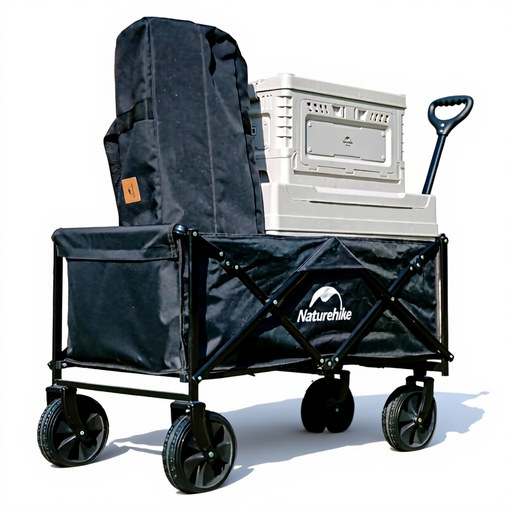
Why it’s a good match: A well-organised transport cart for the garden and campsite, with an adjustable handle and room for tools, plants or outdoor equipment.
The specifications list a capacity of 113 litres and a maximum load of 100 kg. This makes the choice more predictable than relying solely on a label such as “high capacity”.
The model features an alloy-steel frame, a foldable design and a stated weight of 7.5 kg.
Browse a current selection of transport and storage wagons, and compare capacity, load limits, wheels and folding mechanisms based on the available product specifications.
A foldable transport wagon is particularly useful if you do not use it every day and have limited storage space. In a Dutch home, shed or car boot, the folded dimensions make a significant difference. A lightweight model is often sufficient for groceries and short outings. For gardening, festivals or camping, a larger loading compartment, sturdy wheels and an adjustable pull handle are more practical.
Are you primarily looking for mobile indoor storage? In that case, a foldable storage trolley may be less suitable than a fixed three-tier serving trolley with swivel wheels. A metal model with lockable wheels can be useful in the kitchen, bathroom, home office or hobby room. Take assembly requirements and the maximum weight per shelf into account.
Where possible, remove the wheels and fabric compartment. Wipe the fabric and frame with a soft, damp cloth, then allow all components to dry thoroughly. Rinse the wheels only if the product information permits this. Store the wagon in a dry place to help prevent rust and mould.
Its service life depends on the load, surface, storage conditions and maintenance. Regularly checking the wheel attachments, seams, brakes and folding locks helps identify wear at an early stage. A wagon that is frequently pulled across sand, mud or uneven paths requires more maintenance than one used on flat pavements.
Brakes are useful when you want to park the wagon temporarily on a slope or uneven surface. On many models, however, they are intended only to keep the wagon stationary and do not replace safe loading. Always check the safety information for the model you choose, and do not use the wagon on steep slopes when carrying a heavy load.
