
Vandaag of morgen in huis

Kwaliteit gegarandeerd

Welkomstaanbiedingen ontgrendelen: GRATIS bezorging | Tot 80% korting | Gratis 30 dagen JoyPlus-proefperiode
Download de app
A foldable transport trolley can make it much easier to move shopping, garden waste, camping equipment or moving boxes. Yet many people buy a model that disappoints in practice. The stated capacity may only be achievable under ideal conditions, the wheels may get stuck on grass, or the trolley may still take up a lot of space when folded.
These checks will help you avoid a poor purchase. You’ll also see which models are suitable for light everyday use, camping or intensive transport.
An advert stating “200 kg” sounds appealing, but that figure does not tell you everything. A heavy load must be distributed evenly across the base. On a slope, loose ground or uneven paving, a fully loaded trolley may be less stable. So also check the base dimensions, wheelbase and safety instructions.
A 200 kg transport trolley is particularly useful when you genuinely need to move heavy or bulky items. For shopping or a picnic, a lighter model may be more practical.
A capacity of, for example, 300 litres does not automatically mean that every large box will fit inside. Check the longest side, the shape of the load compartment and the height of the side walls. A foldable utility wagon with a spacious fabric compartment is useful for loose items, while a sack truck is better suited to straight-sided boxes or crates.
Also pay attention to the folded dimensions. A trolley that does not fit in your shed, boot or caravan will be used less often.
Wide tyres, castor wheels and brakes can improve manoeuvrability, but no transport trolley is automatically suitable for every surface. Check whether the wheels are designed for flat floors, grass, gravel or sand. On many models, the brakes are intended to keep the trolley parked, not to slow it down while moving.
Choose a load capacity with some headroom above your usual load. For example, an 80 kg model is suitable for shopping, camping equipment and lighter garden materials. For bags of compost, tools or heavy crates, consider 150 or 200 kg models.
Keep the weight low and distribute it evenly. Only use the trolley when the frame is fully unfolded and locked. Before each use, check that the drawbar, connections and wheels are securely attached.
Castor wheels are often convenient in shops, garages and on smooth floors. For grass and uneven paths, wide tyres generally provide more contact with the ground. A transport trolley with wheels and an adjustable handle is practical when several people will be using it.
A sack truck works differently from a utility wagon: the load rests on a narrow loading plate and is tilted backwards. This makes it suitable for boxes and crates, but less suitable for loose beach or camping equipment.
A steel frame is generally designed for stability, while aluminium can help reduce the overall weight. 600D Oxford polyester fabric compartments are mentioned in the product descriptions of various models. This is a material specification, not a guarantee that the trolley is waterproof.
After using the trolley outdoors, allow it to dry thoroughly before folding it. Remove sand and mud from the wheels and check the folding mechanism. Keep your hands and feet away from hinge points when folding and unfolding the trolley.
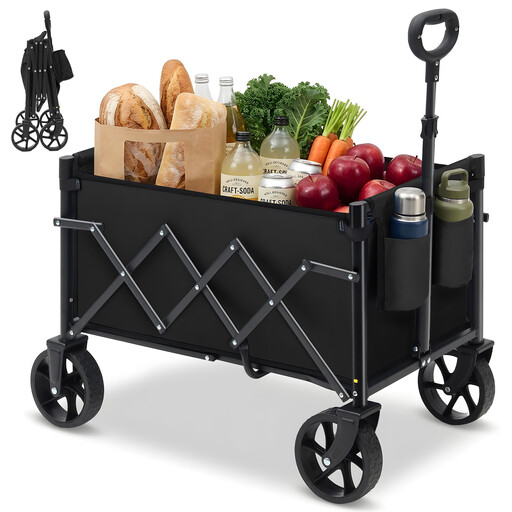
Why it suits this profile: For shopping, picnics and everyday use, a load capacity of 80 kg is often sufficient. According to the product information, the trolley weighs 4.8 kg and folds down compactly.
The stated capacity and net weight are clearly specified. Quick-release wheels make storage easier, but check that they are securely attached before use.
80 kg load capacity; adjustable handle with three positions; no assembly required according to the product description.
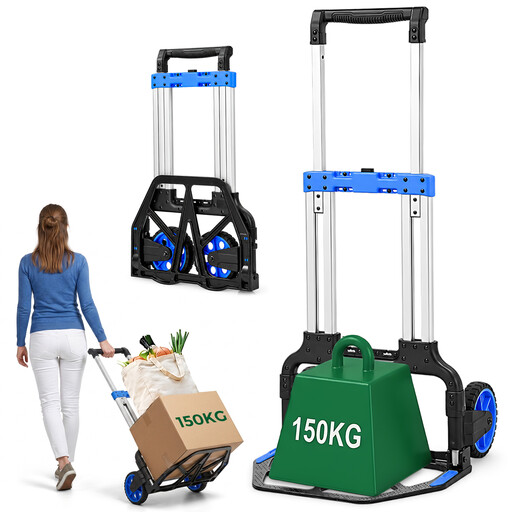
Why it suits this profile: This foldable sack truck is designed for boxes, crates, building materials and removals. The aluminium frame and adjustable handle are practical choices for regular heavy-duty transport.
The product information clearly states the maximum load of 150 kg, handle heights of 77 and 107 cm, and two tie-down straps.
150 kg load capacity; non-slip loading surface; TPR wheels with ball bearings according to the product description.
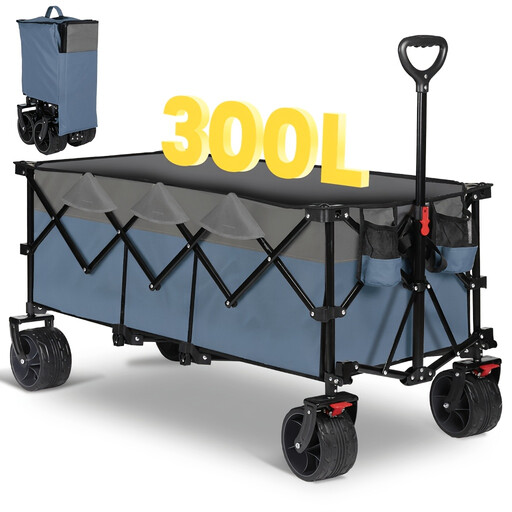
Why it suits this profile: Campers, keen gardeners and small business owners who transport large volumes can make use of the stated 300-litre capacity and 200 kg load capacity.
The product specification states both the load capacity and the storage volume. However, use the trolley on stable ground and distribute heavy loads evenly.
300-litre capacity; stated load capacity of 200 kg; wide 7-inch tyres and a four-way folding mechanism.
We’ve put together a complete, up-to-date list of products that fully meet these strict selection criteria and the applicable European safety regulations.
For shopping and everyday use, a model with a load capacity of around 80 to 100 kg is often sufficient. Pay particular attention to the trolley’s own weight, the adjustable handle and whether it fits compactly in your car. A shopping trolley with wheels and wide tyres is more convenient if you also travel over cobbles or pavements.
This is generally not recommended. Steel, bearings, brakes and fabric can wear out more quickly when exposed to rain, moisture and dirt. Clean the wheels, dry the fabric compartment thoroughly and store the trolley in a dry place. Always follow the manufacturer’s maintenance instructions.
Choose a foldable trolley or utility wagon for loose, bulky items such as camping equipment, shopping and gardening tools. A sack truck makes more sense for stacked boxes and crates. For storage at home, a mobile storage trolley with several levels may be more suitable than an outdoor trolley.
When making your choice, do not focus solely on marketing terms. Compare the load capacity, dimensions, wheel type, folded size and warranty. That way, you can find a heavy-duty transport trolley that suits your needs without paying unnecessarily for features you do not need.
