
Vandaag of morgen in huis

Kwaliteit gegarandeerd

Welkomstaanbiedingen ontgrendelen: GRATIS bezorging | Tot 80% korting | Gratis 30 dagen JoyPlus-proefperiode
Download de app
A foldable transport cart is useful for groceries, camping, gardening, beach days or moving boxes. However, not every cart is suited to the same tasks. A compact shopping trolley can be convenient in the city but may fall short when carrying heavy bags of potting soil. A large camping wagon offers plenty of loading space, but it also takes up more room in your car and storage area.
As a Joybuy Product Recommendation Officer, I filter product information based on practical considerations. Below, you’ll learn what to look for, which marketing pitfalls to watch out for and which models suit different usage scenarios.
A specification such as 200 kg load capacity sounds impressive, but it does not tell you everything about how the cart can be used. Also check:
Several models explicitly state that the cart must not be used as a seat or step. You should also stay within the maximum load specified in the product listing.
A large capacity in litres does not automatically mean that heavy or bulky items will be easy to transport. For example, a 300-litre cart may be suitable for camping equipment or gardening tools, but its dimensions can make it awkward to use in narrow hallways, lifts or car boots.
Consider both the capacity and the external dimensions. In practice, a foldable utility wagon with a capacity of 127 litres may be more convenient for a household than a much larger model.
Almost every collapsible utility wagon is described as compact. For that reason, check whether the product information includes the folded dimensions. Also look for:
A heavy wagon with a steel frame may be stable, but it is less practical if you regularly need to lift it in and out of your car.
For light groceries or laundry, a shopping trolley with a capacity of around 50 to 60 kg may be sufficient. For shopping crates, garden waste or moving supplies, a transport cart with wheels and a load capacity of 90 to 150 kg is more suitable. If you transport heavy camping equipment or large quantities of gardening tools, consider models whose product listing specifies 200 kg or more.
Distribute the load across the base and place heavier items at the bottom. This keeps the centre of gravity lower and reduces the risk of tipping. A cart loaded too high can become unstable even when the total weight remains below the stated limit.
Two small wheels are suitable for pavements and shops but are less practical on grass, sand or uneven paths. According to product descriptions, wide 7-inch wheels may be better suited to camping, gardening and the beach, although the surface remains the decisive factor.
A cart with brakes is particularly useful when loading, parking or stopping on a gentle slope. Some models specify that the brakes are intended solely for parking and must not be used while the cart is moving. Check this before using a cart on an incline.
For stairs, a shopping trolley with six stair-climbing wheels belongs to a different product category than a large utility wagon. The former is designed for groceries and smaller loads; the latter focuses on capacity and outdoor use.
Aluminium frames are relatively lightweight. According to product information, steel frames can support heavier loads but are often heavier themselves. Oxford fabric, such as 600D Oxford, is used for the loading bag in several product listings. A coating may help protect against splashes, but dry the bag after use before folding the cart.
Do not leave sand, mud or moisture on the wheels or in the folding mechanism for extended periods. Wipe the cart with a damp cloth and regularly check the joints, brakes and wheel attachments.
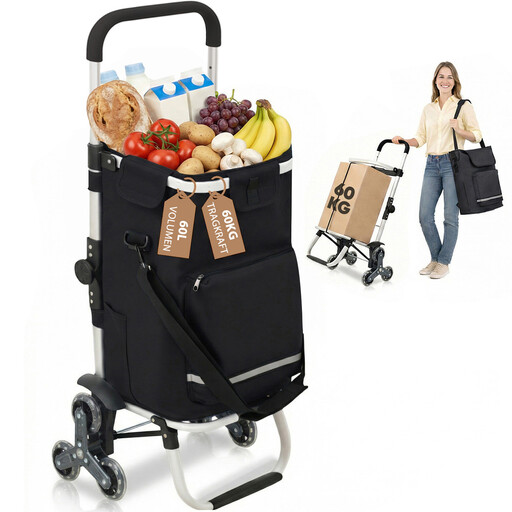
Why This Fits Their Persona: A lightweight option for everyday shopping, city use and short trips. According to the product details, the model weighs 4 kg and has a maximum load capacity of 60 kg.
The product listing specifies an adjustable handle, six PU wheels and a 3-in-1 design. Always check the load capacity before carrying heavy groceries.
60-litre capacity, aluminium frame, insulated cooler compartment and a bag that is detachable according to the listing.
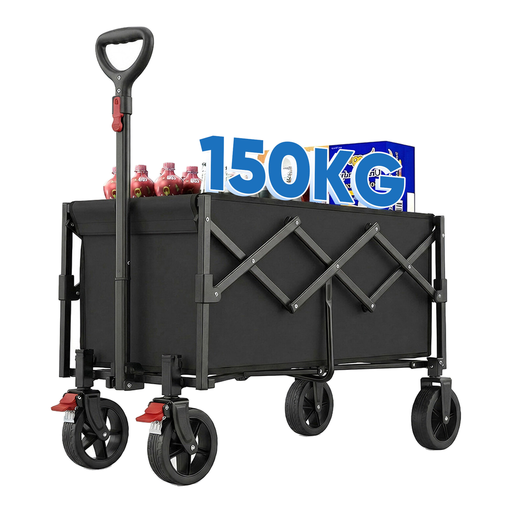
Why This Fits Their Persona: A good fit for households that want to transport groceries, gardening supplies or light camping equipment and store the cart in a cupboard or car boot.
The product information states an 80-litre capacity, a net weight of 5.8 kg and a load capacity of up to 150 kg. According to the listing, the bag and wheels can be removed for maintenance.
Foldable design, water-repellent 600D Oxford fabric and a stated load capacity of 150 kg.
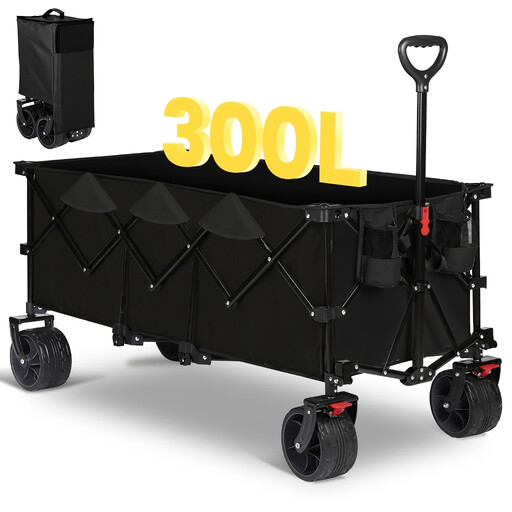
Why This Fits Their Persona: Designed for campers, gardening enthusiasts, movers and beach or festival visitors who want to transport a large amount of equipment at once.
The product listing specifies a locking mechanism, wide 7-inch tyres and parking brakes. Do not use the brakes while moving, and distribute the load evenly.
According to the product details, 300 litres of storage volume, a maximum load capacity of 200 kg and a square folding mechanism.
Browse a current selection of transport solutions and compare capacity, construction, wheels and intended use before placing your order.
That depends on the type. A shopping trolley with stair-climbing wheels is designed for smaller loads and often has multiple wheels. A large utility wagon with four wide wheels is generally intended for flat or reasonably stable surfaces. Always check the warnings and take extra care to keep the cart stable on stairs.
Its lifespan depends on the load, terrain, moisture and maintenance. Overloading and travelling over sharp stones put stress on the wheels, frame and seams. Wipe away sand and mud after use, allow the fabric to dry and check the folding mechanism regularly.
With normal use, maintenance is generally limited to cleaning, drying and checking the wheels, brakes and fasteners. A model with removable wheels or a detachable bag may be easier to clean. Never exceed the specified load capacity, and store the cart in a dry place.
