
Vandaag of morgen in huis

Kwaliteit gegarandeerd

Welkomstaanbiedingen ontgrendelen: GRATIS bezorging | Tot 80% korting | Gratis 30 dagen JoyPlus-proefperiode
Download de app
A foldable shopping trolley is ideal for anyone who shops regularly, does not want to carry heavy bags or has limited storage space. However, many models look very similar. A trolley may appear spacious in the product photo, yet prove disappointing in practice because of small wheels, an awkward handle or a bag that does not remain upright.
That is why you should focus mainly on the construction and how you intend to use it. Marketing terms such as “extra strong” or “suitable for seniors” do not say much on their own. Always check the dimensions, materials, wheel configuration, capacity and maximum load in the product specifications.
The stated load capacity is not the same as comfortable everyday use. A shopping trolley with a maximum load of 60 kg may technically carry a lot, but it becomes harder to steer when heavily loaded. The surface also makes a difference: paving slabs, kerbs and stairs put more strain on the wheels and frame than a flat supermarket aisle.
Treat the maximum load as an upper limit, not an everyday recommendation. Distribute the weight evenly and secure loose shopping properly.
A stair-climbing shopping trolley with six wheels can help on stairs and uneven surfaces. That does not mean every staircase can be tackled safely or comfortably with a full trolley. Check whether the model is suitable for your stairs, keep the load stable and do not use the trolley in a way the manufacturer advises against.
A shopping trolley with a cool compartment is practical for chilled shopping, drinks or a picnic. An insulating layer does not actively cool the contents. How long it remains effective depends on the starting temperature, the surroundings and any ice packs used. So think of a cool compartment as insulated storage, not as a replacement for an actively cooled cool box.
For a small daily shop, a compact trolley of around 30 litres may be sufficient. A 30-litre model is usually lighter and easier to store. If you shop for several days at a time or buy groceries for a family, a 60-litre shopping trolley or a high-capacity trolley is likely to be more suitable.
As well as the number of litres, consider the shape of the bag. A wide bag can be awkward in narrow aisles, while a tall bag raises the centre of gravity. Also check the external dimensions if you plan to store the trolley in a hallway, storage room or car.
According to the product specifications of various models, an aluminium frame offers a combination of low weight and support. Oxford fabric is often used for the bag and is described in product listings as hard-wearing and water-repellent. This does not mean the bag is fully waterproof, so protect your shopping during prolonged rain.
Wheels made from PU or PVC are suitable for a range of surfaces, but handling varies from one model to another. Two larger wheels are often easy to use on flat streets. Six wheels with a stair-climbing design are intended for kerbs and stairs, but may feel heavier when the bag is full.
Measure the trolley not only when unfolded, but also when folded. A foldable shopping trolley must actually fit in the space where you intend to store it.
An adjustable ergonomic handle can be useful for users of different heights. When assessing one, check whether the adjustment locks securely into place and whether the handle feels comfortable to hold. A 3-in-1 shopping trolley can also serve as a shopping trolley, sack truck and shoulder bag. These additional functions are particularly useful if you plan to use the trolley for more than just shopping.
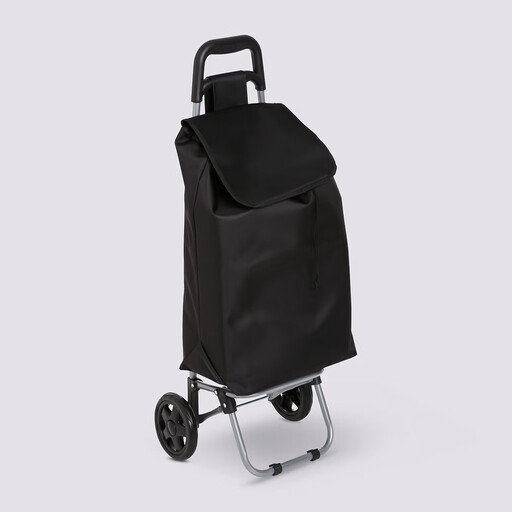
Why it suits this profile: The 30-litre capacity is suitable for smaller shops, while the foldable design makes it easy to store in a flat, storage room or car.
The product specifications clearly state the capacity, folding design and two-wheel configuration. This makes it easier to judge in advance what the trolley is suitable for.
30-litre capacity, foldable design and a weight of 1.33 kg according to the product information.

Why it suits this profile: This model combines a trolley, sack truck and detachable shoulder bag. It is well suited to city dwellers who want one product for shopping and days out.
The product information states the 60-litre capacity, securing strap and adjustable handle. The cool compartment is insulated; active cooling is not mentioned.
Aluminium frame, Oxford fabric bag, 60-litre capacity and a stated maximum load of 60 kg.
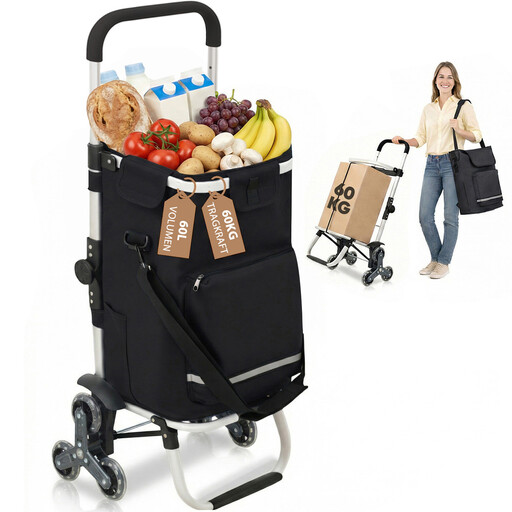
Why it suits this profile: The six PU wheels are designed for stairs and uneven surfaces. Combined with the sack truck function, this is practical for heavy shopping and transport tasks.
The specifications state the wheel type, dimensions of 36 × 42 × 98 cm and maximum weight. This allows you to compare the trolley with your staircase, storage space and usual shopping volume.
60-litre capacity, aluminium frame, PU stair-climbing wheels and adjustable handle according to the product description.
We have compiled a complete, up-to-date list of products that fully meet these strict selection criteria and the applicable European safety regulations.
Fully unfold the frame and check that all locks are securely fastened. Attach the bag, if necessary, following the instructions supplied. Then check the wheels, handle and any securing strap. For models supplied without assembly according to the product information, you can usually start using them immediately after unfolding.
Its lifespan depends on the load, surface, moisture and storage conditions. A trolley will generally last longer if you do not exceed the maximum load, distribute heavy shopping evenly and store the frame somewhere dry after use. Regularly check that the wheels, joints and handle are still working securely.
Maintenance is usually minimal. Many models can be cleaned with a damp cloth. Do not use abrasive products on plastic or coated parts, and only wash a fabric bag when this is expressly permitted. If your trolley has a cool compartment, it is advisable to let the inside dry thoroughly after use.
