
Vandaag of morgen in huis

Kwaliteit gegarandeerd

Welkomstaanbiedingen ontgrendelen: GRATIS bezorging | Tot 80% korting | Gratis 30 dagen JoyPlus-proefperiode
Download de app
A foldable shopping trolley may seem simple: a bag, two or more wheels and a handle. Yet there are clear differences in load capacity, stability and ease of use. If you only look at a low price or a large capacity, you could end up at home with a shopping trolley that is difficult to steer, does not fold away properly or feels less practical after just a few trips.
For Dutch consumers, these situations are particularly familiar:
That is why it is sensible to look at verifiable specifications before buying, rather than relying solely on marketing terms.
A wheeled shopping trolley is often described by its capacity in litres and maximum weight in kilograms. These values mean different things:
A shopping trolley with a capacity of 56 or 60 litres may be suitable for a larger supermarket shop, but also check whether the load can be secured properly. A tall, heavy bag can shift the centre of gravity. A tension strap or securing strap can be useful in this case.
A lightweight shopping trolley is easier to lift, but low weight should not come at the expense of stability. Aluminium is often used to keep the trolley’s own weight low. Steel or carbon steel may offer a different balance between strength and weight.
Pay attention to the type of wheel:
Also check whether the product description explicitly states which surfaces the model is designed for. “For uneven surfaces” does not guarantee that every pavement, cobbled road or staircase can be used without difficulty.
With a foldable shopping trolley, the dimensions both before and after folding are important. Measure the available space in your car, hallway or cupboard beforehand. A quick-fold mechanism is convenient, but check that the frame locks securely once unfolded.
An adjustable handle can be useful when several people use the trolley. For older people or anyone who prefers not to bend down deeply, the combination of handle height, trolley weight and wheel position is particularly relevant. No trolley automatically prevents physical strain; distribute the shopping evenly and lift the trolley safely when using stairs.
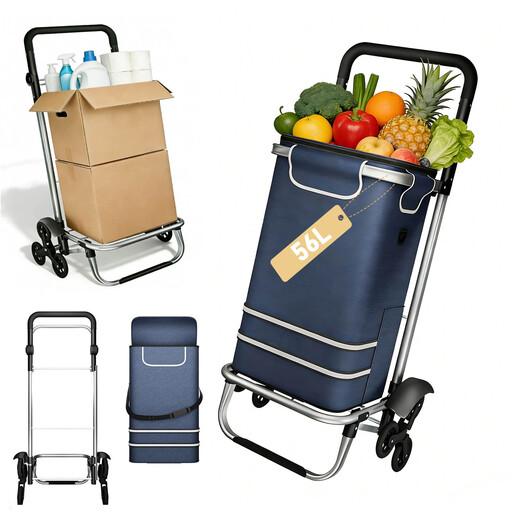
Why it suits this profile: A practical entry-level option for shopping and camping, with a stated capacity of 56 litres and a foldable design.
The stated capacity makes comparisons easier. Before buying, however, check the actual load capacity and folded dimensions.
56-litre capacity; suitable for shopping and outdoor activities; foldable for storage.
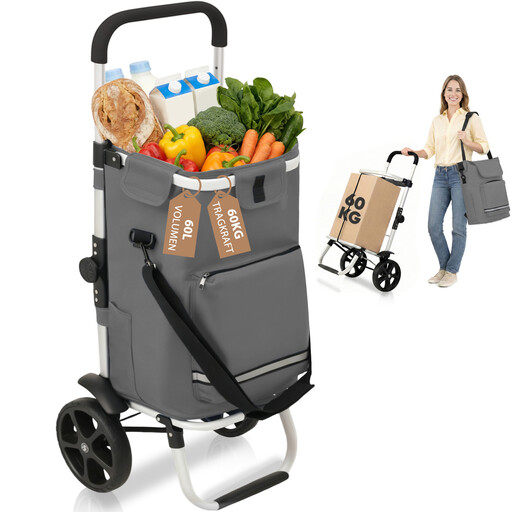
Why it suits this profile: For anyone wanting one transport solution for the supermarket, picnics and camping. The product information lists an aluminium frame, Oxford fabric, an insulated compartment and a capacity of 60 litres.
The product information states a maximum load of 60 kg and includes a securing strap. Do not treat this limit as a target weight, and secure the load properly.
3-in-1 use; 3.8 kg own weight; insulated compartment with aluminium insulation material; dimensions 36 × 42 × 98 cm.

Why it suits this profile: For boxes, crates, parcels or heavy shopping where an open loading platform is more convenient than a fabric bag.
The stated weight of 3.5 kg and three adjustable handle heights are clear specifications to assess. The load limit of 80 kg must not be exceeded.
3 handle heights; folds down to a stated width of 5.7 cm; TPR wheels; maximum load 80 kg.
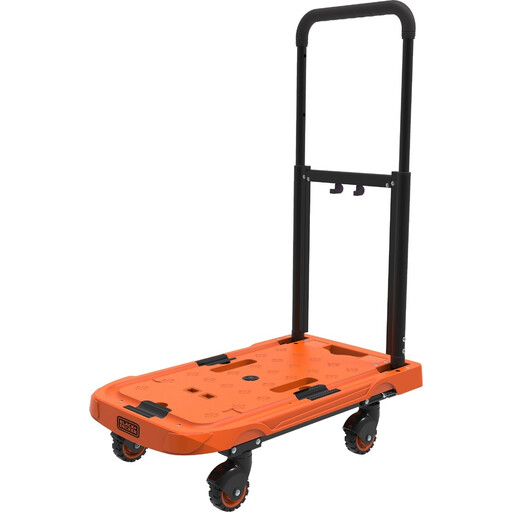
Why it suits this profile: An option for removal boxes, bags of compost or larger items. The flat loading platform is less focused on traditional shopping, but offers greater versatility.
The product information lists a loading surface of 61.4 × 37.3 cm and an adjustable handle. This allows you to check in advance whether boxes will fit securely.
Maximum load according to the product information: 89 kg; two fixed and two swivel castors; foldable; handle adjustable to three heights.
We have put together a complete, up-to-date list of products that fully meet these strict selection criteria and the applicable European safety regulations.
Unfold the frame fully and check that the mechanism is locked. Attach the bag according to the product instructions and place heavy items at the bottom. Distribute the weight as evenly as possible between the left and right sides. Before use, check that the wheels and handle are securely attached.
Its lifespan depends on the load, surface, storage conditions and maintenance. A trolley that is regularly pulled over kerbs places more strain on the frame and wheel connections than a model used only on smooth shop floors. Keep the hinges free from dirt, clean the surfaces with a slightly damp cloth and store the trolley in a dry place.
According to the product description, an insulated compartment can help keep food and drinks at a stable temperature for longer. The actual duration depends on the outside temperature, the quantity of products and whether cool packs are used. Put chilled shopping in the fridge as soon as possible and follow the storage instructions on the packaging.
