
Vandaag of morgen in huis

Kwaliteit gegarandeerd

Welkomstaanbiedingen ontgrendelen: GRATIS bezorging | Tot 80% korting | Gratis 30 dagen JoyPlus-proefperiode
Download de app
A foldable shopping trolley is handy for shopping trips, markets, days out and carrying items around town. However, a model that looks promising can sometimes disappoint in practice. A bag may seem spacious but support very little weight. Wheels can roll smoothly across a flat shop floor yet be awkward on pavements or stairs. It is also not always clear how compact the trolley really is after use.
By keeping these points in mind, you can avoid a disappointing purchase and choose a wheeled shopping trolley that suits your everyday needs.
A large bag does not automatically mean you can carry a lot of shopping comfortably. As well as capacity, pay attention to the maximum load, the frame and how the bag is attached to the base. A 60-litre shopping trolley may be suitable for a large supermarket shop, but become less practical if the frame is heavy or difficult to store.
Also check whether the stated capacity refers to the entire bag or just one individual compartment.
A shopping trolley with stair-climbing wheels can help with steps and uneven surfaces, but that does not mean every staircase can be tackled effortlessly. The design, load and width of the steps all make a difference. On a flat surface, six wheels may also feel different from two larger wheels.
Think of stair-climbing wheels as a specific feature for certain routes, rather than a replacement for careful manoeuvring. Always secure the load properly and do not exceed the stated maximum load.
An ergonomic shopping trolley should be comfortable to hold, but every user has a different height and preference. An adjustable handle is therefore more practical than a fixed one. Also check that the handle locks firmly and that the trolley does not constantly pull to one side when you are towing it.
A compact model may be sufficient for a small daily shop. If you shop less frequently, you may prefer a large-capacity shopping trolley. A capacity of 60 litres provides more room for packaged goods, vegetables and household items. Bear in mind that a full trolley can quickly become heavy.
Always check these three details:
Some models state a load capacity of 60 kg. This is a product specification provided by the seller, not an independent performance assessment. Use the trolley in accordance with the instructions and distribute heavy shopping evenly.
An aluminium frame is generally lightweight and suitable for anyone who regularly needs to lift their trolley. Carbon steel or steel may feel sturdy, but always check the product’s total weight. Oxford fabric and PVC are often used for the bag and wheels. Pay attention to the attachments, seams, base and protection against moisture.
A heavy shopping trolley can be stable, but it is not always convenient for older people or anyone with limited lifting strength. For use in a flat, a low tare weight and a simple folding mechanism are often more important than extra-large load capacity.
Measure the space where you plan to store the trolley: in a utility cupboard, hallway, shed or boot. A foldable shopping trolley saves space, but check whether the wheels, handle and bag can actually be folded flat or compactly.
Also consider the width. A wide shopping trolley may feel reassuringly stable, but can be harder to manoeuvre through narrow shop aisles, doorways or cycle paths.

Why it suits this profile: This model combines a shopping trolley, hand truck and detachable shoulder bag. With a capacity of 60 litres, it is suitable for everyday shopping and days out.
The product information lists the dimensions, a tare weight of 3.8 kg and a maximum load of 60 kg. This makes it easier to compare capacity and load-bearing capacity side by side.
60-litre capacity, aluminium frame, adjustable handle, integrated cooling compartment and securing strap according to the product description.
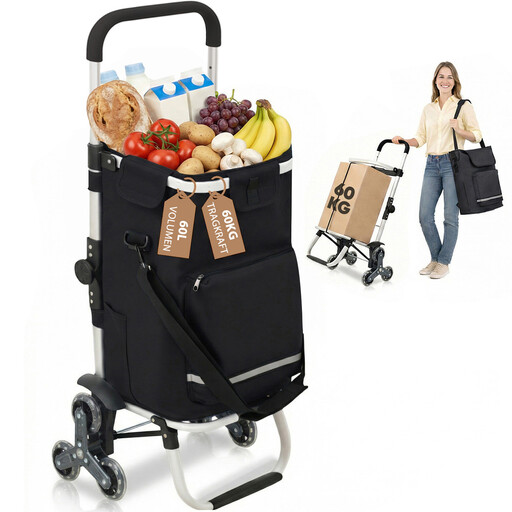
Why it suits this profile: For city dwellers who encounter pavements, uneven surfaces or stairs, this model combines six PU wheels, a hand-truck function and a detachable bag.
The product description explicitly mentions PU stair-climbing wheels, an adjustable handle and a maximum load of 60 kg. Using it on stairs still depends on the load and the circumstances.
Aluminium frame, Oxford fabric bag, six PU wheels, 60-litre capacity and 3-in-1 use according to the stated product specifications.
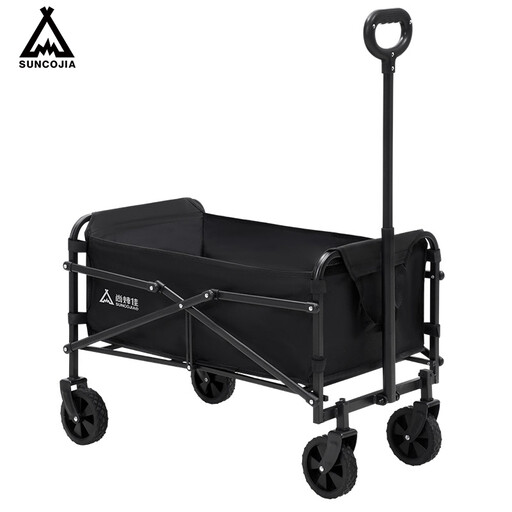
Why it suits this profile: This foldable transport cart is designed for large or bulky loads for camping, picnics, trips to the beach and occasional shopping.
The product information states a load capacity of 100 kg and a capacity of 170 litres. This clearly distinguishes a shopping trolley from a larger transport cart.
170 litres of loading space, stated load capacity of 100 kg, 600D Oxford fabric and multidirectional wheels according to the product description.
Use this quick checklist:
A shopping trolley for older people does not necessarily have to be the largest model. An adjustable handle, easy-to-use fastening and low tare weight may be more important in everyday use than extra litres of capacity. If you mainly use the trolley on stairs, look specifically for a shopping trolley with stair-climbing wheels. For trips to the market or picnics, a shopping trolley with a cool bag may be more practical.
We have compiled a complete, up-to-date list of products that fully meet these strict selection criteria and the applicable European safety regulations.
Wipe the frame, wheels and outside of the bag with a slightly damp cloth. Allow damp parts to dry completely before folding the trolley. Do not use harsh cleaning products without checking the product instructions first.
Its lifespan depends on the load, surface, storage and maintenance. Regularly pulling a bag that is too heavy puts strain on the wheels, seams and frame. Check the wheel attachments, folding mechanism and handle regularly. Storing the trolley in a dry place helps keep the materials in good condition.
There are no fuel or electricity costs when you use the trolley manually. However, the wheels, attachment components or bag may need replacing over time. The most important way to limit wear and tear is not to exceed the stated maximum load.
