
Vandaag of morgen in huis

Kwaliteit gegarandeerd

Welkomstaanbiedingen ontgrendelen: GRATIS bezorging | Tot 80% korting | Gratis 30 dagen JoyPlus-proefperiode
Download de app
A foldable garden trolley is handy for camping gear, shopping, garden waste or festival essentials. However, choosing the wrong one can quickly prove disappointing. A cart that looks spacious in the product photo may actually be too small for cool boxes and tent poles. A high load capacity also does not automatically mean that the trolley will remain stable on grass, sand or sloping paths.
As a Joybuy Product Recommendation Officer, I therefore focus mainly on verifiable details: load capacity, capacity, wheel type, brakes, dimensions and ease of storage. This allows you to compare a foldable transport trolley based on practical features rather than marketing copy alone.
A garden trolley with a capacity of 200 litres may offer plenty of room, but that does not mean it can also carry 200 kg. Both figures appear in the supplied product information, but they have different meanings:
Always check that the figures refer to the same product and version. For example, a product title may mention 200 kg, while the technical specification states 150 kg. In that case, it is sensible to check with the seller before loading heavy items.
A garden trolley with brakes is particularly useful when parking the cart. Some models explicitly state that the brakes are only intended to help keep it stationary and are not designed to slow it down while moving. Never leave a fully loaded trolley unattended on a slope, and do not use the brake as a substitute for controlled pulling.
A transport trolley with all-terrain wheels will generally travel more easily over grass, gravel or woodland paths than a model with small, narrow wheels. However, even a wide tyre has its limitations on loose beach sand. So pay attention to:
Choose a load capacity with some margin. For a family carrying beach gear, shopping and a cool box, 80 to 120 kg may be sufficient. For heavy garden materials or substantial camping equipment, a 150 kg foldable trolley is a more suitable choice. A 200 kg foldable trolley is worth considering if you regularly transport heavy, compact loads.
Distribute the weight evenly across the base and do not exceed the stated limit. A high maximum load does not automatically make a trolley suitable for every surface; the wheel construction, frame and load distribution still determine its stability.
A capacity of 80 litres is relatively compact and will fit more easily in a smaller boot. Models of 150 to 200 litres offer more room for camping or festival equipment. A 300-litre trolley is suitable for bulky loads, but it also takes up more space when unfolded.
Measure the following beforehand:
Many models use a steel or aluminium frame with 600D Oxford fabric. Product descriptions often describe this fabric as water-repellent or water-resistant. This does not mean that the load area is permanently waterproof. After using a foldable hand trolley outdoors, allow it to dry before putting it away.
A four-sided folding mechanism can make setting up and folding down easier. Always check that the frame is fully locked before loading it. Keep your fingers and hands away from the hinges when folding the trolley.
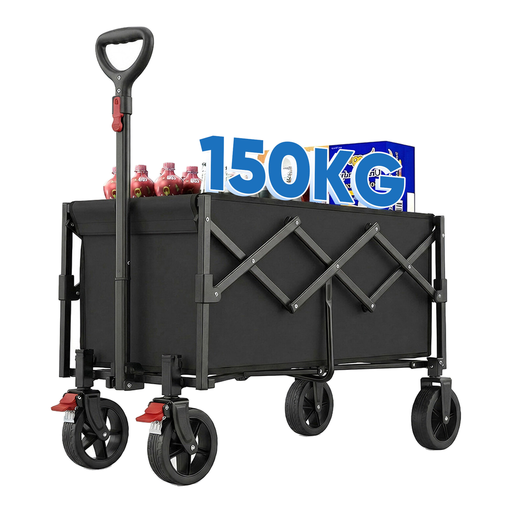
Why it suits this profile: This compact model is designed for smaller shopping trips, outings and use in or around the car. The product information states a weight of 5.8 kg and a capacity of 80 litres.
The limited capacity makes it clear that this is not a model for large family loads. This helps you avoid buying an oversized trolley for light, everyday tasks.
80-litre capacity, foldable design, and removable wheels and bag according to the product description.
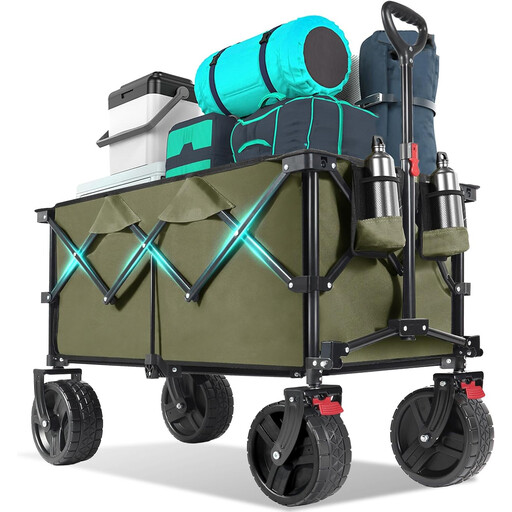
Why it suits this profile: For campers and festival-goers who need a spacious trolley. The product information states a capacity of 200 litres, a specified load capacity of 150 kg and 7-inch-wide all-terrain wheels.
Listing the capacity and load separately helps prevent you from confusing volume with carrying capacity. Use the stated 150 kg as your guideline.
600D Oxford fabric, adjustable handle, lashing straps and a folding mechanism requiring no assembly according to the product information.
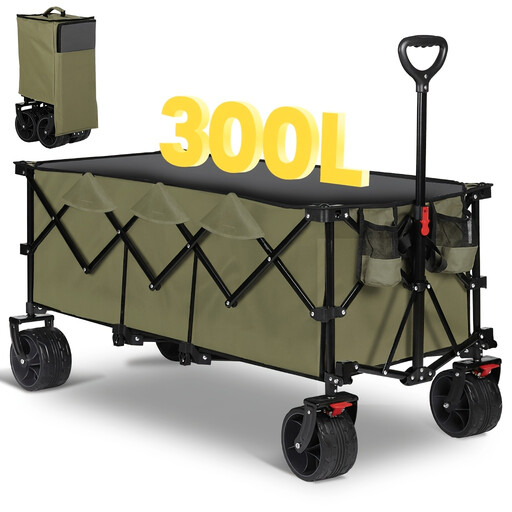
Why it suits this profile: For users transporting heavy and bulky items, such as garden materials or extensive camping equipment. According to the product information, it offers a capacity of 300 litres and a load capacity of 200 kg.
The large capacity is clearly linked to a separately stated load capacity. Even with this model, stay below the limit and distribute heavy loads evenly.
300-litre load area, wide 7-inch wheels, brakes and a two-sided 2-year guarantee mentioned in the product information.
We have put together a complete, up-to-date list of products that fully meet these strict selection criteria and the applicable European safety regulations.
Choose a model with wide all-terrain wheels, a sturdy frame and a spacious load area. Pulling across soft sand can still be difficult, even with wide tyres. A garden trolley for the beach and camping is therefore most practical on firm sand, paths and grass.
This varies by model. The range includes specifications from 80 to 200 kg. Always check the technical product information and ensure that the load is distributed evenly. Do not rely on a title or advertising copy alone when the specifications contradict one another.
Its lifespan depends on the load, surface, moisture and maintenance. Regular cleaning, storing it in a dry place, and checking the frame, seams, wheels and brakes will help you spot wear and tear early. A guarantee period, such as 2 years for some of the models mentioned, describes the guarantee offered and is not a fixed lifespan.
