If you’ll mainly be filming from one spot, first check whether the whole worktable and small movements will fit in shot. Then choose your camera and, if you’re using a mirrorless camera, the lens. A webcam is best suited to recording via a computer, while a compact gimbal camera is designed for additional moving footage. Also test audio clarity, mounting, power and storage with a trial recording.
Who is this setup suitable for?
Teacher demonstrating a craft
Wants students to follow how a floral arrangement is put together, as well as the small movements involved at the worktable. onlineBloemschikken describes classes in which techniques are demonstrated slowly and in detail.
Teacher who explains as they go
Talks while arranging flowers and wants their explanations to remain clear while attention is focused on the work. It’s worth testing the microphone and the distance from the camera or computer in practice.
Creator of varied lesson footage
Wants to capture details and moving footage of the arrangement as well as a fixed demonstration, and weighs that flexibility against the simplicity of a fixed setup.
What should you consider when choosing?
Mirrorless camera with interchangeable lens
Choose this option if: you want to film both the arrangement and your hands from a fixed position, and can match the lens to your working distance.
Trade-off: a body-only version and a lens kit are different purchases, so check which lens comes with the version you choose.
Webcam connected to a computer
Choose this option if: you record or teach via a computer and can securely point the webcam at the worktable.
Trade-off: a webcam that tilts down doesn’t guarantee that a taller arrangement will fit fully in shot. Also check the computer connection and mount.
Compact gimbal camera
Choose this option if: you want to film around the arrangement or table as well as capture a fixed demonstration.
Trade-off: a gimbal is no substitute for a secure, fixed mount above the worktable, and the lens cannot be changed.
| What to consider |
What to look for when buying |
Who should pay extra attention? |
| Getting the worktable and movements in shot |
Make a test recording from the planned height, showing the whole work surface and a small movement. With a mirrorless camera, check the lens; with a webcam, check the field of view and mount. |
If I want to show both the arrangement and small movements, the framing needs to work from my fixed position. Around 36% of consumers say showing the worktable is their top priority. |
| Clear audio |
Test a recording from where you would normally speak, and check which external microphones are compatible with the camera or computer setup. |
I want to be able to talk while arranging flowers without having to stand close to the camera all the time. Around 29% of consumers prioritise clear explanations. |
| Recording a full lesson |
Check the power supply, memory card, any recording limits and the storage space required for your chosen recording settings. |
If I want to record a lesson in one go, I need to know in advance that the power supply and storage will last for the planned duration. Around 21% of consumers say uninterrupted recording is their top priority. |
| Switching between fixed and moving footage |
Test the focus at the planned distance and arrange a separate, stable position for the fixed demonstration. |
I want to be able to film around the arrangement as well as capture a fixed lesson shot. Around 14% of consumers say changing camera angles is their top priority. |
Common mistakes
-
Choosing based on 4K alone
Resolution doesn’t tell you whether the whole work surface will be visible or the explanations will remain clear. So assess a test image and recording from your own workspace.
Depending on your setup, you may also need a suitable lens, mount, lighting or microphone.
-
Assuming a body-only camera is a complete kit
The Canon EOS R50 V version reviewed is a body without a lens, while the Sony ZV-E10 II lens kit is described as including a lens. Check the exact version and what’s in the box.
With a body-only version, you’ll also need to choose a suitable lens.
-
Confusing gimbal stabilisation with a fixed overhead view
The DJI Osmo Pocket 3’s gimbal is designed for moving camera footage, but it won’t automatically keep the camera above the worktable. Plan the fixed demonstration and moving close-ups as separate camera positions.
For a fixed lesson recording, you’ll need to arrange a secure, stable mount.
Relevant brands to consider
Sony
The ZV-E10 II is a mirrorless camera with an E-mount and interchangeable lenses, suited to a fixed setup where you want to choose the framing yourself.
- Sony Netherlands lists an APS-C sensor and describes a lens kit with an E PZ 16–50 mm F3.5–5.6 OSS II lens.
- The body and lens kit are different versions. These specifications come from the manufacturer and aren’t based on a practical test for flower arranging classes; check that the lens suits your working distance.
Canon
The EOS R50 V is a video-focused mirrorless camera with interchangeable RF lenses, suited to a fixed studio setup.
- Canon lists autofocus, a vari-angle screen and video features for this model.
- The body-only version reviewed doesn’t include a lens. The manufacturer’s specifications don’t establish how the camera performs when filming flower arranging, so choose a suitable lens separately.
DJI
The Osmo Pocket 3 is a compact gimbal camera for creators who also want to capture additional moving footage for their lessons.
- DJI specifies a three-axis gimbal, a focus range starting at 0.2 m and storage on a microSD card.
- The gimbal is no substitute for a fixed mount above the table, and the lens cannot be changed. Also check which accessories are included with the bundle you choose.
Logitech
The MX Brio is a webcam option if recording or teaching via a computer is your priority.
- Logitech describes Show Mode for showing desk work and lists built-in microphones.
- This doesn’t prove that a complete floral arrangement will fit in shot from your position. Check the mount and computer connection, and take a test image.
Cameras and webcams at Joybuy
This selection includes webcams for recording via a computer and a mirrorless camera with a zoom lens for a fixed setup around the worktable.
 No image available
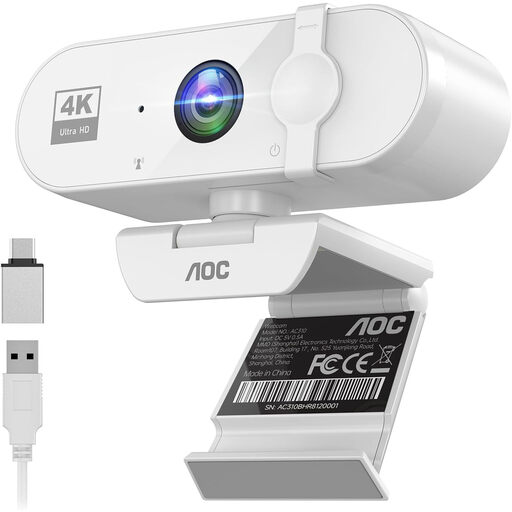
AOC 4K PRO webcam
A good fit for a computer setup if you’re looking for a webcam with a tabletop tripod to film work at the table.
The product information lists a 75° field of view, PDAF autofocus, dual microphones, and USB-A and USB-C connections. It also mentions 1080p at 60 fps; test your preferred recording settings and framing for yourself.
Joybuy
 No image available
AOC PC webcam with microphone
A good fit if you want to record worktable footage via a computer and can position the camera on a desk or tripod.
The product information lists 4K, a 99° field of view, a built-in microphone, tilt up to 180° and rotation up to 360°. Check with a test recording that your chosen angle captures the whole arrangement.
Joybuy
 No image available
Philips 4000 Series 4K UHD webcam, SPL6408BT/00
A good fit for a desktop setup if you’re looking for a webcam with autofocus, built-in microphones and a mounting clip.
The product title lists 8 MP, 4K UHD, dual microphones, a privacy shutter and EU Version. Test whether the mount and field of view work with your table setup.
Joybuy
 No image available
Sony ZV-E10 with 16–50 mm zoom lens, black
A good fit for a fixed setup if you want to adjust the framing of the work surface using a zoom lens.
The product title lists a 16–50 mm zoom lens. From the planned camera height, check that your chosen framing captures both the arrangement and your hands.
Joybuy
 No image available
Insta360 Link 2C Standard Bundle Graphite Black
A good fit for computer recording if you want to use DeskView to show work at the table.
The product information lists 4K, a 1/2-inch sensor, HDR, autofocus and a microphone with AI noise reduction. Use a test recording to check your preferred camera angle and audio clarity.
Joybuy
Frequently asked questions
How can I check that the flowers and my hands are in focus and fully in shot?
From the planned camera height, make a short test recording showing both the complete arrangement and a small movement. Check the framing and focus. An interchangeable lens or a tilting webcam gives you options, but neither guarantees the right shot without testing.
What should I have ready before recording a long lesson?
Check the mount, power and storage with your chosen recording settings, and test for the planned lesson duration. DJI says that recordings from the Osmo Pocket 3 are saved to an inserted microSD card. You’ll need to choose a lens separately for the Canon EOS R50 V body reviewed.
Does a faulty camera in the Netherlands always come with exactly two years of statutory cover?
No. According to the Dutch government, there is no fixed statutory guarantee period in the Netherlands; you’re entitled to a product that works as it should. Depending on the circumstances, a fault may entitle you to a free repair, replacement or refund. Normal wear and tear or damage caused by your own actions isn’t automatically covered.
Can I publish footage of identifiable participants in an online flower arranging class?
Not automatically. According to the Dutch Data Protection Authority, identifiable people in footage count as personal data. For professional or public publication, you need a valid legal basis under the GDPR. Consent is often one possible basis, but it isn’t the only one. The regulator describes an exception for footage that remains strictly private or is shared with a very limited group.


