
Precision docker
You want to control thrust and lateral movement separately while docking. Check which axes your game supports and which functions you can assign them to. Models from Thrustmaster, VKB and Logitech offer different control options.


If you already have a suitable stick, compare a standalone throttle with a control that can also handle lateral movement. If you don’t have a stick yet, consider a combined controller or a HOTAS set. For virtual docking, check which axes your game lets you assign separately, as well as how the controls will fit into your setup: a compact throttle may need to be mounted, while two bases take up more desk space.
You want to control thrust and lateral movement separately while docking. Check which axes your game supports and which functions you can assign them to. Models from Thrustmaster, VKB and Logitech offer different control options.
You don’t want a large cockpit taking up floor space, so you’re comparing a combined stick with separate devices or a throttle you can mount. VKB describes different versions for mounting and desktop use; they aren’t interchangeable.
You already have directional control and don’t want to buy a complete set when all you’re missing is a throttle. A standalone throttle, such as the Thrustmaster TWCS, is a different purchase from a stick with built-in throttle levers.
A good fit if: your flight stick already meets your needs and you want to control thrust separately. According to Thrustmaster, the TWCS has a sliding axis and a mini-stick; check whether your game lets you assign those inputs.
Trade-off: you’ll need a second device and enough desk width; the throttle doesn’t replace the stick.
A good fit if: you have a suitable mounting point and want to control movement in several directions. VKB describes the STECS Space Mini as a mountable space throttle.
Trade-off: VKB specifies that the Space Mini must be secured when used on a table; the STECS Mini Plus Mk.II is a different version.
A good fit if: you don’t have a stick yet and want to keep the number of separate devices to a minimum. The original Turtle Beach VelocityOne Flightstick combines a stick with two multifunction levers.
Trade-off: the throttle levers are on the stick base, not on a separate throttle.
A good fit if: you need both devices and can make room for two bases. Logitech lists mini analogue sticks for additional axes on the X56.
Trade-off: you’ll need room for both the stick and the throttle; the number of buttons doesn’t tell you how much space the set takes up.
A good fit if: you value separate movement controls and have room for two sticks. Thrustmaster describes the Sol-R 2 as a two-stick system.
Trade-off: this isn’t a standalone throttle and requires two setup spaces.
| Key consideration | What should you check? | Who is this important for? |
|---|---|---|
| Movement while docking | Check the axes on the exact model and whether your game lets you assign them separately to the movements you want. | If I want to control thrust and lateral corrections separately while docking, I first check the axes and in-game assignments. Around 34% of consumers prioritise control over docking movements. |
| Desk and mounting space | Measure the space available for all the bases and check whether the version you’ve chosen needs to be secured. | I don’t want a large cockpit taking up floor space, so I need to know whether the controller will fit on my desk or needs a mounting point. Around 33% of consumers give available setup space top priority. |
| Expanding without buying twice | Check what’s included in the box and how the controller connects to your existing setup. | If I already have a suitable stick, I want to add to my setup without buying a complete set again. Around 20% of consumers prioritise expanding an existing stick setup. |
| Keeping the setup simple | Check whether both the stick and throttle are included and whether the exact model is compatible with your platform. | If I’m looking for a complete control setup, I compare how many separate devices I’ll need to place. Around 13% of consumers prioritise a simple all-in-one setup. |
VKB specifies that the STECS Space Mini must be secured when used on a table. The STECS Mini Plus Mk.II is a different version, which VKB describes as having a steel base plate and non-slip feet for desktop use.
Check how the exact version needs to be mounted and whether you have a suitable mounting point.
For tabletop use, you may need a suitable mount for your desk, chair or sim rig.
The Thrustmaster TWCS is a throttle, while the original Turtle Beach VelocityOne Flightstick combines a stick with throttle levers. Check which controls you already own and what’s included with the version you’ve chosen.
Compare what’s in the box with your existing setup before you decide.
Turtle Beach lists different specifications for the original Flightstick and the Flightstick II. Features of one model don’t automatically apply to the other.
Check the full model name and compare it with the specifications for that exact version.
Offers a standalone throttle for anyone who already has a stick, as well as a two-stick system for a different approach to space-sim controls.
The STECS Space Mini is a mountable space throttle; the STECS Mini Plus Mk.II is a separate version described as a desktop device.
The original VelocityOne Flightstick combines stick controls with throttle levers.
The X56 is a HOTAS with a separate stick and throttle, for anyone with room for two bases.
VIRPIL offers the CDT-VMAX as a standalone PC throttle in a small-form-factor design.
These products are for anyone who wants to combine stick and throttle controls or add throttle controls to an existing sim setup. Check that each product’s connections and in-game functions suit the way you plan to use it.
 No image available
A good fit if you want to combine stick and throttle controls in one controller.
8 axes; 27 programmable buttons; OLED display; wired via USB-C; for Xbox Series X|S, Xbox One and PC with Windows 10/11.
 No image available
An option if you want combined stick and throttle controls for a PC flight sim setup.
For PC; black.
 No image available
A good fit if you want to add throttle controls to an existing sim setup.
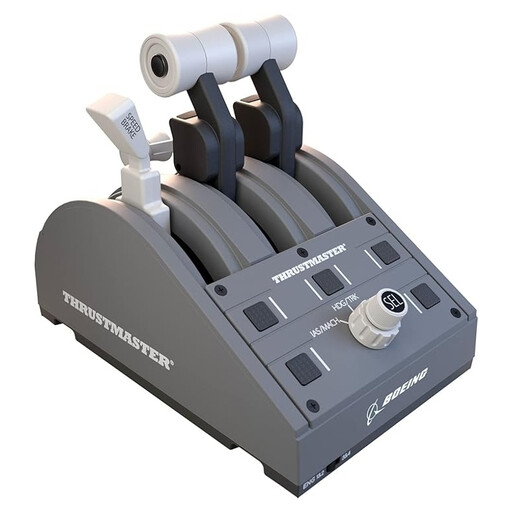
Grey version. For Xbox, the product description states that the TCA Yoke Boeing Edition must be connected.
No. VKB specifies that the Space Mini must be secured through its pre-drilled holes when used on a table. The STECS Mini Plus Mk.II is a different version; VKB describes it as having a steel base plate and non-slip feet for desktop use.
First, check which axes your controller has. If your game supports it, assign main and lateral thrust separately. Thrustmaster lists a throttle axis and mini-stick for the TWCS, but assignments depend on the game.
For online consumer purchases in the Netherlands, you generally have a statutory cooling-off period of up to 14 days after delivery, with some exceptions, according to ACM ConsuWijzer. Faulty products are also covered by the statutory guarantee: the seller is responsible, and its duration depends on what you could reasonably expect from the product.