
Radio practice on a single screen
You want to operate an assigned command within easy reach while flying, so you can focus on radio procedures. Whether this works depends on your simulator settings.


A flight throttle makes most sense if you want a supported command, such as an assigned push-to-talk button, within easy reach while flying. For physically setting and reading COM frequencies, a separate radio panel is a better fit. Then choose the levers to suit the aircraft you simulate, and check that the functions you want work with your platform, simulator and aircraft. A throttle does not provide voice communications by itself.
You want to operate an assigned command within easy reach while flying, so you can focus on radio procedures. Whether this works depends on your simulator settings.
You want to physically set and read COM frequencies. To do this, compare a radio panel with a throttle: they serve different purposes.
You want to use levers suited to the aircraft you’re simulating during radio practice. So look at the controls your aircraft requires.
First decide whether you mainly need an accessible button for assigned commands or want to physically set COM frequencies. Then choose lever controls that suit your aircraft and check they work in your simulator.
| Priority | What to look for when buying | Who this matters to |
|---|---|---|
| Accessible buttons | Check that the buttons are easy to reach and can be assigned to the commands you want. Set up push-to-talk in the voice client you use, too. | If I want to operate an assigned radio command while flying without repeatedly reaching for the screen, accessible buttons are my priority. Around 36% of consumers prioritise buttons for these commands. |
| Setting COM frequencies | Check the COM1/2 controls, how easy they are to read, and whether they’re supported by your simulator and aircraft. | If I want to physically set and read frequencies, I look for controls designed for the job. Around 29% of consumers prioritise physical frequency controls. |
| Controls suited to your aircraft | Compare the number of levers and configuration options with the aircraft you simulate. | If I practise with different aircraft types, I want levers that suit those aircraft. Around 21% of consumers prioritise suitable engine levers. |
| Platform and settings | Check the connection, platform support and assignments for the specific aircraft. | If I want to check before buying that the controls and simulator work together on my platform, compatibility and setup are key. Around 14% of consumers prioritise these factors. |
A throttle may offer levers and programmable commands, while a separate radio panel may be designed for setting and reading COM frequencies. Additional engine controls don’t replace frequency controls.
Before buying, decide whether you mainly need a button for an assigned command or physical controls for frequencies.
If physical COM controls turn out to be your main requirement, you may need a separate radio panel as well as a throttle.
In Microsoft Flight Simulator 2024, settings may vary by device, aircraft category or aircraft; some controllers need to be assigned manually.
Check the commands you want in your simulator and test them with the aircraft profile you practise with.
According to Honeycomb, the Honeycomb Bravo housing measures 273 × 382 mm, excluding the mounting plate or clamp.
Measure the space available beside your keyboard and mouse, and allow for mounting and room for your hands.
The range includes standalone throttles with buttons, HOTAS controls with a stick and throttle, and aircraft-focused quadrants.
Logitech G offers both a throttle quadrant for aircraft controls and a separate Flight Sim Radio Panel for radio and navigation functions.
The Bravo Throttle Quadrant can be configured for a range of aircraft types and includes an autopilot panel.
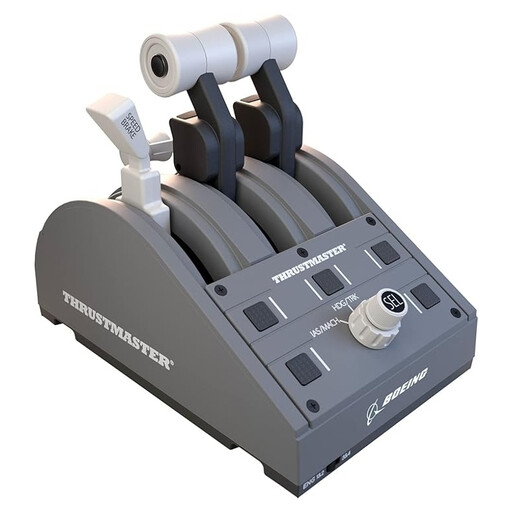
This selection focuses on physical throttle controls for flight simulation, including aircraft-focused controls for use alongside radio practice.
 No image available
An option for anyone who wants to use physical throttle controls during flight simulation.
The product listing names PC, Xbox, Xbox One X and Xbox Series S. For use with Xbox, the TCA Yoke Boeing must also be connected.
No. A throttle is a control device, not a voice client or microphone. For VATSIM, the network documentation describes using a pilot client, setting up a microphone and assigning a push-to-talk key. Check whether you can assign the throttle button you want to use.
According to Microsoft, select the connected device in Settings > Controls and check the general settings, as well as the profiles for the aircraft category and specific aircraft. Not every controller has a suitable profile by default, so check for conflicting assignments too.
Before installing, check the connection and support for your platform. Logitech lists a USB 2.0 connection for the Flight Throttle Quadrant J-U0014; Thrustmaster provides manuals and drivers for the TWCS. Have the exact model number to hand if you need support.
According to ACM ConsuWijzer, online purchases generally come with a statutory cooling-off period of up to 14 days after delivery, subject to exceptions. If a product is faulty, you also have rights against the seller under the statutory guarantee; this is separate from any manufacturer’s warranty.