
Navigation pilot flying a light aircraft
If you practise longer navigation legs, you may value separate engine controls and easy-to-reach cockpit functions, so you don’t have to keep reaching for your keyboard or mouse.


Choose a flight throttle based on the aircraft you usually fly and the controls you want within reach during a navigation flight. Separate engine levers may suit light aircraft, while airliner pilots may prefer aircraft-specific lever configurations and accessible route controls. Also check the space available for mounting and your simulator settings. A throttle won’t control how multiple monitors are displayed.
If you practise longer navigation legs, you may value separate engine controls and easy-to-reach cockpit functions, so you don’t have to keep reaching for your keyboard or mouse.
If you practise Airbus- or Boeing-style procedures, you can match the lever layout and accessible autopilot controls to the aircraft type and the functions you need en route.
If you have several screens on your desk, it’s worth checking how much room you’ll have left for a standalone quadrant, a modular setup or a combination with a yoke.
First, decide which functions you want to control physically while en route. Then compare the lever layout with your aircraft type and check that the device and its mount will fit on your desk.
| What to consider | What should you check? | Who is this important for? |
|---|---|---|
| Route controls within easy reach | Which controls are included, and whether your simulator and aircraft support the commands you want. | If I want to use physical controls for heading, altitude or other route functions while flying, I check that they can be assigned. Around 33% of consumers prioritise route controls. |
| Separate engine controls | The number of axes you need and which levers or buttons are included with the version you’ve chosen. | If you want to adjust engine power, propeller and mixture separately, suitable levers matter more than thrust settings designed for a particular aircraft type. Around 25% of consumers prioritise separate engine controls. |
| Levers for the aircraft you practise in | The specific lever settings, number of axes and functions available on the version you’re considering. | If I practise procedures for a particular airliner, I want the lever layout to match. Around 25% of consumers choose controls that are specific to their aircraft type. |
| Space, mounting and connection | The desk space available, the clamp or base, and the connection required. | If my screens already take up a lot of room, I want to know in advance whether the device can be positioned securely and comfortably. Around 17% of consumers give the most weight to space and connection. |
Screen layout and aircraft controls are separate settings, so a throttle quadrant won’t replace your multi-screen settings.
Check your screen setup separately from your levers and buttons. Microsoft Support explains how to arrange multiple screens in Windows; also check your simulator’s display settings.
Allow time to set up your screen layout and display settings in your simulator.
According to the installation guide, the VelocityOne Flight attaches to the yoke base. With a modular system, the lever modules you need may also depend on the version you choose.
Before buying, check what’s included in the box and how the device is mounted and connected. Don’t assume it can be used on its own if the guide refers to a base.
The layout and controls differ between versions. Thrustmaster’s Airbus version has two thrust levers; a second quadrant for four levers is available separately.
Let the aircraft and procedures you practise guide which version you compare. Also check which functions you can assign to the controls in your simulator.
You may need a second quadrant for four separate Airbus thrust levers.
The Bravo Throttle Quadrant is designed for people who switch between light aircraft and airliners and want a choice of lever configurations.
The Flight Throttle Quadrant has a separate lever setup for anyone who wants to control engine power, propeller and mixture, for example.
The TCA Quadrant Airbus Edition and TCA Quadrant Boeing Edition are aircraft-specific options with different layouts.
The MTQ is a modular quadrant for anyone who wants to switch between aircraft types or lever styles.
According to the manufacturer, the VelocityOne Flight combines a yoke with a modular quadrant and trim wheel.
These flight controls may be relevant when putting together a setup for virtual navigation flights. Check each model to make sure its controls suit the throttle and aircraft functions you want.
 No image available
An option for anyone looking for a flightstick as well as throttle controls; the product title also mentions an OLED display.
The title lists 8 axes, 27 programmable buttons and a wired USB-C connection. Compatibility listed includes Xbox Series X|S, Xbox One and PCs running Windows 10/11.
 No image available
A flight control system to compare if you want to combine throttle controls with a flightstick. Check that the controls suit your aircraft and simulator.
The product title lists the colour as black and states that it’s for PC use.
 No image available
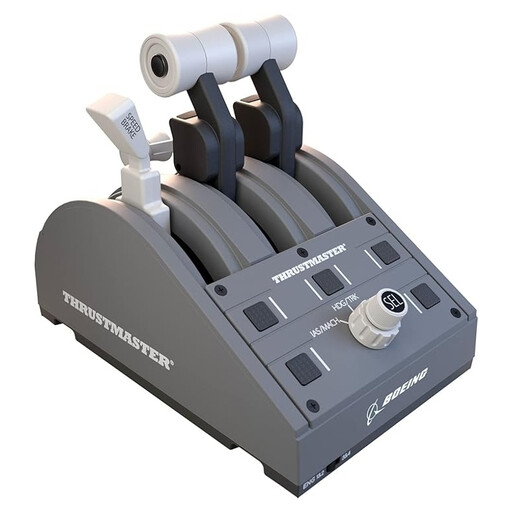
An aircraft-specific option for anyone looking for Boeing-style controls. Thrustmaster describes controls for altitude, speed and heading; check that the functions suit the aircraft you use in your simulator.
The product title lists a grey version and a USB joystick for PC and Xbox.
No. Choose a throttle for aircraft controls and set up your screen layout separately. Microsoft Support explains how to arrange multiple screens in Windows; display settings also depend on your simulator.
After connecting it, check which function each axis or button is assigned to for each aircraft. Honeycomb provides aircraft profiles for the Bravo. For the VelocityOne Flight, Turtle Beach recommends choosing the correct profiles for both YOKE and QUAD in Microsoft Flight Simulator.
Don’t assume so: according to Turtle Beach’s PC installation guide, the quadrant attaches to the yoke base. Check the mounting instructions for the version you’re considering.
For eligible online purchases from a business, you generally have 14 days to change your mind; check the terms and exceptions. In the Netherlands, you’re also entitled to a product that is fit for purpose. According to the Dutch government, there is no fixed statutory guarantee period, and the retailer is your point of contact if something is wrong.