
Learners practising GA navigation
If you fly routes in light aircraft, consider whether you need separate controls for power, propeller and mixture, and whether you need to reach them without constantly looking at an instrument display.


Choose a flight throttle based on the aircraft and the functions you want to operate while navigating, not on the number of monitors. A programmable quadrant suits a range of GA configurations, while a model with autopilot controls or an aircraft-specific layout puts different functions within easy reach. Also check your simulator settings, connections and available mounting space.
If you fly routes in light aircraft, consider whether you need separate controls for power, propeller and mixture, and whether you need to reach them without constantly looking at an instrument display.
If you practise in both light aircraft and airliners, you can choose between reassignable levers and physical autopilot controls that suit the simulator functions you use.
If you practise procedures for Airbus or Boeing aircraft, you can match the quadrant’s layout and functions to the aircraft family used in your simulator.
First decide which controls you want to operate physically while navigating. Then check the axis layout, connections and available space in your setup.
| What to consider | What should you check? | Who is this important for? |
|---|---|---|
| Navigation functions within easy reach | Count the individual axes your virtual aircraft requires and check which levers you can assign or swap. | If I want to adjust settings directly while navigating, I prioritise having physical access to them; around 40% of consumers say navigation controls are their main buying concern. |
| Axes for different aircraft types | Compare the available autopilot controls with the functions of your chosen aircraft, and check the button assignments in your simulator. | When I switch between light aircraft and airliners, I want to adapt the axis layout to the aircraft; around 30% of consumers put this flexibility first. |
| Layout for an airliner family | Check the levers, detents and autopilot functions for the aircraft you want to practise in, as well as the relevant PC or console connection. | For Airbus or Boeing procedures, I look for controls that suit the aircraft family I’ve chosen; around 20% of consumers prioritise aircraft-specific controls. |
| Space and connections | Measure the space needed for the clamp, cables and lever movement, and check the available USB port and model instructions. | If my desk is already crowded with screens and controls, the quadrant must fit with its clamp and moving levers; around 10% of consumers prioritise placement and connections. |
Screen layout and flight controls are separate settings. A throttle does not determine how you arrange multiple screens.
First decide which functions you want to operate physically in your chosen virtual aircraft. Then set up your screens separately in the simulator and on your computer.
Models differ in their axes, lever layouts and stated autopilot functions. Controls designed for one aircraft do not automatically suit another type.
Compare the quadrant’s functions with those of the aircraft you actually want to practise in, and check which functions you would otherwise control through the simulator.
The stated dimensions of the Honeycomb Bravo exclude the mounting plate and clamp. Cables and lever movement also need space.
Measure the full available space alongside your other cockpit controls. You may need a different mounting solution or to rearrange your desk.
A manufacturer’s warranty does not replace your statutory rights. The Government of the Netherlands says that the retailer must provide a solution if a product is faulty.
Check exactly what the warranty covers and compare it with your existing statutory rights before considering additional cover.
The Flight Throttle Quadrant is designed for assigning levers individually alongside your existing flight controls.
The standard Bravo is designed for a range of GA and commercial layouts and, according to the manufacturer, has an autopilot panel.
The TCA Quadrant Airbus Edition and Boeing Edition have different layouts designed for their respective aircraft.
The VelocityOne Flight combines a yoke with a throttle quadrant.
This selection includes a Boeing-focused quadrant and a PC flight system with a throttle for general flight control. Check that each model’s layout suits your simulator and aircraft choice.
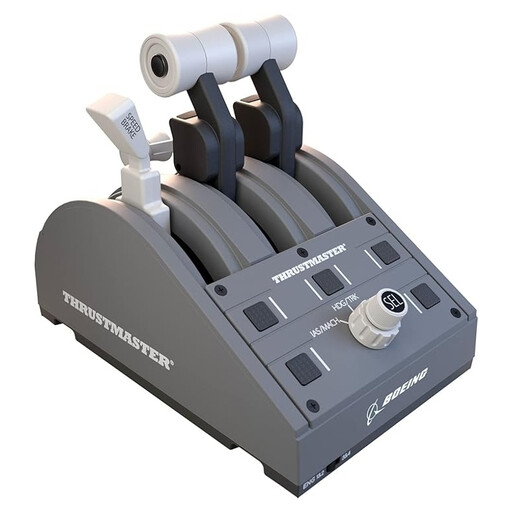 Image unavailable
May suit Boeing-focused practice if you want to set altitude, airspeed and heading using physical autopilot controls.
The product description lists three axes, 17 action buttons and interchangeable levers. For Xbox use, a TCA Yoke Boeing Edition is required, according to the product description.
 Image unavailable
May suit PC flight control if you’re looking for a joystick with a throttle and programmable controls.
The product description lists a metal throttle lever with a switch function, programmable buttons, a 3D rudder function, Windows compatibility and USB 2.0.
No. A throttle is input hardware; you set up your screen layout separately in the simulator and on your computer. The X-Plane 12 manual treats monitor configuration and flight controls as separate settings.
For each aircraft, assign the axes to the functions you want to operate and calibrate them in the simulator. X-Plane explains how to assign and calibrate axes and buttons, including for throttle quadrants. If you use another simulator, follow its own settings.
According to Thrustmaster, no: for PC use, the quadrant can be connected directly to a USB port on the computer. The manufacturer lists different requirements for Xbox use, so check your platform before ordering.
If a product is faulty, your statutory rights under Dutch law may entitle you to a solution; the retailer is your point of contact. According to the Government of the Netherlands, there is no fixed statutory two-year guarantee period for all products in the Netherlands.
For many qualifying online purchases from a business in the Netherlands, the Government of the Netherlands says you have a 14-day cooling-off period. Check the terms and exceptions for your specific purchase; this is not a general rule for purchases from private individuals.