
Pilots who want to control several engine functions
You mainly fly regional routes and want to work out which engine and flight functions you’d like to assign to their own levers before choosing.


First, match the number of levers and separately assignable axes to the aircraft you simulate most often. Then measure the space you need, including the mounting area and lever movement. A standalone quadrant works with an existing stick or yoke; a set with a yoke makes most sense if you need that control too. Also check the platform requirements and settings for the exact model.
You mainly fly regional routes and want to work out which engine and flight functions you’d like to assign to their own levers before choosing.
You want to place a throttle alongside your existing controls while allowing for its mounting and the levers’ range of movement.
You use different types of aircraft and want a layout you can adapt, or you’re deciding whether you need a yoke as well as a throttle.
For regional flights in a compact cockpit, first consider which controls you need to use at the same time. Then look at the space available, adjustability and compatibility with your existing equipment.
| Key consideration | What to look for | Who is this most relevant to? |
|---|---|---|
| Independent control | List the engine and other functions on the aircraft you usually fly. Compare the number of axes and levers on the exact model. | If you want to control engine functions directly, what matters most is how many commands you can assign separately at the same time. Around 33% of consumers say independent control is their main consideration. |
| Space and mounting | Measure the available space, mounting edge and lever movement. Check whether the stated dimensions exclude the clamp or mounting plate. | With a small desk, you’ll want to know whether the complete setup will fit alongside your other controls. Space and mounting are the main concern for around 27% of consumers. |
| Switching between aircraft | Check whether the levers are interchangeable, whether detents can be disabled and whether you can assign functions in your simulator. | If you switch between aircraft types, an adaptable layout may matter more than a fixed layout for one aircraft. Around 20% of consumers prioritise adjustability. |
| Platform and existing controls | Check your platform and simulator, and whether the exact quadrant connects on its own or needs to be connected through a specific stick or yoke. | If you want to use the throttle with your current equipment, its connection needs to suit your setup. Around 20% of consumers prioritise platform and device compatibility. |
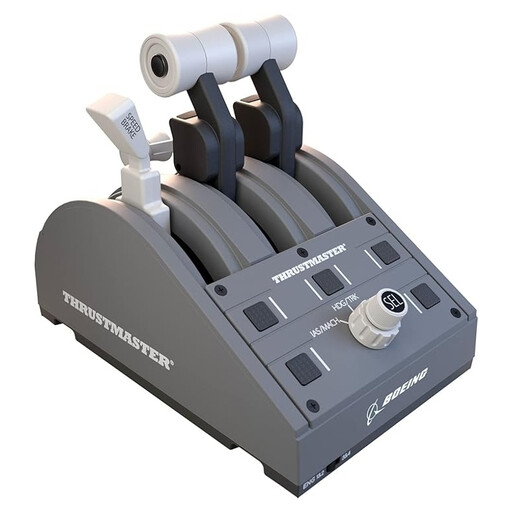
The Thrustmaster TCA Quadrant Boeing Edition comes with four levers, but the model has three axes. So the number of levers doesn’t tell you how many functions you can assign separately at the same time.
Compare the number of axes with the engine and other functions you want to control independently at the same time.
The dimensions Honeycomb gives for the Bravo LITE don’t include the mounting plate and clamp. The space you actually need will also depend on how you mount it and how far the levers move.
Measure the entire setup you have in mind, including the clearance needed to operate the controls, before choosing a model.
According to Thrustmaster’s manual, the TCA Quadrant Boeing Edition must be connected to a TCA Yoke Boeing Edition to be recognised on Xbox.
Check how the exact model connects and which controls you already own.
This Xbox setup requires a TCA Yoke Boeing Edition, sold separately.
A standalone throttle quadrant with three levers, designed to complement existing flight controls.
Separate TCA Quadrant models with Airbus- or Boeing-inspired controls; features and platform requirements vary by model.
Bravo quadrants with different numbers of interchangeable levers for a range of aircraft layouts.
According to Turtle Beach, the VelocityOne Flight combines a yoke with a modular throttle quadrant.
This selection includes a flight stick with throttle functions and a standalone, Boeing-focused quadrant. Check which setup suits your existing controls and available cockpit space.
 No image available
The two levers described provide physical control of engine power and additional flight functions; compare the dimensions with the space you have available.
Stated dimensions: 16,4 × 21,7 × 23,0 cm.
Wired USB-C connection; the product name lists Xbox Series X|S, Xbox One and PC with Windows 10/11.
 No image available
This standalone quadrant is designed for those looking for Boeing-inspired throttle controls; check the connection requirements for your platform before choosing.
Four interchangeable levers and three axes.
According to the manual, to use the quadrant on Xbox, you need to connect it through a TCA Yoke Boeing Edition, sold separately.
That depends on which engines you want to control independently and the commands in the aircraft profile you’ve chosen. The TCA Quadrant Airbus Edition has two physical thrust levers; compare these with the functions you want to assign in your simulator.
Remember to measure the mounting area and the space the levers need to move. Honeycomb gives dimensions of 273 × 330 mm for the Bravo LITE and 273 × 382 mm for the Bravo, excluding the mounting plate and clamp.
According to the manual, for the quadrant to be recognised on Xbox Series X|S or Xbox One, it must be connected to the back of a TCA Yoke Boeing Edition, sold separately. This requirement applies to that Xbox setup and does not automatically apply to every quadrant or PC configuration.
No. ACM ConsuWijzer distinguishes between a manufacturer’s or seller’s warranty and your statutory right to a product that meets the standards you can reasonably expect under normal use. If a product is faulty, the seller is your point of contact; what you can expect depends on the circumstances.
The Dutch Authority for Digital Infrastructure (Rijksinspectie Digitale Infrastructuur) states that CE marking is required for equipment covered by the relevant equipment regulations. Check the product and manufacturer details for the specific offer; general information does not prove that a particular item meets all applicable requirements.