
Propeller aircraft pilot
You want to control the engine functions of the aircraft you simulate on mountain routes separately, where the aircraft has those functions.


First, choose the levers and functions that suit the aircraft you usually fly. For some propeller aircraft, separate controls for throttle, propeller and mixture are more useful than Airbus-style detents. Then consider how easy the controls are to reach, how they’re mounted and how they connect to your platform. A standalone quadrant can complement an existing stick or yoke; a combined set also provides primary flight controls. However, product specifications can’t guarantee comfort during long sessions.
You want to control the engine functions of the aircraft you simulate on mountain routes separately, where the aircraft has those functions.
You’re looking for easily accessible throttle control and extra controls without replacing your stick or yoke, and you need to be able to position the throttle in your workspace.
You don’t yet have a stick or yoke, and you’re comparing a combined controller with a standalone throttle alongside separate primary controls.
Start with the functions of the aircraft you usually fly, then check that the throttle is compatible with your existing controls, workspace and platform.
| What to consider | What should you check? | Who is this most relevant to? |
|---|---|---|
| Separate engine controls | Check which engine functions your aircraft has, and whether your simulator lets you assign throttle, propeller and mixture to separate axes. | For a propeller aircraft, I want to control the relevant engine functions separately, if the aircraft has them. Around 36% of consumers prioritise separate engine controls. |
| Accessibility and positioning | Measure the available space, including the clamp or mounting plate, and think about where you’ll position your hand. | During a long session, I want to be able to reach the lever without it getting in the way of other controls. Around 29% of consumers prioritise accessibility and mounting position. |
| Quick access to functions | Make a note of the trim, switch or autopilot functions you use frequently, and check whether your simulator lets you assign them. | If I often use the same extra functions during a flight, I want them within easy reach, provided my simulator supports the assignments. Around 21% of consumers mainly choose a throttle for quick access to extra functions. |
| Controls and platform | Check whether you already have a stick or yoke, and whether the exact model works with your PC or console, possibly with additional equipment. | If I don’t yet have a stick or yoke, I want to know whether I need a combined device and whether it’s compatible with my platform. Around 14% of consumers base their choice mainly on their existing controls and platform compatibility. |
A standalone quadrant and a flightstick with integrated levers don’t control the same parts of the flight setup.
First, work out which primary controls you already have. Then choose between a standalone throttle as an addition and a combined set.
If you don’t have a stick or yoke, a standalone throttle may mean you also need separate primary controls.
Honeycomb lists the Bravo’s base as 273 × 382 mm, excluding the mounting plate and clamp. Measuring only the base won’t tell you how much space you’ll need overall.
Also measure the edge of your desk, the mounting position and the space needed for your hand and the levers to move.
A limited workspace may require you to rearrange things or find another mounting solution.
An Airbus-focused quadrant has a different layout from a propeller aircraft with separate mixture and propeller controls. For four separate thrust levers, Thrustmaster recommends a second quadrant.
Compare the functions of the aircraft you usually fly with the axes and levers you want to assign.
A second quadrant may be needed for the four separate thrust levers mentioned.
Honeycomb lists additional requirements for using the Bravo with Xbox: according to the manufacturer, you’ll need an Alpha XPC and Xbox Hub.
Check the exact model, your platform and any additional equipment required before ordering.
This Xbox setup also requires the additional devices listed above.
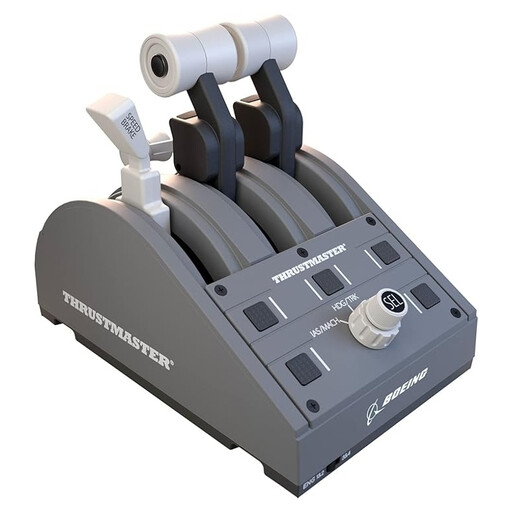
The Flight Throttle Quadrant is a standalone solution with three levers, designed for those who already have primary flight controls.
Honeycomb positions the Bravo Throttle Quadrant for configurable setups with general aviation and commercial aircraft types, featuring an integrated autopilot panel.
The TWCS features a sliding throttle with buttons. According to Thrustmaster, the TCA Quadrant Airbus Edition has an Airbus-focused layout with two thrust levers.
The VelocityOne Flightstick is worth considering if you also need a stick; it isn’t a direct replacement for a standalone quadrant with three levers.
This selection includes both a combined flightstick with throttle levers and a standalone throttle quadrant for a setup with separate primary flight controls.
 No image available
Suited to a setup where you need primary flight controls as well as throttle control.
Turtle Beach describes it as having two multifunction levers and a trim wheel. The product name lists eight axes, 27 programmable buttons and an OLED screen.
The product name lists USB-C and compatibility with Windows 10/11, Xbox Series X|S and Xbox One.
 No image available
Suited to a setup where you already have separate primary flight controls and are looking for a throttle quadrant.
The product name lists PC and Xbox. According to the product information, the TCA Yoke Boeing Edition must also be connected for Xbox use.
A standalone throttle doesn’t provide primary flight controls by itself. Check which controls you already have and which input devices your simulator supports. Microsoft Flight Simulator, for example, describes setups with a stick or yoke alongside a throttle.
Assign the axes and buttons in each aircraft profile to functions that the simulated aircraft actually has. An interchangeable lever knob or a switchable detent changes the physical controls, but you should also check the assignments in your simulator.
No, it varies by model. For using the Bravo with Xbox, Honeycomb lists an Alpha XPC and Xbox Hub as additional requirements; Thrustmaster describes the TCA Quadrant Airbus Edition as a PC model. Check the exact version and the full connection setup.
For a standard online purchase by a consumer in the Netherlands, there is generally a statutory cooling-off period of up to 14 days after delivery. ACM ConsuWijzer lists some exceptions, so check which terms apply to your purchase.
In the Netherlands, your statutory rights apply alongside any manufacturer’s warranty. According to ACM ConsuWijzer, the seller must offer an appropriate solution if the product doesn’t meet what you could reasonably expect from it under normal use; there isn’t one fixed warranty period that automatically applies to every product.