
Someone sharing a desk
You want to clear your desk after practising, so you’re comparing a single unit with controls on its base against a setup with two separate parts.


Choose a flight stick based on the controls you want to practise for your chosen aircraft and how much desk space you have. Checklists vary by aircraft, so assign the functions you need in your simulator; a stick with throttle controls on its base needs a different desk layout from a HOTAS set with a separate throttle. Product specifications won’t tell you how noisy a model will be in your bedroom.
You want to clear your desk after practising, so you’re comparing a single unit with controls on its base against a setup with two separate parts.
You want to assign common pre-flight actions to familiar controls. A flight stick won’t carry out an aircraft checklist for you.
You want to control engine power with your other hand and have room for a second control unit.
Best for: anyone who wants to keep the stick and throttle controls on one device and put it away after practising. Turtle Beach lists two multi-function levers on the VelocityOne Flightstick; Thrustmaster describes the TCA Sidestick X as having a throttle on the base.
Bear in mind: the levers are on the stick’s base and aren’t the same as a separate throttle.
Best for: anyone who wants to control engine power with their other hand and has room for two components. Thrustmaster describes the T.Flight Hotas One as having a detachable throttle and the T.16000M FCS Hotas as a PC set with a TWCS throttle.
Bear in mind: both components need desk space while you practise. Check platform compatibility and exactly what’s included in the set, too.
Best for: anyone who wants to start with basic controls and assign functions themselves. Logitech G describes the Extreme 3D Pro as having a twist rudder control and programmable buttons.
Bear in mind: the listed features don’t include a separate throttle. Don’t assume it’s compatible with consoles based on the number of buttons.
| Buying concern | What should you check? | Who is it more important to? |
|---|---|---|
| Space and storage | Compare the full model’s base dimensions, cable routing and clearance for movement with the free space on your desk. | If I want to use my shared desk again after practising, a setup with fewer separate parts matters to me. Around 33% of consumers say clearing the desk is their main buying concern. |
| Checklist controls | Make a note of the functions for your chosen aircraft, then check the button and axis assignments in your simulator. | If I want to practise repeated pre-flight actions, I want to be able to assign the functions I need to controls within easy reach. Around 27% of consumers say these assignments are their main concern. |
| Platform and simulator | Check the exact model, your platform and compatibility with the simulator you use. | If I want to practise on my own PC or console, I want to know in advance whether the stick is compatible with my platform. Around 20% of consumers give platform compatibility top priority. |
| Separate throttle | Check that the set actually includes both a stick and a throttle, and that both fit securely on your desk. | If I want to control engine power with my other hand, I’m looking for a setup with a separate control. Around 20% of consumers put this requirement first. |
Checklists vary by aircraft. The number of buttons won’t tell you which actions are assigned to them in your simulator.
Start with one aircraft and a short list of actions you want to practise regularly. Test each assignment in the simulator.
A stick with levers on its base is different from a set with a separate throttle. Check the full product name and the list of items included in the offer you’re considering.
Before buying, check that the throttle you expect is actually included in the set.
A small setup tells you nothing about the noise made by clicking or moving controls in a shared bedroom.
Consider noise levels separately and, where possible, try the controls in the room where you plan to practise.
The VelocityOne Flightstick is an option for anyone who wants throttle and other controls on a single device base. Turtle Beach lists support for certain Xbox platforms and Windows 10/11.
The models described differ in their throttle controls: the TCA Sidestick X has them on the base, while the T.Flight Hotas One and T.16000M FCS Hotas have a separate throttle.
The Extreme 3D Pro is described as a simple flight stick for basic controls and buttons you can assign yourself.
These Joybuy products are suited to flight simulation practice with programmable controls, a stick-and-throttle setup or a separate control unit.
 No image available
The levers on the same device base may suit anyone who wants to keep throttle and stick controls together on one desk unit.
The product name lists USB-C, 8 axes, 27 programmable buttons, an OLED screen and support for Xbox Series X|S, Xbox One and Windows 10/11.
 No image available
This PC flight simulation option may suit anyone looking for a stick-and-throttle combination. Check that it works with your simulator and fits your available desk space.
The product name lists PC use.
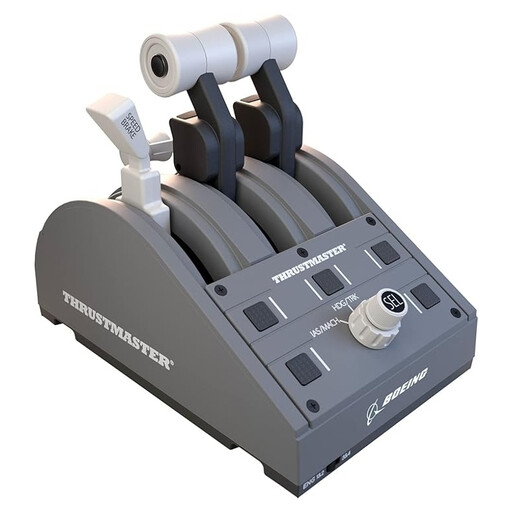 No image available
This listing may be relevant if you’re looking for a separate control unit for your setup. Check that it’s compatible with the stick and simulator you use.
The product name lists USB and PC, Xbox, Xbox One X and Xbox Series S. Check compatibility with your specific simulator.
Don’t assume so. The Microsoft Flight Simulator SDK describes checklists as aircraft-specific; decide which actions you want to practise for each aircraft and which inputs you want your simulator to assign to them.
Not just to get started with a flight stick. The Microsoft Flight Simulator beginner’s guide describes the twist movement on some sticks as rudder control, with pedals as a separate option. Check that your stick and simulator provide the rudder control you want.
Agree on practice times and, where possible, try the controls in the room where you plan to play. Product specifications don’t provide comparable noise measurements that would allow you to describe any of these models as quiet.
ACM ConsuWijzer states that the statutory cooling-off period for a product bought online ends 14 days after delivery. The seller must also resolve, at no cost to you, any issue where a product doesn’t provide what you could reasonably expect under normal use. This could mean a repair, replacement or refund.