Who might benefit from a flight simulator monitor panel?

Multi-screen pilot

You want to spread the outside view and flight instruments across different screens, and only then choose suitable physical controls. Microsoft Flight Simulator describes additional render windows; RealSimGear describes separate G1000 displays for supported aircraft.

Procedures-focused pilot

You want to rely less on mouse controls during approaches and are looking for buttons and levers that suit the aircraft you usually fly. Logitech G, Honeycomb Aeronautical and Thrustmaster describe different control functions and product formats.

Cockpit builder

You want to add dedicated instrument hardware and need to plan your display outputs, mounting, power and simulator connection. RealSimGear outlines, among other things, the connection requirements for the G1000 Suite.

What should you consider when choosing a flight simulator panel?

Extra outside view

Choose this option if: you want to show more of the outside view on extra screens.

Trade-off: you’ll need to arrange your screens and adjust your simulator settings; a physical control panel won’t automatically add a video display.

Separate instruments

Choose this option if: you want to read your instruments separately from the outside view, for example in a supported G1000 aircraft.

Trade-off: check how many video connections you’ll need, along with simulator compatibility and power requirements.

Physical controls

Choose this option if: you want to operate functions such as autopilot, flaps, trim or throttle physically during approaches.

Trade-off: an input panel isn’t a complete instrument display; also check whether an add-on requires a corresponding base unit.

Consideration What to check before buying Who is this most important for?
Screen layout Check your computer’s display outputs and the capabilities of your simulator version. If I want to arrange the outside view and instruments across several screens, I want to know in advance what each screen will show. Around 36% of consumers prioritise screen layout.
Controls during landing Check whether you get autopilot controls, throttle levers, flaps or a speedbrake, and whether a base unit is required. Pilots who want to rely less on on-screen controls during approaches look for buttons and levers suited to the aircraft they fly. Around 29% of consumers prioritise physical landing controls.
Separate instruments Check the instrument type, which aircraft avionics are supported and how many video connections you’ll need. If I’d rather read my instruments separately from the outside view, I look for a display that suits my aircraft and simulator. Around 21% of consumers prioritise separate instruments.
Components and connections Compare the box contents with your existing equipment, and check the cables, mounting and power requirements. If you want to know what you need to connect a panel, it’s worth checking the required base unit and connections in advance. Around 14% of consumers prioritise a complete set and its connections.

Common buying mistakes with flight simulator panels

  • Mistaking an autopilot panel for an additional instrument monitor

    An autopilot panel is designed for physical controls and an LED readout; an instrument panel or G1000 display serves a different purpose. Microsoft Flight Simulator describes additional render windows for extra outside views.

    Before buying, decide whether you want a wider outside view, separate instruments or physical controls.

  • Buying an Airbus add-on without the required quadrant

    Thrustmaster describes the TCA Quadrant Add-On Airbus Edition as an add-on for the TCA Quadrant Airbus Edition. Without that base unit, it won’t suit the setup described.

    Check the full product name and compare it with the components you already own.

  • Budgeting for only the displays in an instrument set

    The RealSimGear G1000 Suite described here doesn’t include HDMI cables or a stand; the supplied power adapters have North American plugs.

    Before buying, check what’s in the box, the available video connections, mounting and power requirements for the version you’re considering.

    Remember to allow for the required HDMI cables and a stand, too; check which power solution is suitable for your setup.

Brands to explore for flight simulator controls and instruments

Logitech G

Offers separate Flight Multi Panel and Flight Instrument Panel units for physical controls and instrument readouts.

  • According to Logitech G, the Multi Panel controls functions including autopilot, flaps and trim; the Instrument Panel can switch between 15 readouts.
  • The Multi Panel isn’t a complete instrument display. Check compatibility with your simulator and aircraft.

Honeycomb Aeronautical

The Bravo Throttle Quadrant combines configurable levers with autopilot and annunciator functions for different aircraft types.

  • According to Honeycomb Aeronautical, the unit has six levers and fourteen indicator lights.
  • Check the space available and which simulator profiles or LED driver you’ll need. The quadrant doesn’t replace an instrument screen.

RealSimGear

The G1000 Suite is designed for cockpit setups with separate PFD and MFD hardware for supported G1000 aircraft.

  • According to RealSimGear, the suite described comprises two 10.4-inch HDMI displays.
  • The set described requires two HDMI connections; HDMI cables aren’t included, and the supplied adapters have North American plugs. Check the version and power requirements.

Thrustmaster

Offers controls designed for specific aircraft types, including an Airbus add-on and a separate Boeing-inspired quadrant.

  • According to Thrustmaster, the Airbus Add-On is designed for flaps, speedbrake and landing gear; the Boeing Edition provides controls for altitude, speed and heading.
  • The Airbus Add-On requires a TCA Quadrant Airbus Edition. The Boeing Edition is a different product, not an identical variant.

Joybuy products for physical flight simulator controls

These Joybuy products are designed for physical controls when using a flight simulator; check whether the functions of each model suit your aircraft, computer and simulator.
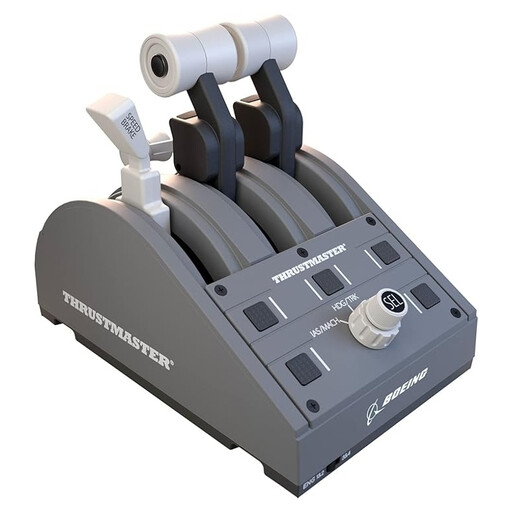
Thrustmaster TCA Quadrant Boeing Edition Grey USB joystick

Thrustmaster TCA Quadrant Boeing Edition Grey

For anyone looking for physical controls designed for Boeing aircraft; Thrustmaster describes the Boeing Edition as offering controls for altitude, speed and heading.

The product title states that it works with PC and Xbox. According to the product information, a TCA Yoke Boeing Edition is also required for use with Xbox.

View on Joybuy

Logitech G Saitek X52 Pro Flight Control System Black PC

Logitech G Saitek X52 Pro Flight Control System Black

An option for anyone looking for physical joystick and throttle controls for flight simulator use.

The product title states that it’s for PC.

View on Joybuy

Frequently asked questions about flight simulator panels and multiple screens

Can a physical flight simulator panel spread my outside view across multiple monitors?

No. A physical panel for controls or instrument readouts won’t automatically spread the outside view across extra monitors. Microsoft Flight Simulator describes separate render windows with adjustable position and resolution; check what’s available in your simulator version.

What do I need for a separate G1000 display?

According to RealSimGear, the G1000 Suite described requires a Windows PC, a USB connection and two HDMI connections for the displays; HDMI cables aren’t included. Check the installation instructions for the exact hardware generation and simulator.

Which components do I need for an Airbus panel?

According to Thrustmaster, the TCA Quadrant Add-On Airbus Edition is an add-on for the TCA Quadrant Airbus Edition. So check whether you already have that base unit or need to buy it separately.

What rights apply when buying a product online in the Netherlands?

According to ACM ConsuWijzer, the 14-day cooling-off period for an online product purchase ends 14 days after the product is delivered; check which exceptions apply to your purchase. The seller is also responsible for the statutory guarantee if a product doesn’t meet what you’re entitled to expect from it.

Does practising virtual landings at home automatically count as recognised flight training?

Don’t assume that practising at home automatically counts towards your training. EASA sets out a framework for the qualification and use of flight simulation training devices; what counts depends on the specific course and the device used.
