
Anyone practising airliner approaches
You want the thrust detents and controls to match the Airbus or Boeing procedures you practise most often.


Choose a throttle based on the aircraft you fly most and the functions you want to control during an approach. A configurable quadrant suits pilots who switch between aircraft types, while an Airbus- or Boeing-style model is designed around a specific layout. Also check how it maps in your simulator and whether it fits alongside your monitors and existing controls.
You want the thrust detents and controls to match the Airbus or Boeing procedures you practise most often.
You fly both light aircraft and airliners, and want to be able to reassign levers to functions such as engine power, flaps or other axes.
You already have monitors and may also have a stick or yoke. Mounting space, reach and avoiding duplicate controls are all worth considering.
A good fit if: you fly both general aviation aircraft and airliners, and want to be able to reassign the levers.
Bear in mind: the desk space required and which functions are supported by your simulator and chosen aircraft.
A good fit if: you mainly want to practise Airbus thrust detents or Boeing-focused controls during approaches.
Bear in mind: models vary. For four thrust levers with the Airbus quadrant, Thrustmaster specifies a second quadrant, sold separately.
A good fit if: three programmable levers are enough, or you want to adapt the controls to different aircraft styles.
Bear in mind: check which functions and any aircraft-specific modules are included in the model you choose.
A good fit if: you need a yoke and trim wheel as well as a throttle.
Bear in mind: this is a combined control system, not a standalone quadrant. On PC, Microsoft Flight Simulator recognises the yoke and quadrant as separate devices.
| What to consider | What to check before buying | Who is this important for? |
|---|---|---|
| Levers for your aircraft type | Decide which aircraft you fly most and how many separate axes and detents you need. | If I want the controls to match the aircraft I fly, I focus on the layout and available axes; around 33% of consumers put that compatibility first. |
| Controls during an approach | Check whether your simulator lets you assign the buttons and axes you want to functions such as autopilot, flaps or spoilers. | If I want to use physical controls during an approach rather than hunt for functions on screen, I look at which controls I really need; around 27% of consumers prioritise having approach controls within easy reach. |
| Desk placement | Measure the available space for the unit and its mount, allowing for your monitors and existing stick or yoke. | If my screens and existing controls already take up space, I want to know where the levers will fit and whether I can reach them easily; around 20% of consumers prioritise placement and existing controls. |
| Required add-ons | Compare what is included in the box with your list of required functions, and check whether you need extra levers or modules. | If I only want to pay for features I’ll use, I check what’s included in the model I’ve chosen first; around 20% of consumers make the cost of the required configuration their main consideration. |
The Airbus TCA Quadrant has two thrust levers. Thrustmaster says a second quadrant is available separately if you want four levers; MOZA also offers certain aircraft-specific modules separately.
Compare what’s included in the box with the axes and lever detents you actually want to use.
The Turtle Beach VelocityOne Flight combines a yoke with a quadrant. The set could therefore add controls that are already part of your setup, and needs space for more than just a standalone throttle.
Compare the combined set with a standalone quadrant, taking your existing controls and desk space into account.
The Bravo is a configurable standalone quadrant for anyone switching between general aviation aircraft and airliners.
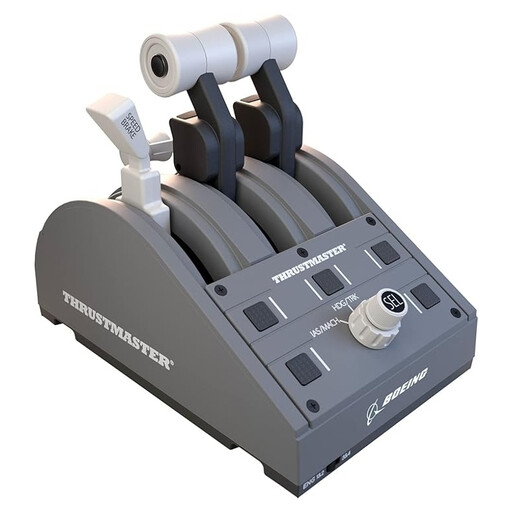
The TCA Quadrant Airbus Edition and TCA Quadrant Boeing Edition offer different layouts tailored to each aircraft type.
The Flight Throttle Quadrant is a standalone option if you want to add three programmable levers to an existing setup.
The MTQ is a modular quadrant for PC users who want to adapt the controls to different aircraft styles.
The VelocityOne Flight combines a yoke, trim wheel and quadrant, so it offers more than a standalone throttle.
Joybuy product picks for physical flight simulation controls, including a Boeing-focused quadrant and a flight control system for PC.
 No image available
A flight control system for PC to consider if you’re looking for a more comprehensive set of controls alongside throttle operation.
 No image available
A Boeing-focused quadrant for anyone who wants the controls for virtual approaches to match that aircraft layout.
Thrustmaster lists three axes, interchangeable levers and controls for altitude, speed and heading.
No, the number of monitors on its own doesn’t determine which throttle model you need. Choose based on your aircraft and the functions you want, set up your screen layout separately in the simulator, and check that you can still reach the controls on your desk.
First, assign the engine axis or axes you need in your simulator. Then test functions such as flaps, spoilers and reverse thrust for the aircraft you’ve chosen. X-Plane explains how to configure and calibrate axes. Check the settings in the aircraft you use, as one profile may not suit every aircraft.
Check that you have enough space for both the unit and its mount. If you’re replacing a lever on the MOZA MTQ, MOZA says to switch off the device first; for other devices, follow the relevant manual.
For eligible online consumer purchases, there is generally a statutory 14-day cooling-off period after delivery; ACM ConsuWijzer explains the exceptions. There is no single fixed period for the statutory guarantee in the Netherlands: it depends on what you could reasonably expect from the product and whether it has been used normally. Contact the seller if the product is faulty.