
Livraison le jour même et le lendemain

Qualité garantie

Débloquez vos offres de bienvenue: Livraison GRATUITE | Jusqu'à -80 % | 30 jours d'essai gratuits à JoyPlus
Téléchargez l'application
A flexible ratchet spanner set 8–19 mm is useful for car maintenance, machine work and jobs where a standard open-ended spanner does not leave enough room. The movable head can help you reach bolts and nuts from a more favourable angle. However, a long list of sizes or a shiny finish does not tell you everything about how practical a set is.
The following three pitfalls are common:
A ratchet mechanism with too few teeth
With fewer teeth, you need to move the spanner further before it can engage again. This can be awkward in a cramped engine bay or between machine components.
A flexible head without clear locking or movement information
“Flex-head” sounds appealing, but check how many degrees the head moves and how the construction is described. A flexible head is not automatically suitable for heavy-duty loosening work.
A set with missing intermediate sizes
A set with many pieces can still have gaps in the metric range. For regular maintenance, sizes 8 to 19 mm are often more practical when every intermediate size is included.
First, check that the set actually contains the sizes you use. According to the product description, the DURATECH 12-piece ratchet spanner set 8–19 mm contains sizes 8, 9, 10, 11, 12, 13, 14, 15, 16, 17, 18 and 19 mm. That means one spanner for each size, with no gaps.
A combination spanner usually has an open end and a ring end with a ratchet function. The open end is practical when you need to position the spanner from the side. The ring end generally provides more contact with the bolt or nut. Also check whether the ring is 12-point. This type can make it easier for the spanner to engage when the available turning angle is limited.
A 72-tooth ratchet is often chosen for working in confined spaces. According to DURATECH’s product information, the ratchet mechanism has a working angle of approximately 5 degrees. In practice, this means you only need to move the spanner a small amount before the mechanism can engage again.
This is particularly relevant when using ratchet spanners on cars, bicycles, machinery and fixings beneath a bonnet. However, the number of teeth is not only an indication of comfort. Do not use a ratchet spanner as an impact tool, and avoid using an extension pipe unless the manufacturer specifically permits it. For seized bolts, a suitable fixed spanner or torque wrench may be more appropriate.
Many sets specify chrome vanadium steel, often abbreviated to Cr-V. The DURATECH set product descriptions state that this material is combined with drop forging, heat treatment and a chrome finish. According to the manufacturer, these features are intended to support strength and resistance to rust. These are manufacturer claims, so also check the specific product specifications and warranty terms before buying.
According to the product information for the DURATECH model mentioned, a flex-head ratchet spanner set with a flexible head can move through up to 180 degrees. This offers more adjustment options than a fixed head, but the head also needs to be used correctly. Position the spanner squarely on the fixing and avoid side loading. Clean the spanners after use and store them somewhere dry.
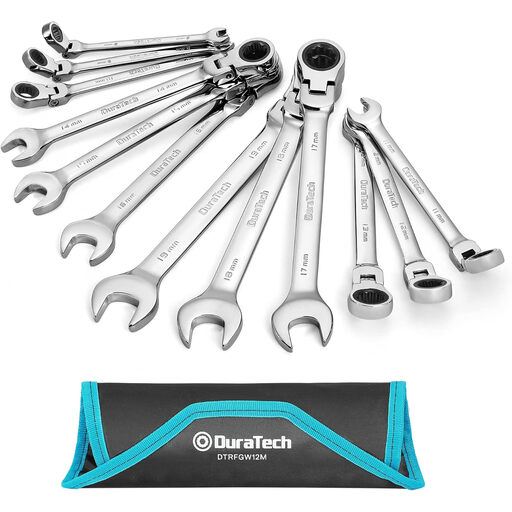
Why it suits this profile: The complete range from 8 to 19 mm is easy for beginners to navigate and ideal for anyone looking to expand their DIY tool set. The set comes with a storage pouch showing the sizes.
The set contains twelve consecutive metric sizes, making missing intermediate sizes less likely to be an issue. According to the product description, the flexible head is designed for hard-to-reach fixings.
Chrome vanadium steel, 72 teeth, a 5-degree working angle and a head that, according to DURATECH, can tilt through up to 180 degrees.
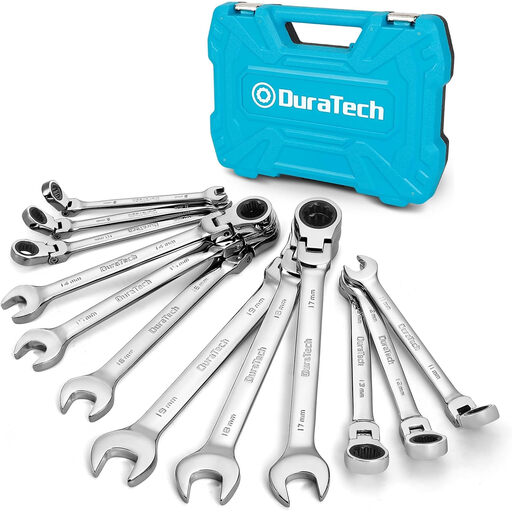
Why it suits this profile: This version is aimed at users looking for a flex-head ratchet spanner set with a sturdy storage solution for the garage, workshop or service vehicle.
The product description specifies both a 12-point ring and a 180-degree flexible head. This makes it clearer what the adjustable construction is intended for: accessing fixings in confined spaces.
72-tooth ratchet, 5-degree working angle, Cr-V steel and a storage case with space for the complete set.
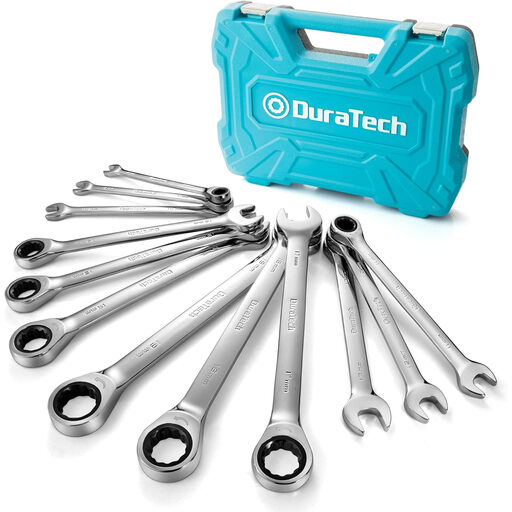
Why it suits this profile: If you mainly use a fixed head and have less need for a flexible head, this set offers the same metric range for everyday maintenance and assembly work.
The fixed head has no hinge that can move while you work. This makes it a straightforward choice when access is not an issue and you prefer a simpler design.
12 sizes from 8 to 19 mm, 72 teeth and a storage case with clear size markings.
Always use the correct size. A spanner that is too large can damage the fixing, while one that is too small may slip. Place the ring end fully over the bolt or nut before applying force. With a flexible head, it is best to set the working angle first and then apply force to the spanner as squarely as possible.
Wipe away oil and dirt after use with a cloth. Store the set in the supplied pouch or case so that the sizes do not get mixed up. Regularly check the ratchet mechanism and flexible joint for play, damage or dirt. For heavy professional use, a second set with fixed heads or a torque wrench can be a useful addition.
We have put together a complete, up-to-date list of products that fully meet these strict selection criteria and the applicable European safety regulations.
A 72-tooth ratchet can be practical when you have very little room to manoeuvre. According to the product information for the DURATECH sets mentioned, a working angle of approximately 5 degrees is required. Always check that the spanner is suitable for the force and fixing you are working with.
Its service life depends on the load, storage and maintenance. Chrome vanadium steel, heat treatment and a corrosion-resistant finish are mentioned in the product descriptions as construction features. This does not guarantee a specific service life. Use the spanners for their intended purpose and avoid overloading them.
Choose a ratchet spanner set with a flexible head when bolts are located in hard-to-reach places and you need to adjust the working angle. A fixed set may be the more logical choice for easily accessible fixings or when you prefer a simpler design. For many garages, both types complement each other.
