
People scanning individual bills
You process small quantities or different types of paper and want to place each original on the glass yourself.


For individual, fragile or unusual bills, an A4 flatbed scanner is a good fit if its scanning area, software and connection suit the way you work. If your group regularly processes batches of suitable loose sheets, also consider a scanner with both a flatbed and an automatic document feeder; the stated scanning speed is not the same as the total time needed to sort, check and save your files. If bills contain personal data, decide how the files will be processed and protected before scanning. The Dutch Data Protection Authority points out that processing requires a lawful basis.
You process small quantities or different types of paper and want to place each original on the glass yourself.
You want to find amounts, names or dates later, so you’re looking at PDF and text features as well as scan quality.
You regularly process suitable loose sheets and want to know whether automatic feeding could reduce the manual work.
| Consideration | What should you check? | Who is this important for? |
|---|---|---|
| Individual or fragile bills | Compare the largest original with the scanning area and check whether the lid leaves enough room for thicker documents. | If I want to place each different or fragile original on the scanner myself, a suitable flatbed matters more than automatic feeding. Around 33% of consumers say carefully scanning individual originals is their main consideration. |
| Finding text later | Test a representative bill to check that the text is searchable and the amounts remain legible. | If I want to look up names, amounts or dates later, I consider not just the PDF format but also text recognition. For around 25% of consumers, a searchable archive is the top priority. |
| Regular batches | Check whether the sheets are suitable for feeding and whether you need duplex scanning; compare the whole process, not just pages per minute. | If I regularly process batches of suitable loose sheets, automatic feeding could be useful alongside the flatbed. Around 25% of consumers say processing these batches is their main consideration. |
| Processing personal data | Before sharing, decide the purpose and lawful basis, and assess suitable access, storage and retention periods. | If I scan bills containing group members’ details, I want to know in advance who will have access and how the files will be stored. For around 17% of consumers, responsible handling of personal data comes first. |
A stated scan time for a flatbed and a speed for an automatic feeder do not describe the same complete task. Sorting, placing, checking and rescanning take time too.
Run a trial batch and time the process from unsorted papers to checked files. Keep manual scans and sheets fed through the automatic feeder separate.
A feature that combines several pages into one PDF does not prove that the text is searchable or that amounts will be recognised correctly.
Test both features separately using real sample bills, then compare the recognised details with the originals.
Allow extra time for checking or correcting text that hasn’t been recognised properly.
Bills can contain information that identifies individuals. Choosing cloud storage or shared files therefore also means considering how the information will be processed and protected.
Before using these features, decide who will have access and what storage and retention approach suits your purpose. The Dutch Data Protection Authority says organisations must determine appropriate security measures.
The CanoScan LiDE 400 is an A4 flatbed scanner for documents placed on the glass by hand; the LiDE 300 is a separate model.
The Perfection V39II is an A4 flatbed scanner for manual scanning, with text enhancement and searchable PDF features.
The ScanJet Pro 2600 f1 combines a flatbed with an automatic document feeder.
This product selection is aimed at groups that process both individual originals on the flatbed and batches of suitable loose sheets.
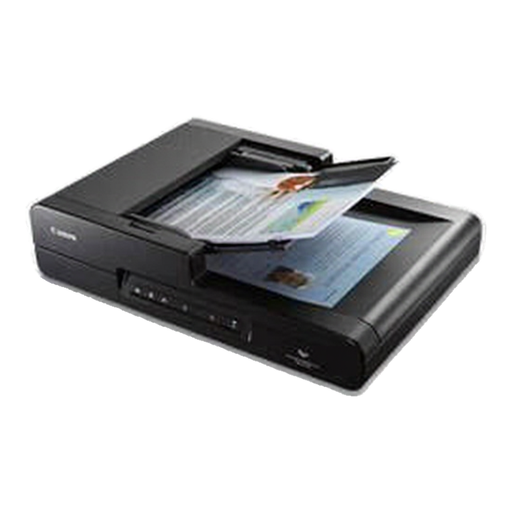 No image available
Suitable for a group that processes individual originals on the flatbed as well as batches of suitable loose sheets.
The product description lists a 50-sheet feeder, duplex scanning at up to 20 pages per minute and output to editable PDF. The product name specifies A4 and 600 × 600 dpi.
When bills contain personal data, the group must put appropriate processing and security measures in place.
Not always: the entire original must fit within the scanning area. Canon specifies a maximum of 216 × 297 mm for the CanoScan LiDE 400, so a larger original won’t fit in a single scan.
Make test scans of representative bills and check legibility, page order and whether you can find text if searchability is important. Epson lists a searchable PDF feature for the Perfection V39II, but the feature description doesn’t guarantee that every amount will be recognised correctly.
First, consider how the group will process the information. According to the Dutch Data Protection Authority, information about an identifiable person is personal data, and processing requires a lawful basis. The organisation must determine appropriate security measures and must not keep personal data for longer than necessary. The lawful basis and retention period for a particular group will depend on how the information is processed.