
Vandaag of morgen in huis

Kwaliteit gegarandeerd

Welkomstaanbiedingen ontgrendelen: GRATIS bezorging | Tot 80% korting | Gratis 30 dagen JoyPlus-proefperiode
Download de app
Buying a set of felt-tip pens and gel pens sounds simple, until the first pen dries out quickly, the ink bleeds through the paper or a marker turns out not to be washable. With online purchases in particular, the difference between an appealing product photo and practical everyday use is not always immediately obvious.
So look out for these common pitfalls:
The nib determines what you can use the pen for. For school notes, planners and journaling pens, gel pens in 0.5 mm or 0.7 mm are practical choices. A finer nib makes it possible to write small letters and draw precise lines. A thicker nib often writes smoothly and stands out better when highlighting.
A fineliner of around 0.4 mm is suitable for outlines, diagrams, hand lettering and writing with a ruler or stencil. For filling in large areas of colour, felt-tip pens with a medium nib are more convenient. Brush pens offer greater flexibility: light pressure creates a thin line, while more pressure produces a broader stroke.
With dual-tip markers, check both ends. A brush nib and a chisel nib provide more uses, but they also make the marker somewhat thicker and often more expensive than a standard felt-tip pen.
Water-based ink is generally suitable for paper and is often low-odour. For children’s products, the description may provide additional information about washability, age suitability and safety features. Always check the manufacturer’s instructions and keep small parts away from children under three years old.
Gel ink is intended for writing and drawing on paper. Black gel pens are practical for everyday use, while coloured gel pens are suitable for colour coding, cards and creative notes. Fast-drying ink can help reduce smudging, but the result also depends on the type of paper and how quickly you write.
Acrylic markers generally contain opaque paint ink. According to Faber-Castell’s product information, the Acrylic Markers mentioned can be used on surfaces including paper, metal, ceramic, plastic, glass, textiles, stone, canvas and wood. Always test a small area first. Adhesion and washability may vary depending on the surface.
Alcohol markers are mainly intended for drawing and sketching. According to Faber-Castell’s product information, the Goldfaber Sketch Markers are fast-drying and permanent once dry. They may bleed through thin paper, so marker paper or thicker paper is a more sensible choice.
A marker that is regularly left uncapped will dry out more quickly. Close caps immediately after use and preferably store felt-tip pens in the box or case provided. With retractable gel pens, it is important to retract the nib fully.
Also consider the contents of a set. A set of 50 brush pens offers a broad range of colours, but it is not automatically better value if you mainly use black, blue and red. For school pupils and students, a smaller set with a few basic and accent colours may be more practical. For illustrations or detailed journaling, a larger selection may instead reduce the cost per colour.
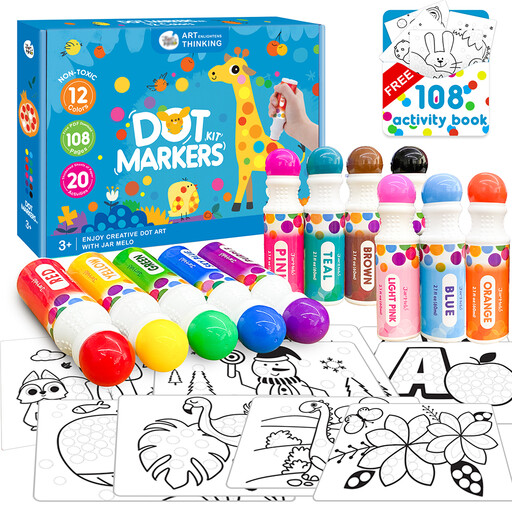
Why it suits this profile: The jumbo dot markers are easy to hold and designed for dots, lines and large areas of colour. According to the product information, they contain water-based, alcohol-free ink and are 90% washable from skin and most fabrics.
The product information specifically states that the ink is washable from skin and most fabrics, rather than simply describing it as “easy to clean”. It is still best to treat marks straight away.
12 colours, an integrated sponge pad and an activity set with physical and digital worksheets.
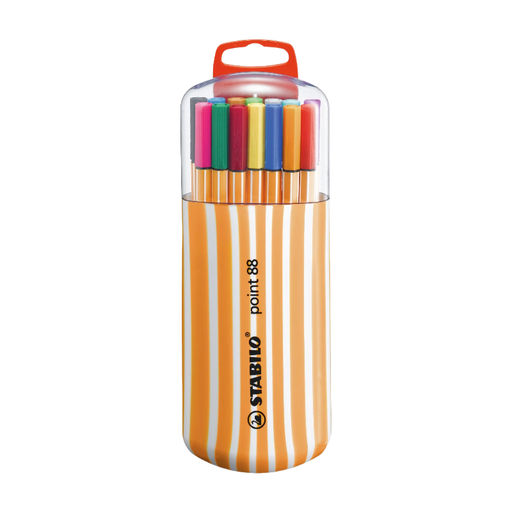
Why it suits this profile: According to the product information, this set has a writing thickness of 0.4 mm, water-based odourless ink and a metal sleeve around the nib. That makes it suitable for precise notes, drawing and journaling.
The fixed nib size makes it clear what the pen is designed for: fine lines and details, not broad areas of colour.
20 colours, a resealable storage box and a nib suitable for use with rulers and stencils.

Why it suits this profile: According to the product information, these acrylic markers contain water-based opaque ink and have two nibs measuring 1 mm and 3 mm. They are designed for projects on a range of hard and porous surfaces.
The product description specifies particular surfaces and nib sizes. A test patch is still recommended when using it on a new material.
Six standard colours, two nib sizes and an ink-level indicator. Activate the markers by shaking and pumping.

Why it suits this profile: The combination of a flexible 1 to 5 mm brush nib and a 0.6 mm fineliner nib supports sketching, colouring and detailed work.
The set specifies both the brush nib and the fine nib, so you do not need to combine two separate types of drawing pen.
24 colours, alcohol-based ink and two nib styles per marker. Use thicker paper to help prevent bleed-through.
We have compiled a complete, up-to-date list of products that fully meet these strict selection criteria and the applicable European safety regulations.
A gel pen uses gel ink and is mainly intended for smooth writing, notes and journaling. A fineliner usually has a fibre or plastic nib and produces an even, fine line. For small drawings and outlines, a fineliner is often more practical; for everyday writing, a gel pen may feel more comfortable.
Check the recommended age, whether there are any small parts and the information about the ink. Some children’s craft pens contain water-based ink and are described by the manufacturer as largely washable. Always supervise children when the packaging indicates that this is necessary, and do not let them chew on the pens.
Close caps immediately after use, keep the pens out of direct sunlight and store the complete set in a box or pencil case. Store retractable gel pens with the nib retracted. For acrylic markers, follow the activation instructions on the packaging; with other markers, closing the cap properly is the most important step.
