
Vandaag of morgen in huis

Kwaliteit gegarandeerd

Welkomstaanbiedingen ontgrendelen: GRATIS bezorging | Tot 80% korting | Gratis 30 dagen JoyPlus-proefperiode
Download de app
Felt-tip pens and markers may seem easy to choose, but the difference between a useful set and a disappointing purchase often comes down to the details. An attractive colour mix, for example, says little about the nib, ink or surface a marker is suitable for. If you focus only on the number of pens or eye-catching packaging, you could end up with ink that bleeds through the paper, nibs that dry out quickly or colours that are unsuitable for your planned project.
These points will help school pupils, students, parents, hobbyists and creative users make a more informed choice between highlighters, marker pens, felt-tip pens, brush pens and acrylic markers.
A set of 24 or 30 colours may look appealing, but first check whether you will actually use them. For school and office use, a few clear highlighters are often more practical than an extensive drawing set. For drawing, hand lettering or crafting, a broader palette can be useful.
Also pay attention to the colour names. “Pastel” generally refers to softer shades, while neon or fluorescent colours are designed to make text stand out more clearly. The final impression also depends on the paper.
A chisel tip is suitable for both broad and narrow lines. A fine fibre tip works well for writing, outlines and small details. A brush tip can produce different line widths by adjusting the pressure and angle. A broad XL tip is ideal for quickly colouring in large areas.
So do not buy brush pens if you mainly want to underline neatly, and avoid fine drawing pens for large areas of colour.
Water-based ink is common in highlighters and many felt-tip pens. The ink can bleed through thin paper, particularly if you go over the same area several times. Alcohol markers dry quickly and are often suitable for illustrations, but they require paper designed for this purpose. Acrylic markers are intended for different surfaces and must be activated before use.
Claims about drying time, washability or colour intensity should be regarded as product specifications provided by the brand. Results may vary depending on the paper, surface, pressure and storage method.
Always check the stated line width. A highlighter with 1 and 4 mm tips offers a narrow line for underlining and a broader line for highlighting. Other marker pens may specify, for example, 2 to 5 mm. For colouring, a tip of around 1 to 2 mm or a brush tip is suitable for details; a 3 mm tip works more quickly on larger areas.
Choose according to how you plan to use the pens:
Acrylic markers often feature a shake-and-pump system. For the Faber-Castell sets, the product description recommends shaking the marker 20 to 30 times and repeatedly pressing the tip until the ink flows through.
For children, a sturdy tip, comfortable grip and securely closing caps are practical features. Some sets display CE or EN 71. These markings are useful points to check in the product information, but they do not replace supervision or the safety instructions on the packaging. For young children, also look out for small parts and ventilated caps.
Close felt-tip pens securely after use, store them according to the brand's instructions and test new markers on a scrap sheet first. This helps prevent surprises on a piece of artwork or in a book.
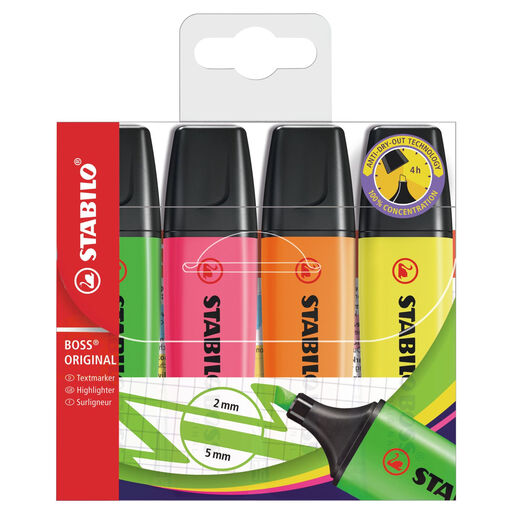
Why it suits this profile: A compact set with four familiar colours for diaries, learning materials, planning and everyday use.
You are not paying for an unnecessarily large range of colours. According to the product description, the chisel tip produces lines of 2 to 5 mm.
Four colours, water-based ink and two line widths in one tip.
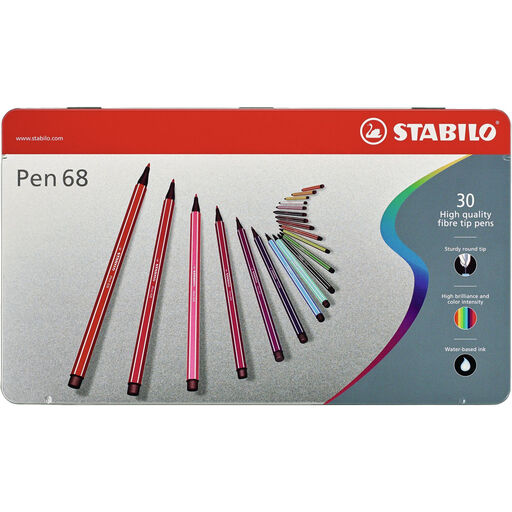
Why it suits this profile: An extensive set for adults, students and creative users who need plenty of coloured pens.
The robust tip is designed to distribute ink evenly. However, always replace the caps securely to help prevent the pens from drying out.
30 colours, an approximately 1 mm writing width and water-based, odourless ink according to the product description.

Why it suits this profile: For projects on a range of materials, such as canvas, wood, glass, ceramics or plastic, when ordinary drawing pens are not enough.
The product description lists several suitable surfaces and an ink-level indicator. Always test adhesion on a small area first.
Six metallic colours, water-based acrylic ink and 1 and 3 mm tips.
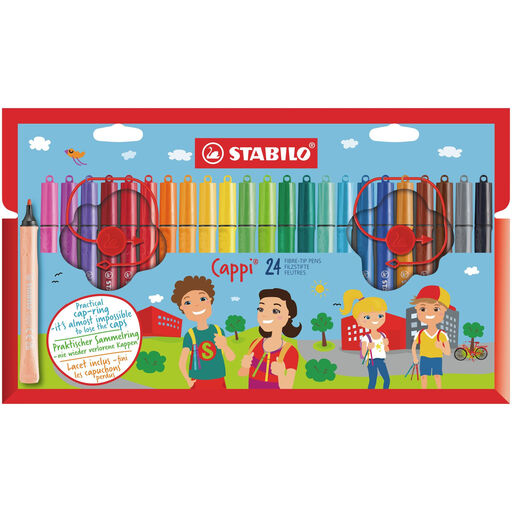
Why it suits this profile: The cap ring helps keep loose caps together, which is useful at home, when travelling or at school.
The cap ring reduces the risk of losing caps. According to the product description, the ink is washable; however, treat stains immediately.
24 colours, an ergonomic grip, a 1 mm tip and washable ink according to the product information.
We have compiled a complete, up-to-date list of products that fully meet these strict selection criteria and the applicable European safety regulations.
Look at the recommended minimum age, a sturdy or pressure-resistant tip, a comfortable grip and information about the ink. STABILO power and STABILO Cappi are examples of felt-tip pens whose product descriptions mention features designed for children. Always use felt-tip pens on the recommended surface and follow the warnings on the packaging.
Replace the cap immediately after use and check that it closes securely. Store markers away from direct sunlight and extreme temperatures. Some models specify a limited cap-off time, but this does not mean the cap can be left off permanently. For metallic pens, STABILO Trio Deco's product information recommends storing them horizontally.
No type of ink performs the same way on every kind of paper. For highlighters and water-based felt-tip pens, use thicker paper when bleed-through is a problem. Alcohol markers generally require special marker paper or a protective sheet beneath your work. Test a new set on a loose sheet first before using it in a book, planner or final drawing.
